Head-to-Head Architecture Comparison
When independent multi-specialty practices evaluate ambient scribes, the decision rarely comes down to whether a note reads well. Both Merry AI and DeepScribe produce structured, defensible clinical documentation. The friction lives elsewhere: in how the finished note reaches the chart, in whether complexity codes are captured at the moment they are billable, and in what the annual line item does to a practice with twelve clinicians across six specialties. This review examines those axes the way a colleague would walk a chart with you, without slogans.
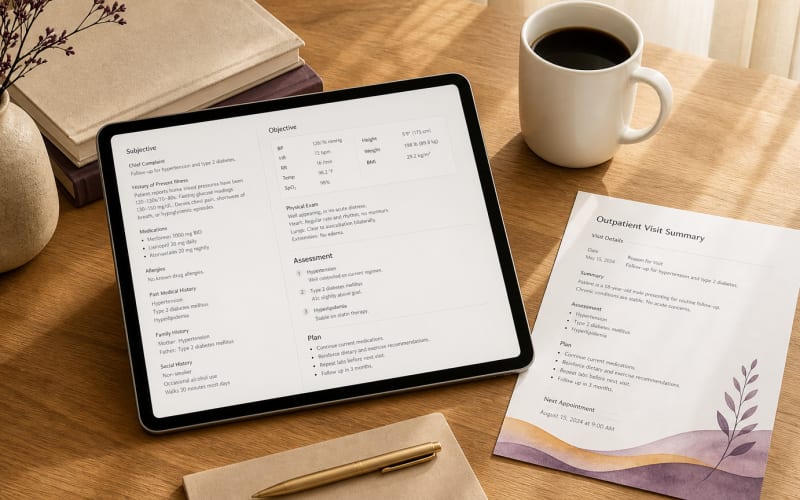
DeepScribe is publicly positioned as an enterprise-grade ambient scribe with deep, named EHR integrations, particularly Epic through Haiku and Canto. Its documented flow is start the app, select the patient from a synced schedule, speak naturally, then review and sign the generated note that syncs back to the EHR. That model works, and it works well inside large integrated delivery networks. The question for an independent group is whether that integration depth is necessary or whether it introduces implementation burden you do not need.
Merry AI takes a different architectural stance. Rather than building bi-directional integrations per EHR, it runs as a browser extension that writes directly into the DOM field your cursor already occupies. There is no queue, no per-integration deployment, and no waiting for a specialty-specific connector. This is the central trade the rest of this review interrogates: named integration depth versus universal DOM-level injection.
| Feature | Merry AI | DeepScribe |
|---|---|---|
| Monthly Cost (Annual) | $54/mo Pro | $99/mo standard |
| DOM Injection Speed | Sub-second direct field write | API sync / review-and-place |
| Multi-Speaker Group Splitting | Speaker diarization, per-party notes | Single-author structured draft |
| CPT G2211 Complexity Prompting | Real-time visit-close prompt | Manual add-on attachment |
| Attestation Logs | Cures Act compliant timestamping | Basic text export |
| Data Retention | Configurable, US residency, BAA | US residency, SOC 2 Type II, BAA |
| Setup Model | Self-serve, zero-IT | Sales-led implementation |
The Note Insertion Problem
The single largest source of hidden latency in ambient documentation is the gap between note generation and note placement. DeepScribe generates a structured note and syncs it into the EHR, then presents it for clinician review and sign-off. Its public product page describes this sync as happening in seconds, though several third-party reviews note that delivery is not always real time and that a QA layer may sit between generation and delivery in some configurations. For a busy multi-specialty schedule, any variance in when the note is ready to sign compounds across a day.
Merry AI removes the placement step entirely by injecting the finished text into the focused DOM element. The extension dispatches native input events against the active field, so the note appears where your cursor sits, in the HPI, assessment, and plan sections, without a clipboard action. This is not a cosmetic difference. Eliminating the copy-verify-reformat loop returns roughly thirty to ninety seconds per encounter, and across twenty-five daily encounters that is meaningful recovered clinical time.
Why DOM Injection Beats API Queues
API-mediated sync depends on the vendor having built and maintained a connector for your specific EHR and version. DOM injection depends only on the field being a standard editable web element. For an independent practice running a mix of EHRs across acquired sub-specialties, the universal approach means every clinician gets the same behavior on day one, regardless of whether a named integration exists. It also means no IT ticket to enable write-back scopes.
Group Notes and Speaker Diarization
Multi-specialty groups increasingly run group visits, shared medical appointments, and family conferences where more than two voices appear in the record. Merry AI diarizes speakers before language modeling, so it can split one recording into attributable note streams per participant. DeepScribe's documented output is a single-author structured note, which suits the dominant one-clinician-one-patient encounter but leaves group settings to manual reconstruction. If your behavioral health or endocrinology lines run group programs, this distinction determines whether documentation is automatic or manual.
Coding Accuracy and CPT G2211
Revenue integrity is where the two systems diverge most sharply for independent practices. DeepScribe offers E/M coding intelligence, recommending the appropriate code with supporting documentation, and its own materials cite $565 million in lost 2023 Medicare payments tied to 99214 documentation errors. That figure underscores a real problem. The open question is capture of the G2211 complexity add-on, which the CMS G2211 FAQ defines as the visit complexity inherent to serving as a patient's continuing focal point, reportable alongside 99202-99215.
Merry AI surfaces a visit-close prompt that evaluates whether the encounter meets the longitudinal-relationship criteria for G2211 and drafts the supporting rationale text into the note. Because omission rather than miscoding drives most add-on revenue leakage, as coding benchmarks indexed across the literature at PubMed Central consistently show, a real-time prompt at the moment of eligibility recovers more than a passive suggestion the clinician must remember to act on. At roughly $16 per eligible visit, the annual recovery clears $15,600 per clinician on a modest capture rate.
Attestation and Audit Defensibility
Coding recovery only matters if it survives audit. Merry AI's Clinical Logic Bridge writes a timestamped attestation block recording draft creation, clinician review, and the complexity elements that supported the E/M level, producing Cures Act compliant timestamping rather than a plain text export. When a payer questions a G2211 or 99214 claim, that immutable log is the artifact auditors request. This is documentation discipline built into the workflow, not a report you assemble after the fact.
Cost, Compliance, and Migration
On price, Merry AI Pro Annual runs $54/mo against DeepScribe's $99/mo standard tier, a 45% reduction in per-seat software overhead with no per-encounter API metering. For a twelve-clinician group that difference funds meaningful capacity elsewhere. Both vendors sign a BAA, maintain US data residency, and DeepScribe holds SOC 2 Type II; neither publicly claims broader sovereign residency, so verify your specific requirements during procurement. You can review the full tier structure at Compare Practice Partner Plans.
Migration from DeepScribe is deliberately low-friction because Merry AI does not require the sales-led, EHR-integrated deployment DeepScribe uses. Our team maps your Customization Studio note shells to Merry AI prompt templates so section order and macros carry forward, and clinicians typically browse our library first at Access 1,000+ Specialty Clinical Prompts. There is no connector to build, no IT scoping engagement, and no waiting list for a specialty integration. If you want to see the DOM injection and G2211 prompt against your own EHR, Book a 15-Minute Workflow Audit and we will review a live encounter the way a colleague would review a chart with you.