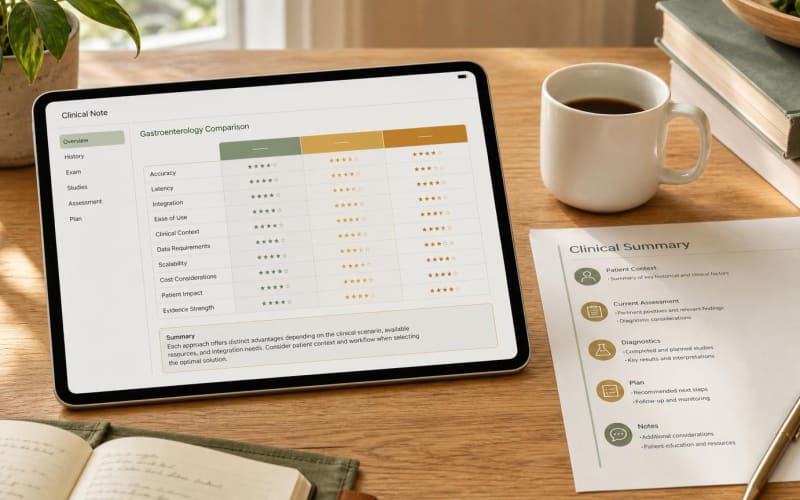
Head-to-Head Architecture Comparison
When behavioral health teams evaluate documentation tools, the constraint is rarely prose quality. It is what happens after the note exists: how it reaches the chart, whether it lands in the correct field, and whether an auditor can trace it back to a signed clinician action. We reviewed Freed AI against Merry AI on those terms, using each vendor's published materials and list pricing at the time of writing.
Freed describes its Kipu workflow as generating chart-ready notes and pushing them into the EHR through a browser-based step. That is a reasonable design for individual sessions. The open question for group programs is granularity: one encounter narrative versus distinct, per-client content mapped to Kipu's Individual Assessments/Interventions fields.
Freed is a capable general-purpose scribe. For solo therapists writing individual SOAP or DAP notes, the gap narrows considerably. The comparison below is weighted toward multi-client programs, where the structural differences compound with every session.
| Dimension | Merry AI | Freed AI |
|---|---|---|
| Real pricing | $54/mo (Pro Annual) | $99/mo list per clinician |
| Annual cost per clinician | $648 | $1,188 |
| DOM injection speed | One approval writes all per-client Kipu fields in a single pass | Browser push per note; per-field group targeting not publicly documented |
| Group note-splitting | Diarizes each participant; one individualized note per client | Encounter-level generation; per-participant splitting not publicly documented |
| CPT G2211 capture | Flags longitudinal-care language on eligible E/M visits | No dedicated G2211 prompt publicly documented |
| Attestation logging | Clinician attestation block plus native Kipu signature and timestamp | Relies on EHR signature workflow |
| Data retention | Audio discarded after draft generation; notes stored only in Kipu | Governed by Freed's BAA and privacy policy |
The Group Therapy Bottleneck
A typical intensive outpatient group runs eight to twelve clients for ninety minutes. Payers reviewing group psychotherapy (CPT 90853) expect each client's record to show that client's participation, response, and progress toward their own treatment plan goals, not a shared summary pasted ten times. Identical narratives across charts are a recognized audit pattern.
Speaker Diarization and Per-Client Splitting
Merry separates every speaking participant in the session audio, attributes statements to the correct client, and drafts one individualized note per person. Shared context, such as the group topic, goes to Kipu's Group Description field, which carries no PHI. Each client's statements, affect, and interventions go to that client's own assessment field.
Single-narrative scribes leave clinicians with a different task: reading one combined note and manually rewriting it into ten distinct entries. At five minutes per client, that is fifty minutes of reconstruction per group, roughly the length of the group itself.
One-Click Injection Across Ten Kipu Charts
Kipu renders its Group Sessions screen as structured HTML, with each client's narrative field exposed as a standard textarea in the DOM. Merry's Chrome Extension maps diarized notes to those selectors inside the clinician's authenticated tab, inheriting existing permissions and requesting host access to the Kipu domain only.
From Approval to Charted Record
After the clinician reviews ten drafts, one approval writes each note into its matching field exactly as typed input. Nothing passes through the clipboard, so there is no risk of pasting one client's content into another client's chart. Attendance, individual start and end times, and signatures remain in Kipu's native workflow, and Golden Thread linkage to plan objectives stays intact.
Keeping documentation inside Kipu's boundary matters for 42 CFR Part 2. Records created in-tab do not accumulate in a parallel file store that needs its own consent and redisclosure analysis. Your compliance team should still review deployment against current state statutes.
Cost and Revenue Mathematics
List pricing is the easiest variable to verify. Freed at $99 per month is $1,188 per clinician per year. Merry Pro Annual at $54 per month is $648. The difference is $540 per clinician, or 45 percent. For a fifteen-clinician program, that is $8,100 annually before counting any time recovered.
Time recovered is harder to measure honestly. Our 2.1-hour daily estimate assumes a clinician running two groups and several individual sessions per day, with reconstruction and copy-paste time removed. Track your own baseline for two weeks before trusting anyone's number, including ours.
G2211 Capture for Prescribers
HCPCS G2211 applies only to office/outpatient and home E/M visits, so it is relevant to psychiatrists and nurse practitioners managing medications, not to 90853 group codes. CMS pays roughly $16 per add-on nationally, adjusted by locality, and it is generally not payable when the E/M carries modifier 25, with limited exceptions. A prescriber with about 20 eligible Medicare visits weekly across 49 weeks reaches 980 claims, or approximately $15,600. Merry prompts for the longitudinal-relationship language CMS describes in its G2211 FAQ; the clinician decides whether it applies.
For the underlying literature on ambient documentation, group psychotherapy outcomes, and documentation burden, search peer-reviewed work at https://www.ncbi.nlm.nih.gov/pmc/. We would rather you check our assumptions than accept them.
If you would like to see the ten-chart injection in your own Kipu instance, Schedule a 15-Minute Workflow Audit. Bring a de-identified group schedule, and we will walk through the field mapping together.