Head-to-Head Architecture Comparison
When multispecialty groups evaluate documentation tools, the useful question is not whether a note reads well. It is whether the measurements a payer looks for end up in the fields where the billing engine and the auditor actually look. Those measurements include flexion degrees, wound length and width, and prior therapy dates. Nabla produces a capable narrative note. Merry AI is built to populate the discrete exam and procedure fields beneath it.
The table below summarizes what we observed, using published pricing and our own internal timing on browser-based EHRs. Nabla figures reflect its public materials at the time of review. Please verify current terms with Nabla directly.
| Parameter | Merry AI | Nabla |
|---|---|---|
| Real pricing | Pro Annual $54/mo ($648/yr), flat and unmetered | Free tier with a monthly encounter cap; Pro about $119/mo ($1,428/yr); Enterprise quoted separately |
| DOM injection speed | Sub-second write to mapped fields (internal benchmark) | Note text inserted or copied into the main note area; timing depends on clinician steps |
| Discrete-field mapping | ROM degrees, wound cm², LVEF, and PHQ-9 bound to exam and procedure inputs | Narrative note; structured-field mapping not publicly documented |
| Group note-splitting | Diarized per-member notes for group psychotherapy | Single-encounter note; per-member splitting not publicly documented |
| CPT G2211 capture | Longitudinal-complexity prompt with an evidence trail | No dedicated G2211 logic publicly documented |
| Attestation logging | Clinical Logic Bridge block with time-stamped clinician sign-off | Clinician review before export; no attestation block documented |
| Data retention | Audio shredded from RAM, 0-day retention | States audio is not stored by default; confirm note retention settings |
Cost Modeling for a Multispecialty Panel
The arithmetic is deliberately simple. At Nabla's Pro list price of roughly $119 per clinician per month, a ten-clinician group spends about $14,280 per year. Merry AI Pro Annual, at $54 per month, costs $6,480 for the same group. That is a difference of $7,800, or about 54.6 percent. For context, Freed lists around $99/mo, and Nuance DAX enterprise contracts commonly run near $8,000 per clinician per year. Both Nabla and Merry AI sit at the self-serve end of the market.
Software price is only half the ledger, and recovered revenue usually matters more. HCPCS G2211 pays roughly $16 nationally under recent fee schedules. Suppose a clinician appropriately reports it on four established visits per day across 244 clinic days. That captures about 976 add-ons, or roughly $15,600 annually. The figure depends entirely on documentation that supports a continuing, longitudinal relationship.
G2211 Documentation Logic
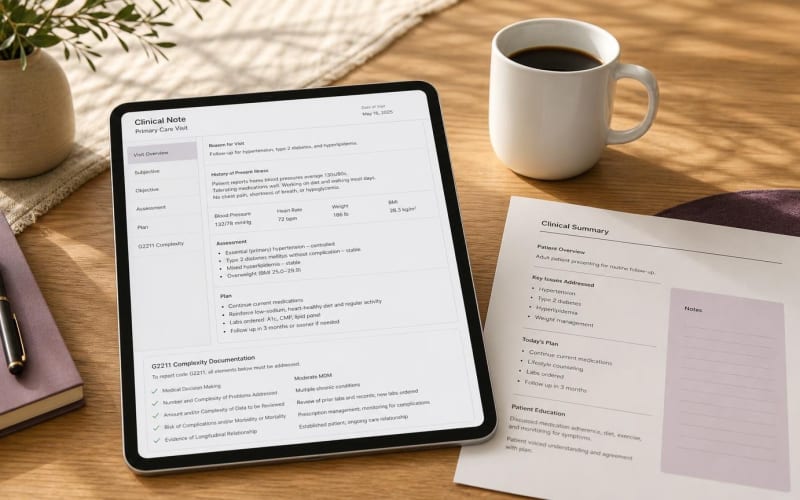
CMS describes G2211 as reflecting the complexity inherent to being the continuing focal point for a patient's care, or to ongoing care of a single serious or complex condition. Merry AI extracts prior therapy dates, chronic problem history, and follow-up plans into structured history fields, then flags the visit for clinician review. It never appends modifier 25 to G2211 itself. It allows G2211 alongside a modifier-25 E/M only when the same-day service is a preventive visit, an annual wellness visit, or vaccine administration, consistent with current CMS guidance. Diagnosis specificity is checked against the code sets at https://www.cms.gov/medicare/coding-billing/icd-10-codes.
Discrete Exam and Procedure Field Binding
Most browser-based scribes, Nabla included, deliver text to the main note region. That is useful. However, a payer reviewing a debridement or joint injection wants numbers in the procedure record, not buried in the fourth paragraph of an HPI.
Orthopedic and Wound Measurements
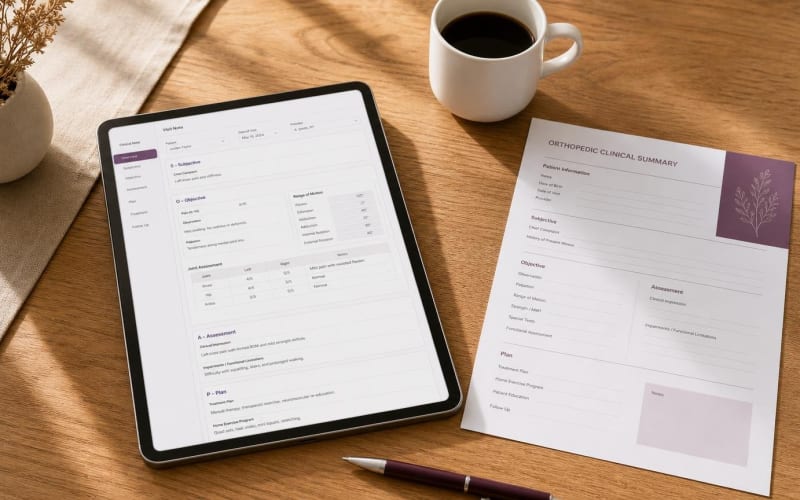
Merry AI parses spoken measurements such as 'right knee flexion 95 degrees, extension lacking 10' and writes each value to the corresponding ROM input. For wounds, it captures length, width, and depth in centimeters, computes area in cm², and populates the wound panel alongside tissue type and debridement depth. Every minor procedure receives its measurable parameters. This supports modifier 59 or XS distinctions when separate anatomic sites are treated on the same day.
Overlay Binding Across Tabs and Iframes
The Chrome extension binds its overlay directly to exam and procedure fields, including panels rendered inside nested iframes or hidden tabs. When a specialty tab is not yet rendered, Merry AI queues the values and writes them once the panel mounts, rather than failing silently. Selector maps are versioned per EHR. As a result, a vendor UI update triggers a visible remap prompt instead of a misplaced value.
Audit Posture and Fit Assessment
CMS reported a 10.3 percent improper payment rate for E/M codes in its 2024 data. Incorrect coding accounted for 49.1 percent of those errors, and insufficient documentation accounted for 34.1 percent. Those categories are exactly where narrative-only notes are vulnerable.
Merry's Clinical Logic Bridge records which transcript segment supported each coded element. The clinician signs a time-stamped attestation block before anything leaves the extension. Audio is held only in volatile memory and shredded once values are written, which gives a 0-day retention posture. For California practices, patient-facing summaries carry AB 3030 disclosures and a pathway to contact a human; clinician-reviewed internal notes are handled separately.
Nabla's privacy stance is genuinely conservative, and we credit it. The difference between the two products is less about retention than about structure: what gets written, where it goes, and what evidence is attached.
If your clinicians mainly need a clean narrative note and a free entry tier, Nabla is a reasonable choice. Your panel may instead include orthopedics, wound care, cardiology, or group behavioral health, where discrete values and per-member notes drive reimbursement. In that case, the structured approach tends to pay for itself within the first quarter.
We would rather show you than assert it. Bring one de-identified encounter from your busiest specialty and Schedule a 15-Minute Workflow Audit. We will map the fields together and compare outputs line by line.