CLINICAL MEMORY
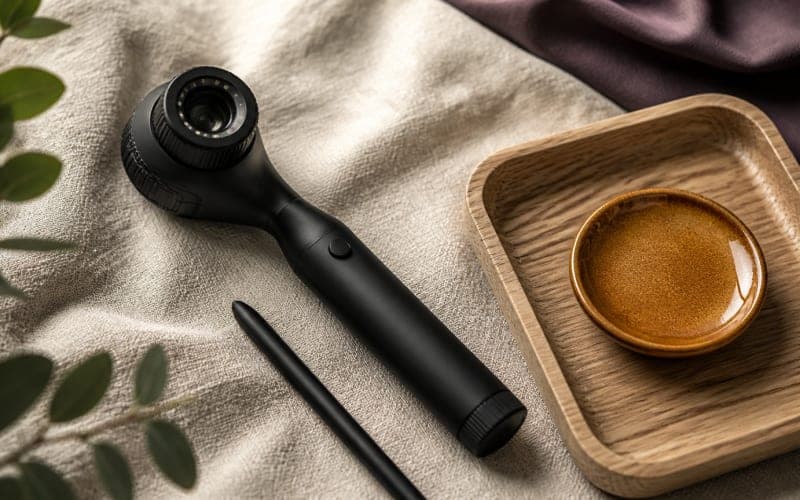
Longitudinal Lesion Memory
Find 40+ derm prompt packs at templates.scribing.io to generate lesion logs in 5 seconds and surface unresolved biopsy questions.
Specialty Clinical Playbook
Ambient documentation that respects EMA sectional boundaries, auto-maps ABCDE morphology, and defends modifier-25 logic. Book your audit at https://cal.com/merryai/demo.
 Dr. Sarah Chen, MD
Specialty Architecture
Engineered to mirror the pacing, diagnostic frameworks, and documentation requirements of high-volume dermatology and layered Mohs micrographic surgery.
CLINICAL MEMORY
Find 40+ derm prompt packs at templates.scribing.io to generate lesion logs in 5 seconds and surface unresolved biopsy questions.
CONTEXT RETRIEVAL
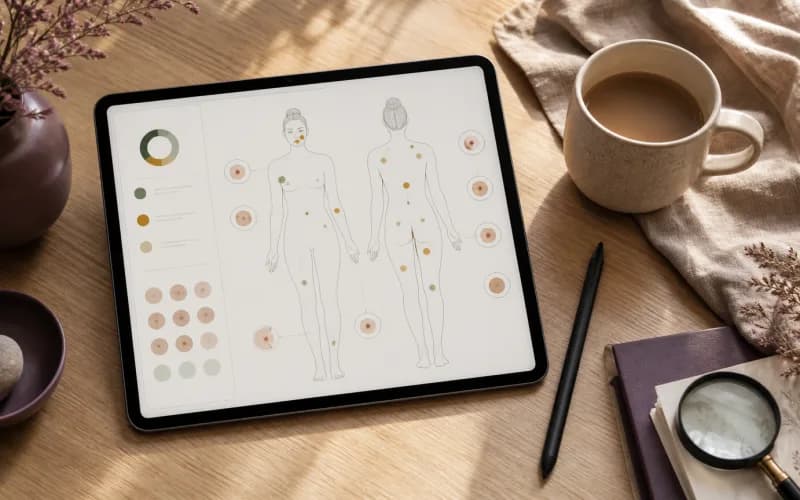
Retrieve prior lesion measurements, biopsy specimen logs, and pathology margins in one structured draft without tab bouncing.
WORKFLOW INTELLIGENCE
Capture separately identifiable E/M cognitive work and run a virtual cross-out test. Claim your 15-Minute Workflow Audit today.

SPECIALTY-AWARE REASONING
Route ambient dialogue into E/M exam fields versus Mohs stage, block, and reconstruction sections without cross-contamination.
Point-of-Care Flow
Zero IT friction, zero complex API setup, and human-verified attestation on every note.

Dermatology and Mohs micrographic surgery occupy a uniquely bifurcated documentation reality, where a single encounter can simultaneously generate a cognitively complex evaluation-and-management service and a highly technical, multi-stage surgical procedure. The core architectural challenge Merry AI solves is the enforcement of strict sectional boundaries: the E/M assessment must remain physically and logically distinct from the procedural report. When these streams collapse into a single narrative, practices invite CO-97 bundling denials and elevated audit exposure, because the modifier-25 defense evaporates the moment procedural content contaminates the cognitive work.
Because ModMed EMA is purpose-built for dermatology with body mapping and skin-specific structured templates, Merry AI positions itself as a compliance-first ambient layer that respects that native schema rather than overwriting it. Our engine treats the EMA dermatology exam template as canonical, routing ambient dialogue into discrete flowsheet fields so that EMA's downstream auto-coding logic continues to generate ICD-10 diagnoses, CPT procedure codes, orders, and pathology requisitions without interruption. You can Access Specialty Prompts at templates.scribing.io to see how each section is pre-structured.
Preserving auditability requires three parallel documentation lanes: the E/M lane (history, review of systems, skin exam, assessment, and medical decision making), the procedure lane (Mohs stages, excision, biopsy, destruction, and repair), and the pathology lane (intraoperative frozen section versus final margin status). Merry AI never auto-promotes procedural narrative into the E/M assessment, and it never populates procedural flowsheet fields from E/M narrative. This hard boundary set is the technical spine of the entire workflow.
| Diagnostic Framework | Required Clinical Data Points | Billing Evidence |
|---|---|---|
| ABCDE Lesion Morphology | Asymmetry, Border regularity, Color variegation, Diameter (mm), Evolution/history | ICD-10 D48.5 / C43.x; MDM risk stratification |
| Mohs Micrographic Staging | Stage count, block count, margin status, tissue map (clock-face) | CPT 17311-17315 by site and stage |
| Reconstruction / Repair | Flap or graft type, defect size, closure layers, suture technique | CPT 12031-14302, billed separately |
| Same-Day E/M + Procedure | Distinct chief complaint, independent MDM, risk elements | Modifier-25 cross-out test defense |
| Longitudinal Surveillance | Continuous care relationship, ongoing lesion monitoring | CPT G2211 complexity add-on |
Ambient dictation in a skin exam room is dense and rapid: a clinician may say 'two-tone irregular brown macule, seven millimeters, changing over six months' while examining a suspicious pigmented lesion. Merry AI parses this narrative into the discrete ABCDE elements EMA expects, converting free speech into structured exam data that feeds both the diagnostic engine and the medical decision-making risk calculus.
Critically, these ABCDE descriptors live in the E/M examination section as objective findings, not in any procedural report. This is a subtle but essential sectional boundary. The morphology data informs the decision to biopsy, excise, or refer for Mohs, but Merry AI references that indication in the procedure section rather than duplicating the full ABCDE detail. This avoids the note bloat and cross-contamination that auditors flag when reviewing whether an E/M service was genuinely separate from the procedure.
Each spoken descriptor maps to a single discrete field: 'irregular borders' sets Border to irregular, 'shades of brown, black, and red' sets Color variegation to yes with an enumerated hue list, and 'approximately seven to eight millimeters' populates the Diameter field with a numeric range. Evolution captures growth, bleeding, itching, or morphologic change over a documented time course, which directly elevates the risk element under AMA 2023 MDM rules.
High-risk lesions suspicious for melanoma legitimately raise the problems-addressed and risk dimensions of medical decision making, potentially supporting a level 4 or level 5 visit per the guidance published at the AMA CPT resource center. Merry AI keeps this cognitive work in the MDM section so that the E/M level is defensible on its own merits, independent of any same-day procedure.
Mohs micrographic surgery generates the most granular procedural documentation in all of dermatology, tracking each stage sequentially with associated tissue block counts, margin status, and precise tissue-map orientation. Merry AI treats Stage 1, Stage 2, and subsequent stages as discrete procedural fields, capturing the surgeon's intraoperative narration of clock-face positions, anatomic landmarks, and frozen-section decisions to proceed or close.
Because CPT codes 17311 through 17315 are driven by anatomic site category, stage count, and block count, Merry AI's Mohs audit guard verifies that documented stages and blocks align precisely with the codes ultimately submitted. Head, neck, hands, feet, and genitalia route to 17311 and 17312; trunk, arms, and legs route to 17313 and 17314; and each additional block beyond the first five in any stage maps to 17315, consistent with the CMS Mohs billing and coding article.
Reconstruction is never bundled into the Mohs excision codes, so Merry AI enforces a discrete repair section documenting flap or graft type, defect measurement, closure layer complexity, and suturing technique. These land in the appropriate repair CPT ranges and are billed as separate operative events, with the procedural report kept entirely distinct from both the Mohs staging record and the E/M assessment.
The modifier-25 guard is the single most consequential compliance feature for high-volume dermatology. When a same-day E/M is billed alongside a minor procedure such as a biopsy or excision, Merry AI runs a virtual cross-out test: it strips all procedural documentation from the note and evaluates whether the remaining E/M content independently supports the billed level under MDM or time logic. If it does not, the system warns the clinician before a defensible claim becomes an audit liability.
Longitudinal complexity capture through CPT G2211 rewards the continuous care relationship that defines dermatologic surveillance, where a clinician manages evolving nevi, chronic inflammatory disease, or post-Mohs follow-up over time. Merry AI flags encounters that reflect this ongoing serious-or-complex condition management and drafts the supporting care-plan language, ensuring the add-on is substantiated rather than reflexively appended.
Ultimately, Merry AI functions as a quiet, disciplined documentation layer that mirrors the diagnostic frameworks and payer realities of dermatology and Mohs surgery without demanding IT overhead or workflow disruption. To see how sectional boundaries, ABCDE mapping, and Mohs stage tracking perform inside your own EMA environment, Schedule a 15-Minute Specialty Workflow Audit and bring a representative encounter for us to structure live.

Separate shot-room narrative from new-problem MDM so modifier 25 holds under review. Book your audit at https://cal.com/merryai/demo.

eGFR trends, KDIGO staging, and G2211 attestation drafted into your Assessment field. Book your audit at https://cal.com/merryai/demo.

Joint-level ROM, dated DMARD failures, and 20610 modifier 25 logic in one calm note. Book your audit at https://cal.com/merryai/demo.