
CLINICAL MEMORY
Longitudinal Surveillance Memory
Find 40+ prompt packs at templates.scribing.io to draft structured procedure notes in seconds and surface prior polyp burden and surveillance intervals.
Specialty Clinical Playbook
Structured colonoscopy notes with discrete polyp morphology, Paris classification, and automated ADR tracking pushed into gGastro and Epic GI. Book your audit at https://cal.com/merryai/demo.
 Dr. Sarah Chen, MD
Specialty Architecture
Engineered to mirror the pacing, diagnostic frameworks, and documentation requirements of Gastroenterology Practices & Ambulatory Endoscopy Centers.
CLINICAL MEMORY
Find 40+ prompt packs at templates.scribing.io to draft structured procedure notes in seconds and surface prior polyp burden and surveillance intervals.

CONTEXT RETRIEVAL
Retrieve prior histology categories, prep scores, and lesion trajectories in one structured draft without tab bouncing between ERS and pathology portals.
WORKFLOW INTELLIGENCE
Capture longitudinal complexity add-on revenue for IBD and chronic surveillance patients and auto-draft care plans. Claim your 15-Minute Workflow Audit today.
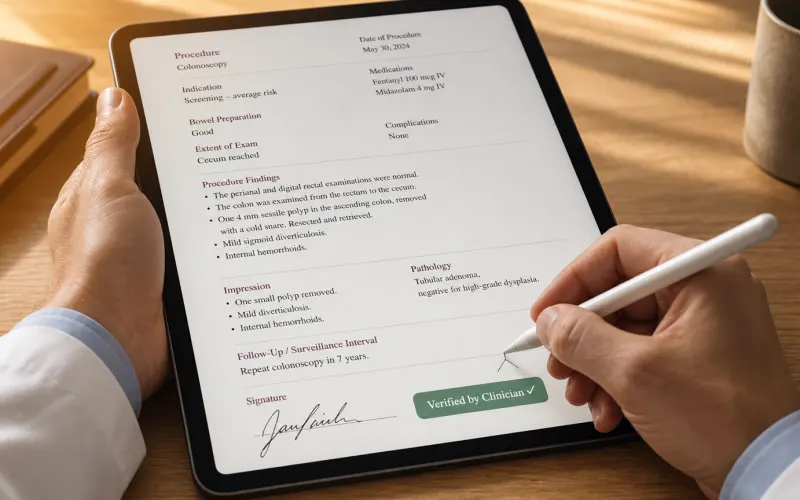
SPECIALTY-AWARE REASONING
Map each lesion to its colon segment and Paris morphology code, then route discrete descriptors directly into ERS polyp tables and quality flowsheets.
Point-of-Care Flow
Zero IT friction, zero complex API setup, and human-verified attestation on every polyp entry.
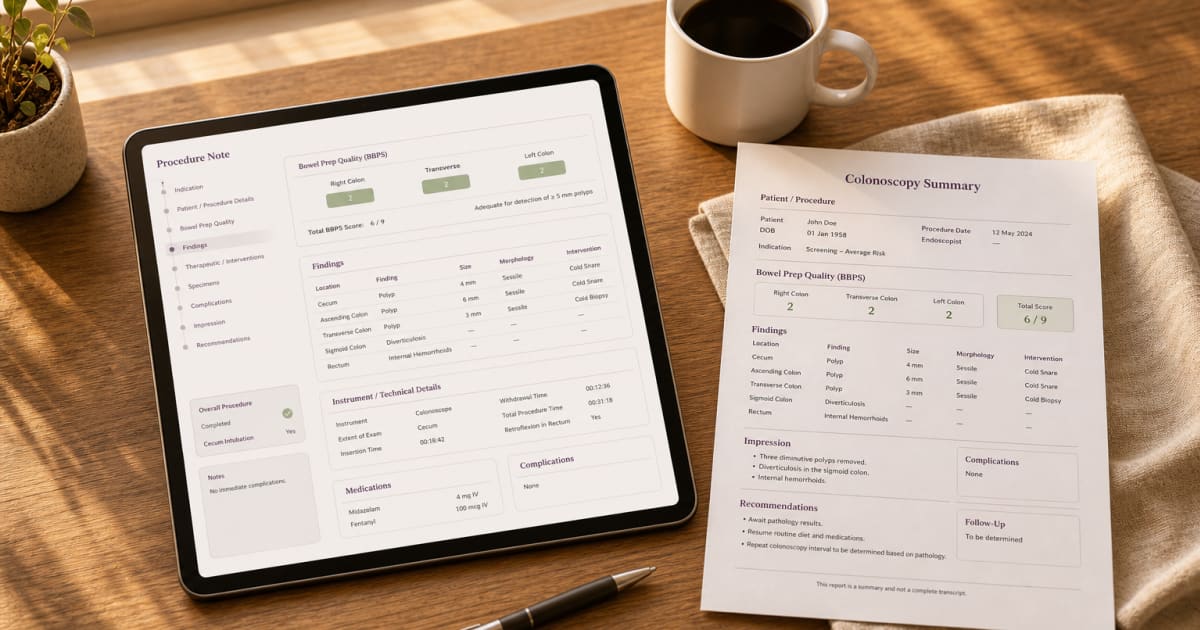
Clinical documentation in Gastroenterology practices and ambulatory endoscopy centers is not a single narrative report; it is a layered, structured artifact assembled from indication data, technical procedure metrics, segment-based findings, per-lesion interventions, and pathology linkage. A modern colonoscopy note must simultaneously satisfy the endoscopist reviewing surveillance intervals, the coder defending CPT 45385, and the quality director extracting the practice's Adenoma Detection Rate. Merry AI was engineered around this reality, treating each polyp as a discrete data object rather than a phrase buried in free text.
High-volume endoscopy centers generate documentation across multiple structured layers per case. Pre-procedure data captures the indication (screening, surveillance, or diagnostic), bowel prep quality via the Boston Bowel Prep Score (BBPS), ASA classification, and sedation details. Technical metrics record cecal intubation with photo attestation, withdrawal time as an ASGE quality metric, and any adjunctive imaging such as Narrow Band Imaging or chromoendoscopy. Merry AI diarizes the endoscopist's live dictation and routes each descriptor to its structured home.
Expert documentation guidance is explicit that an entry reading only "polyp removed" is clinically and medicolegally insufficient. Every lesion must carry location by segment, size in millimeters, morphology using a standardized system, resection technique, specimen disposition, and clinical impression. Standardized reporting programs warn that missing polyp size or morphology directly causes inappropriate surveillance recommendations and misrepresents endoscopist performance. Merry AI enforces these fields at the point of dictation so incompleteness never reaches the signed chart.
The Paris classification remains the internationally accepted standard for describing superficial neoplastic lesions across the esophagus, stomach, and colon. Merry AI parses dictated morphology into discrete Paris codes: 0-Ip for pedunculated lesions, 0-Is for sessile, 0-IIa for slightly elevated, 0-IIb for flat, 0-IIc for slightly depressed, and 0-III for excavated lesions. For advanced disease it can additionally layer Lateral Spreading Tumor (LST) classification and surface pattern descriptors captured under NBI or chromoendoscopy, informing resection strategy and prediction of submucosal invasion.
Barrett's esophagus documentation follows the same discrete-field philosophy through the Prague C&M criteria, where circumferential (C) and maximal (M) extent are recorded in centimeters. Merry AI captures Prague measurements alongside biopsy specimen logs mapped to each level, ensuring the dysplasia surveillance record is auditable and complete. This mirrors the granularity dermatology demands for ABCDE lesion morphology and anatomical specificity, applied here to the luminal GI tract.
Adenoma Detection Rate is the central quality metric for screening colonoscopy, defined as the proportion of screening exams in which at least one adenoma is identified. Its accurate calculation depends on complete per-polyp documentation and correct linkage of each lesion to its histology category once pathology returns. Peer-reviewed work on automated ADR extraction from common electronic health records (available via PMC) confirms that structured, discrete data is the foundation for reliable report-card generation.
Merry AI counts adenomas per screening colonoscopy, distinguishes adenomatous from serrated and hyperplastic lesions once pathology is associated, and feeds ADR, cecal intubation rate, withdrawal time, and BBPS directly into GI flowsheets per endoscopist and per practice. This closes the exact gap standardized reporting guidelines describe: incomplete documentation leading to under-measured ADR and a distorted picture of practice quality. Dashboards populate at the time of reporting rather than through a separate manual export session.
Surveillance interval decisions depend on the number, size, morphology, histology, and location of adenomas and serrated lesions. Merry AI associates returning pathology results with each discrete polyp, recalculates the risk classification, and updates the recommended interval, whether a three-, five-, or ten-year recall, then drafts the recall entry for the scheduling system. This eliminates the manual reconciliation that traditionally forces staff to re-open procedure reports days after the case.
GI-optimized EHRs and endoscopy reporting systems, including gGastro, Epic GI, Provation, and EndoSoft, are expected to store polyp descriptors as discrete, queryable fields rather than narrative only. Many practices run a dedicated ERS alongside an enterprise EHR, which requires write-back of both the narrative report and the discrete fields into the parent record. Merry AI's Chrome Extension performs DOM injection directly into the active browser window, delivering both artifacts in a single pass without HL7 builds or complex API configuration.
Field-level mapping is the decisive implementation step. Merry AI aligns its data model to the ERS polyp table: segment location, size in millimeters, Paris morphology code, removal technique from a standardized dropdown, specimen identifier, retrieval status, and the histology category once pathology arrives. Quality fields such as BBPS, withdrawal time, and cecal landmark attestation map to the flowsheets that drive ADR and CIR calculation, satisfying registry export formats such as GIQuIC. You can Access Specialty Prompts at templates.scribing.io to preconfigure these mappings.
Physician control is preserved throughout. Merry AI pre-populates findings and classifications, but the endoscopist reviews each lesion polyp-by-polyp, adjusts morphology or impression where clinically warranted, and signs off, which triggers the structured write-back. An auditable trail records who accepted each AI suggestion, who edited it, and when, providing the timestamped documentation accreditation surveys and medicolegal review require under ASGE policy guidance. To see this mapped against your live gGastro or Epic GI configuration, Schedule a 15-Minute Specialty Workflow Audit.
| Specialty Diagnostic Framework | Required Clinical Data Points | Billing & Quality Evidence |
|---|---|---|
| Paris Classification (per lesion) | 0-Ip / 0-Is / 0-IIa / 0-IIb / 0-IIc / 0-III morphology, segment, size in mm | Supports CPT 45385 snare polypectomy; defends resection technique coding |
| Boston Bowel Prep Score (BBPS) | Segmental prep scores (right/transverse/left), total 0-9 | Justifies adequacy of exam; flowsheet input for quality reporting |
| Adenoma Detection Rate (ADR) | Adenoma count per screening exam, histology category linkage | ASGE quality metric; GIQuIC registry and payor submission |
| Cecal Intubation Rate / Withdrawal Time | Cecal landmark photo attestation, timed withdrawal | ASGE quality benchmark; accreditation defense |
| Prague C&M Criteria (Barrett's) | Circumferential (C) and maximal (M) extent in cm, biopsy specimen logs | Substantiates dysplasia surveillance; specimen-to-pathology mapping |
| CPT G2211 Complexity Add-on | Continuing focal-point narrative for IBD / chronic surveillance | Longitudinal complexity revenue per CMS MM13473; Modifier 25 logic bridge |
The regulatory throughline is unmistakable: ASGE and standardized reporting guidance treat complete, discrete polyp documentation as the precondition for correct surveillance, accurate quality metrics, and defensible coding. Merry AI operationalizes that standard, enforcing required fields per lesion, applying internationally recognized classification vocabularies, and maintaining an auditable trail, so GI practices and ambulatory endoscopy centers meet or exceed expectation while reclaiming the 45 to 90 minutes of post-procedure charting that burdens high-volume rooms.

Turn one 3-hour group session into individualized, 42 CFR Part 2-compliant progress notes per client. Book your audit at https://cal.com/merryai/demo.
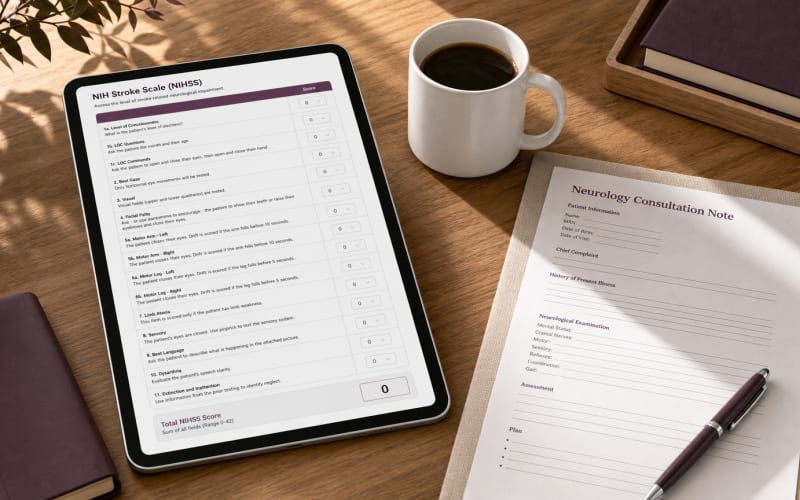
Convert the spoken neurological exam into discrete NIHSS and MMSE item scores with verifiable attestation. Book your audit at https://cal.com/merryai/demo.

Ambient reasoning that captures GDMT titration, LVEF trends, and CPT G2211 complexity without a single voice command. Book your audit at https://cal.com/merryai/demo.