Two Visits Living Inside One Prenatal Encounter
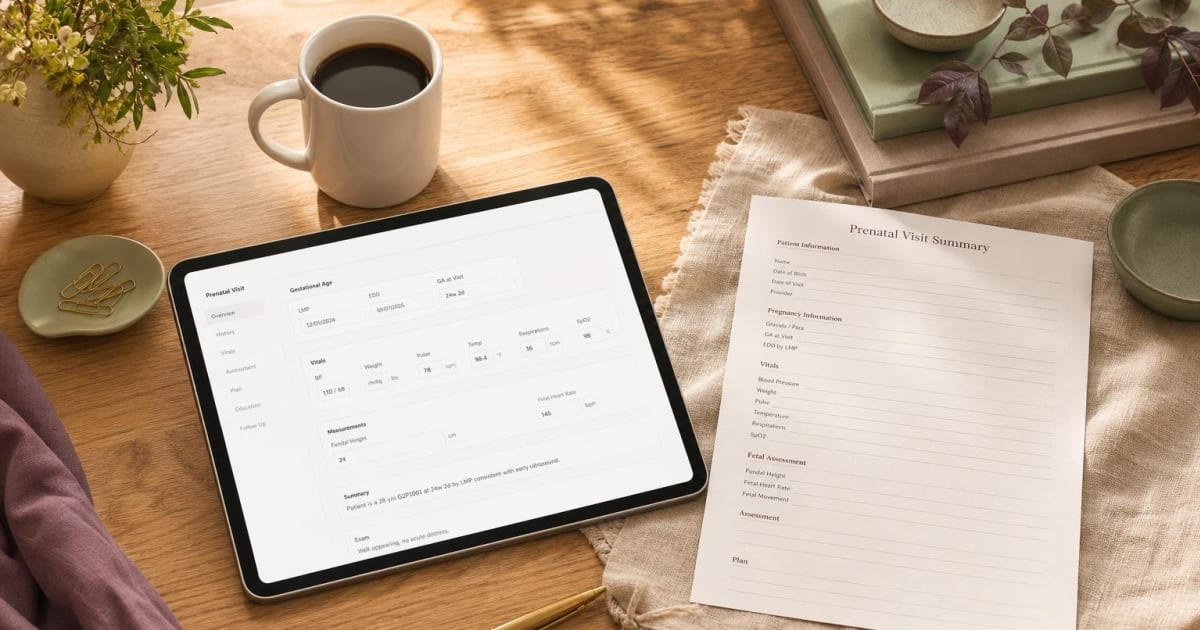
A 28-week prenatal visit often holds two clinical conversations at once. One is the routine antepartum review: fundal height, fetal heart tones, blood pressure, urine protein and glucose, weight trend, fetal movement counseling, and the Tdap discussion that belongs between 27 and 36 weeks. The other is something the patient brings in that sits outside the expected course of pregnancy, such as an acute migraine with photophobia, a new dermatologic eruption, or a respiratory complaint that needs its own workup. When an ambient scribe blends these into one narrative, the coder inherits an ambiguity that downstream editing rarely resolves.
Merry treats these as two distinct documents from the first moment of capture. Diarization separates the clinician's questions from the patient's own account, and the drafting logic sorts each statement into either the prenatal flowsheet stream or the problem-oriented stream. Nothing is coded automatically. The goal is simply that the separation a coder needs is already visible when the chart opens.
Routine Flowsheet Data Stays in the Global Package
Routine antepartum care is bundled into the global obstetric codes, whether 59400 for vaginal delivery with antepartum and postpartum care, 59510 for cesarean delivery, or 59425 and 59426 when only antepartum visits are rendered. Gestational age from the Z3A series, EDD confirmation, G/P TPAL history, EPDS depression screening, and standard counseling belong here. Merry writes this material into the OB Worksheet and preventive fields so it never inflates a separate E/M.
Separately Identifiable Problems Earn Their Own Section
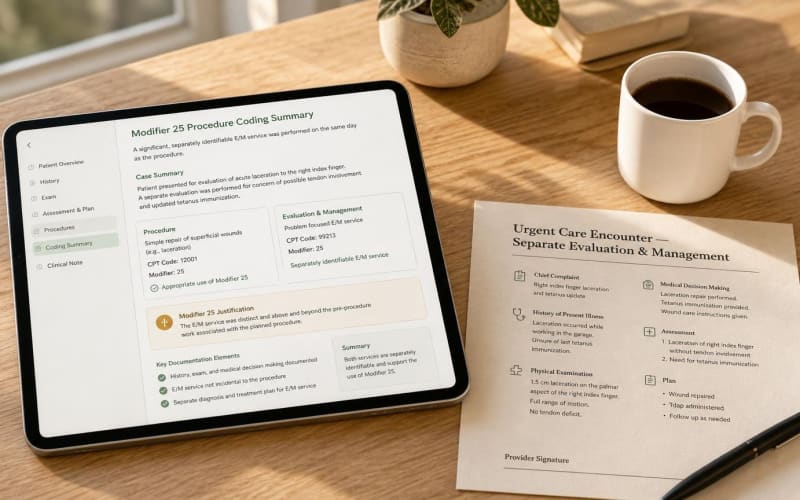
Modifier 25 requires a significant, separately identifiable evaluation and management service. Merry's problem section carries its own chief complaint, focused history, examination, differential, and medical decision making, drafted as if the flowsheet did not exist. If a patient with an uncomplicated pregnancy presents with acute sinusitis, the assessment reads as a stand-alone E/M: symptom duration, exam findings, pregnancy-appropriate antibiotic selection, and return precautions. Whether Modifier 25 applies remains the coder's decision, but the evidence arrives clearly partitioned.
Longitudinal Pregnancy Context Across the Episode
High-risk pregnancies accumulate context visit by visit. A G3P1 at 28 weeks with chronic hypertension on labetalol, a prior spontaneous preterm birth at 34 weeks, and new gestational diabetes after an abnormal three-hour glucose tolerance test is not a single encounter; she is a story. Merry recalls that story each visit, including serial blood pressure trends, growth ultrasound percentiles, cervical length measurements, low-dose aspirin started after 12 weeks, and the planned delivery window at 37 to 38 weeks.
The longitudinal paragraph states plainly who is managing the pregnancy and why. Language such as primary obstetrician managing chronic hypertension and gestational diabetes throughout this pregnancy, seen every two weeks since 24 weeks, with antenatal testing planned from 32 weeks gives a reviewer the continuity signal without embellishment. Trimester-specific O-codes are suggested for clinician review, never finalized silently.
Where G2211 Fits, and Where It Does Not
CMS describes G2211 as complexity inherent to ongoing care of a single serious or complex condition. It adds no documentation requirement beyond the standard E/M, but the record must show the longitudinal relationship. CMS also edits against G2211 when the base office E/M carries Modifier 25, with narrow exceptions for same-day annual wellness visits, vaccine administration, and certain Part B preventive services. Global maternity visits are not separately reported E/M, so G2211 applies only when a qualifying office visit is billed outside that package. Merry surfaces the narrative; your billing policy decides.
Clinical Logic Matrix for OB/GYN
Each row below pairs a specialty diagnostic metric with the data points Merry captures and the evidence a reviewer will look for.
| Specialty Diagnostic Metric | Required Clinical Data Points | Billing Evidence |
|---|
| Gestational age and dating | LMP, first-trimester CRL, EDD, Z3A weeks code | Supports trimester-specific O-code selection |
| Hypertensive disorders of pregnancy | Serial BP, urine protein/creatinine ratio, severe features, labetalol or nifedipine dose | O10, O13, O14 specificity and drug-management MDM |
| Gestational diabetes | One-hour and three-hour GTT values, glucose logs, insulin or metformin plan | O24.41- specificity for diet versus medication control |
| Preterm birth risk | Prior PTB gestational age, transvaginal cervical length, progesterone plan | O09.21- supervision and longitudinal narrative |
| Fetal surveillance | NST reactivity, BPP score out of 10, EFW percentile, AFI | Separately reportable testing with interpretation |
| Separate acute problem | Distinct chief complaint, exam, and MDM outside routine antepartum care | Modifier 25 defensibility beyond global package |
The matrix is deliberately conservative. It names evidence rather than codes to bill, and every suggestion remains editable before signature. Verify current descriptors at the https://www.cms.gov/medicare/coding-billing/icd-10-codes reference before each fiscal-year update.
Routing Sections into athenaOne Encounter Fields
athenaOne organizes pregnancy care inside OB Episodes, with an ACOG-aligned OB Worksheet and a discrete Delivery Information section. Merry's Chrome Extension reads visible section labels rather than brittle page paths, identifies the active chart frame, and writes only into the tab the clinician has open. The preventive stream lands in screening and counseling fields. The problem-oriented assessment lands in the visit Assessment and Plan. The longitudinal pregnancy plan lands in the episode summary, where it persists across every subsequent prenatal visit.
Nothing is signed on your behalf. Each insertion is reversible, logged, and visibly marked as drafted until you attest. athenaOne keeps its native save, versioning, and audit trail. For patient-facing after-visit summaries in California, a configurable AI-assistance disclaimer is placed at the top of the communication, consistent with AB 3030. Internal clinical notes follow your practice policy.
Delivery and postpartum documentation follow the same discipline. Labor type, weeks gestation, anesthesia, incision type, postpartum complications, and NICU admission map into discrete Delivery Information fields rather than disappearing into narrative, which keeps quality reporting and maternal registry data intact.
Specialty prompt packs for prenatal follow-up, six-week postpartum checks, colposcopy follow-up, and annual gynecologic exams are available at https://templates.scribing.io. Begin with one clinic day, compare the drafted sections against your coder's expectations, and adjust from there.