Why Orthopedic Documentation Fails Audit Review
Orthopedic surgery documentation carries a particular weight. Several readers may open a single clinic note: a payer reviewing a total knee arthroplasty authorization, a physical therapist receiving a rehabilitation handoff, or a colleague covering a post-operative check. Occasionally an auditor asks whether a same-day injection was separately justified. Each reader looks for quantified findings, documented conservative care, and a plan that follows from both.
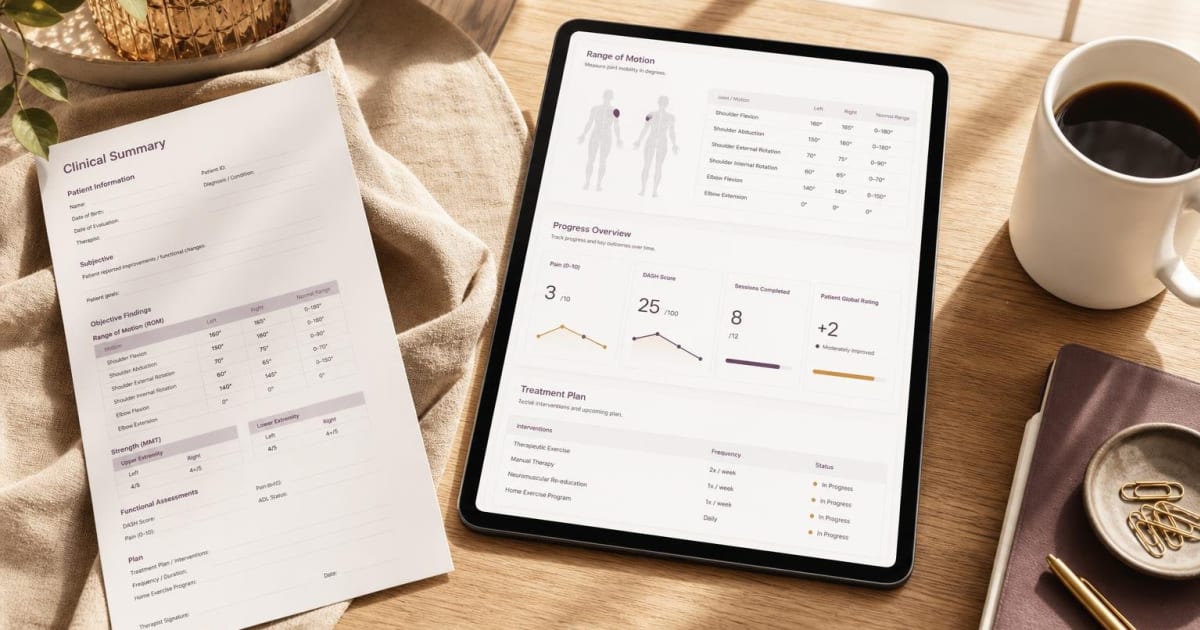
Most ambient tools stop at narrative. They produce a readable SOAP note, but the knee flexion measurement, the six weeks of supervised therapy, and the naproxen trial end up buried in free text. In NextGen Enterprise, a narrative note does not populate the discrete ROM fields, outcome measures, or conservative treatment controls. Episode-based orthopedic care depends on those fields, and they carry forward into the next visit.
The Conservative Therapy Burden
Payers rarely approve arthroplasty, arthroscopy, or advanced imaging without evidence of failed conservative management. That evidence has three parts. The first is the drug, dose, duration, and tolerance of each NSAID trial. The second is the number and dates of physical therapy visits and the functional response. The third is any adjunct care, such as bracing or corticosteroid injection. Merry listens for each element as it is spoken and records who said it. A patient recalling a meloxicam course is never confused with the surgeon summarizing outside therapy records.
Capturing ROM, MMT, and Stability at the Point of Exam
The musculoskeletal exam is spoken in numbers. Surgeons narrate as they examine: active knee flexion 95 degrees, extension lacking 10, quadriceps 4/5, Lachman 2+ with a soft endpoint, distal pulses intact. Merry extracts each value as a discrete element tied to laterality, joint, and plane of motion. Right shoulder abduction of 80 degrees is never recorded as the left side or as forward flexion.
Implant and operative detail matter equally. For pre-operative and post-operative visits, Merry captures dictated implant manufacturer, component size, and lot references, along with tourniquet time and estimated blood loss for operative logs. Published evidence shows that pre-templated operation notes improve documentation completeness in orthopaedic surgery. These studies are indexed at https://www.ncbi.nlm.nih.gov/pmc/.
Mapping Findings into NextGen Enterprise Structured Fields
NextGen Enterprise orthopedic templates render as structured forms across the History, Exam, Assessment/Plan, and Orders panels. The Merry Chrome Extension reads the active encounter workspace and identifies each input by its field label and control identifier. It then writes the value and dispatches the change events NextGen expects, so validation and auto-save behave as though the clinician typed the entry. If the Exam panel has not loaded, injection waits rather than guessing.
Every injected value remains attributable to the logged-in clinician. Nothing is committed without review. The surgeon sees each ROM degree, MMT grade, and conservative therapy entry highlighted in place before signing. Field maps are versioned per template, so an update to the practice's knee exam form does not silently misroute data.
The Orthopedic Clinical Logic Matrix
The matrix below summarizes how each diagnostic metric links to the data a reviewer expects and the billing evidence it supports.
| Specialty Diagnostic Metric | Required Clinical Data Points | Billing Evidence |
|---|
| Joint ROM (goniometric degrees) | Joint, laterality, plane, active vs passive, contralateral comparison | Quantified deficit supporting MDM and surgical necessity |
| MMT grade (0-5) | Muscle group, grade, pain inhibition, root correlation | Objective exam element for E/M and pre-authorization |
| Lachman stability | Grade 1+ to 3+, endpoint quality, pivot shift | Instability justifying MRI or ACL reconstruction |
| Failed NSAID trial | Agent, dose, duration, response, adverse effects | Documented conservative failure for payer criteria |
| Failed physical therapy | Visit count, date range, modalities, outcome | Conservative care threshold before arthroplasty |
| Operative implant log | Manufacturer, size, lot number, fixation | Operative note completeness and supply reconciliation |
Structured capture changes the downstream conversation. When a prior authorization reviewer opens the chart, the failed conservative course sits in discrete fields rather than being inferred from a paragraph. Outcomes across the episode of care can also be tracked without manual abstraction.
Billing Defense: Modifier 25, Modifier 59, and G2211
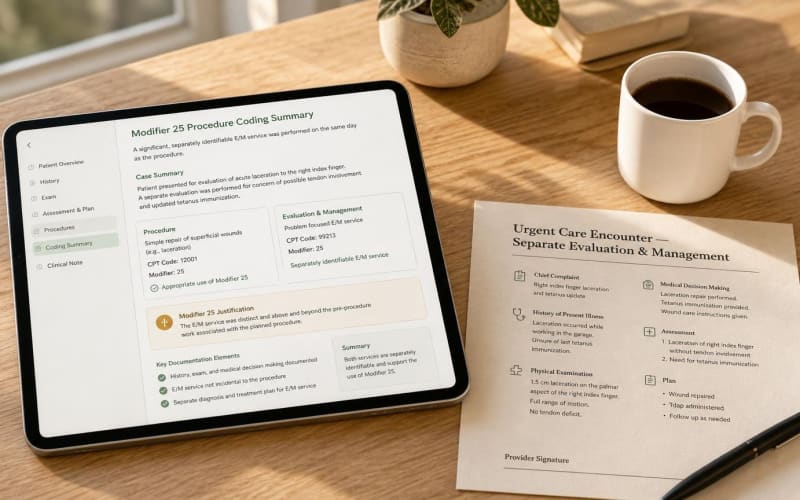
Modifier 25 requires a significant, separately identifiable E/M service on the same day as a minor procedure. Take an established patient with knee osteoarthritis who receives a same-day intra-articular injection. The E/M must stand on its own history, exam, and medical decision making, such as evaluating a new hip complaint or managing NSAID intolerance. Routine pre-injection assessment belongs to the procedure.
Modifier 59 is narrower still. It applies to the column 2 code when two normally bundled procedures occur at distinct anatomic sites or sessions, and it is never appended to an E/M service. Merry records each site discretely and does not suggest modifier 59 from ambient text alone.
HCPCS G2211 reflects longitudinal complexity when the clinician serves as the continuing focal point for a serious or complex condition. CMS generally does not pay G2211 when the E/M carries modifier 25, with limited exceptions. Merry flags that conflict rather than stacking codes.
Keeping the Procedure Note Separate
Merry writes E/M content and procedure content into different NextGen fields. The injection note captures site, approach, needle gauge, agent, dose, guidance method, and patient tolerance. The E/M fields retain the diagnostic reasoning. That separation is what makes a modifier 25 claim defensible under NCCI review.
Specialty prompt packs for knee, shoulder, spine, hand, and fracture care follow the same conventions. They are available at https://templates.scribing.io. Each pack reflects how surgeons actually dictate, so the draft reads like your note and the review before signing stays brief.