
CLINICAL MEMORY
Longitudinal Symptom Threads
Find 40+ prompt packs at templates.scribing.io to generate notes in 5 seconds and surface unresolved dyspnea, agitation, and pain trajectories across visits.
Specialty Clinical Playbook
Structure hospice eligibility, plans of care, symptom threads, and IDG reviews into provenance-linked notes. Book your audit at https://cal.com/merryai/demo.
 Dr. Sarah Chen, MD
Specialty Architecture
Engineered to mirror the pacing, interdisciplinary frameworks, and 42 CFR §418.104 documentation requirements of hospice and palliative care.
CLINICAL MEMORY
Find 40+ prompt packs at templates.scribing.io to generate notes in 5 seconds and surface unresolved dyspnea, agitation, and pain trajectories across visits.

CONTEXT RETRIEVAL
Retrieve prior certification periods, PPS/FAST decline trends, and functional-status trajectories in one structured draft without tab bouncing.
WORKFLOW INTELLIGENCE
Flag missing physician signatures, oral-to-written certification gaps, and benefit-period inconsistencies. Claim your 15-Minute Workflow Audit today.
SPECIALTY-AWARE REASONING
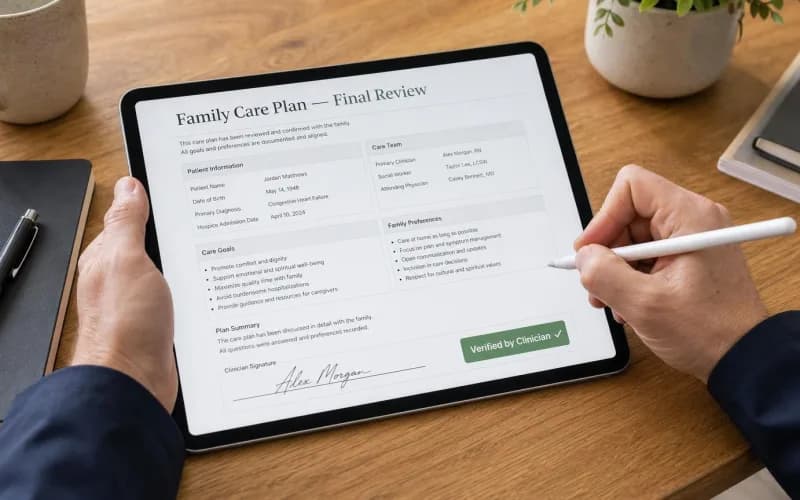
Diarize multi-party family meetings and route nursing, social-work, chaplain, and physician findings into discipline-specific plan-of-care sections.
Point-of-Care Flow
Zero IT friction, zero complex FHIR API setup, and human-verified attestation on every note.

Documentation in palliative and hospice care is governed by the Medicare Conditions of Participation, specifically 42 CFR §418.104, which requires a complete, authenticated, dated, and retrievable clinical record for every patient. Unlike episodic acute-care notes, hospice documentation must sustain a longitudinal narrative across referral, certification, comprehensive assessment, interdisciplinary review, ongoing symptom management, and end-of-episode events. Merry AI is engineered to structure this continuum rather than flatten it into a single summary, preserving the source narrative and clinical authorship at every step.
The central defensible truth of Merry AI in this specialty is that it helps organizations produce audit-ready, provenance-linked documentation while preserving source records, authentication, and human clinical oversight. It does not guarantee CMS, ACHC, or Joint Commission accreditation—that responsibility remains with the hospice—but it organizes the underlying evidence so a surveyor can reconstruct why a patient was admitted, what supported eligibility, and whether the plan of care was individualized, implemented, and updated.
Palliative care and hospice are not synonymous, and Merry AI treats them as distinct service lines. A general palliative consultation carries no six-month prognosis requirement and no hospice election, whereas a hospice episode requires certification, a benefit period, and a formal election statement. The system explicitly separates terminal-eligibility documentation from symptom or goals-of-care consultation, preventing the AI from converting a tentative prognosis into a definitive eligibility claim.
Family meetings and goals-of-care conversations are the acoustic reality of this specialty. A single encounter may include the patient, an adult child, a spouse, a nurse, and a chaplain, each contributing information of different evidentiary weight. Merry AI diarizes these voices and tags each statement by source—patient-reported, caregiver-reported, clinician-observed, or inferred—so that a caregiver's recollection of decline is never silently promoted into a clinician's assessed finding.
This attribution discipline directly addresses the highest-risk AI failure modes identified in the peer-reviewed literature on EHR use in palliative care, available through the National Library of Medicine at https://www.ncbi.nlm.nih.gov/pmc/. Misassigning a symptom to the wrong date, treating a planned intervention as completed, or collapsing contradictory notes into one unsupported conclusion are the exact errors that undermine survey readiness, and structured speaker routing mitigates each of them.
Every structured note produced by Merry AI is designed to connect a diagnostic or eligibility framework to the specific clinical data points that substantiate it and the billing or accreditation evidence it defends. The matrix below reflects the documentation chains most scrutinized in hospice survey and payer review.
| Clinical Framework | Required Clinical Data Points | Billing / Accreditation Evidence |
|---|---|---|
| Terminal Eligibility (6-month prognosis) | LCD-aligned decline, PPS/FAST score, comorbidities, weight loss | Physician certification, benefit-period dates, supporting narrative (42 CFR §418.104) |
| Symptom Burden (ESAS / dyspnea, pain) | Severity, context, intervention, response, follow-up | Symptom-to-outcome thread; medication administration and effect |
| Functional Decline (Palliative Performance Scale) | PPS %, ADL dependence, ambulation, oral intake | Recertification support; longitudinal trajectory |
| Goals of Care / Advance Directives | Patient preferences, code status, surrogate decisions | Consent, election statement, DocumentReference provenance |
| Interdisciplinary Group (IDG) Review | Participants, condition change, plan updates, follow-up owners | CarePlan update, Composition, coordinated-care evidence |
| Complexity (CPT G2211 / 99497) | Problem count, data reviewed, risk of morbidity | Structured MDM evidence for longitudinal complexity capture |
The value of this matrix is that it turns an isolated narrative into an auditable clinical thread. A morphine order alone is weak evidence; a chain showing dyspnea assessment, order, administration, observed response, and plan update is defensible. Merry AI constructs that thread automatically and surfaces the missing links—an unsigned order, an absent follow-up assessment—before the note is signed.
Oral certifications must be documented in the record and followed by written certification within the regulatory timeframe, and the written certification must contain the physician's prognosis statement, specific supporting findings, signatures, dates, and applicable benefit-period dates. Merry AI validates these elements structurally, flagging oral-to-written gaps and benefit-period inconsistencies rather than assuming completeness.
Because eligibility errors are among the most common sources of hospice audit denials, the system links certification evidence directly to the decline narrative and functional trajectory. This preserves the chain a reviewer needs to answer why the patient qualified, who certified, and which period the certification covered—without the clinician manually reconciling scattered documents.
Hospice is inherently interdisciplinary, and the record must distinguish a clinical note from a care-plan update, an IDG decision, a physician order, and a stated patient preference. Merry AI preserves these distinctions in structured output so that the plan of care reflects individualized problems, goals, interventions, responsible disciplines, visit frequencies, and measurable outcomes—the exact elements ACHC and Joint Commission surveyors examine.
Each IDG review captured by the system records participants and disciplines, current symptoms and risks, progress toward goals, medication changes, caregiver concerns, and follow-up responsibilities. This directly supports the coordinated-care and handoff expectations emphasized in Joint Commission hospice standards, where a record of isolated notes without demonstrated coordination is considered incomplete.
Many hospice EHRs remain closed-garden systems without open write access. Merry AI's Chrome Extension performs DOM injection into the active EHR browser window, placing the finalized structured note into the correct field with a single click and zero complex API configuration. Clinicians review speaker attribution, symptom threads, and certification attestation before signing—AI output is clearly labeled as draft until authenticated.
Where FHIR endpoints exist, the system can additionally emit provenance-linked Bundles mapping to Patient, EpisodeOfCare, Condition, Observation, CarePlan, MedicationAdministration, Consent, Provenance, and AuditEvent resources. A survey-ready bundle is self-contained, chronologically coherent, version-preserving, human-readable, and exportable without vendor lock-in.
Protected health information is processed under strict controls: ambient audio is shredded from RAM after draft generation, a Business Associate Agreement governs every deployment, and the retained clinical record lives within the hospice's own governed retention framework meeting the six-year-post-death standard or longer state requirements. Provenance and AuditEvent metadata make late entries, amendments, and authorship independently traceable.
Merry AI is explicitly designed to keep the human clinician in authority. Structured fields cannot be populated by unsupported inference alone, uncertain extractions route to human review queues, and the pre-AI source document is always preserved. To see how these safeguards map to your workflow, Access Specialty Prompts at templates.scribing.io or Schedule a 15-Minute Specialty Workflow Audit with our clinical team.

Convert dietetic assessments into clinician-reviewed ADIME drafts with transparent G0270 unit logic. Book your audit at https://cal.com/merryai/demo.

Convert member priorities and verified data into traceable, clinician-reviewed longitudinal summaries and care-goal records. Book your audit at https://cal.com/merryai/demo.

Structured GLP-1 documentation, BMI-indexed milestone tracking, and payer-ready prior-auth evidence built for metabolic medicine. Book your audit at https://cal.com/merryai/demo.