
CLINICAL MEMORY
Longitudinal Seizure Memory
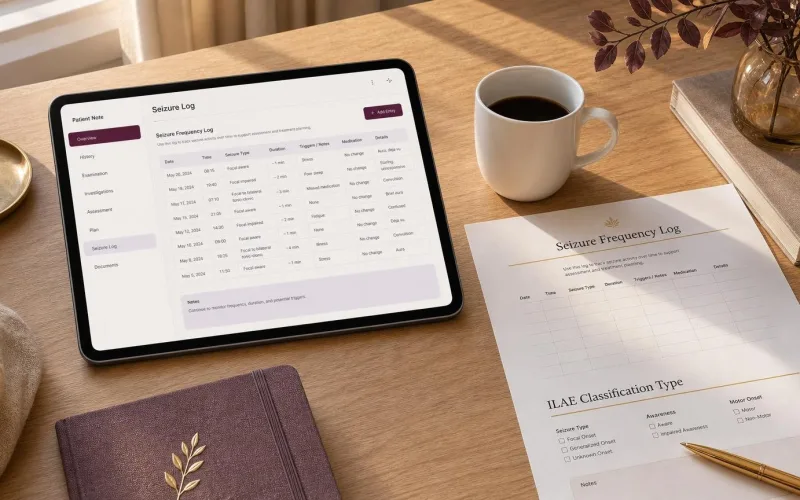
Carry monthly seizure frequency, seizure-free days, and rescue doses forward visit to visit. Find epilepsy prompt packs at Access Specialty Prompts at templates.scribing.io to draft notes in 5 seconds.
Specialty Clinical Playbook
Structure ILAE seizure counts, mg/kg dosing, and growth z-scores in the Plan. Book your audit at https://cal.com/merryai/demo.
 Dr. Sarah Chen, MD
Specialty Architecture
Engineered to mirror the pacing, ILAE diagnostic frameworks, and weight-based documentation requirements of Pediatric Neurology.
CLINICAL MEMORY
Carry monthly seizure frequency, seizure-free days, and rescue doses forward visit to visit. Find epilepsy prompt packs at Access Specialty Prompts at templates.scribing.io to draft notes in 5 seconds.
CONTEXT RETRIEVAL
Surface mg/kg/day antiseizure doses beside weight and head circumference z-scores without tab bouncing.
COMPLEXITY CAPTURE
Tie G2211 longitudinal complexity language to discrete seizure, dosing, and growth data. Schedule a 15-Minute Specialty Workflow Audit today.
SPEAKER ROUTING
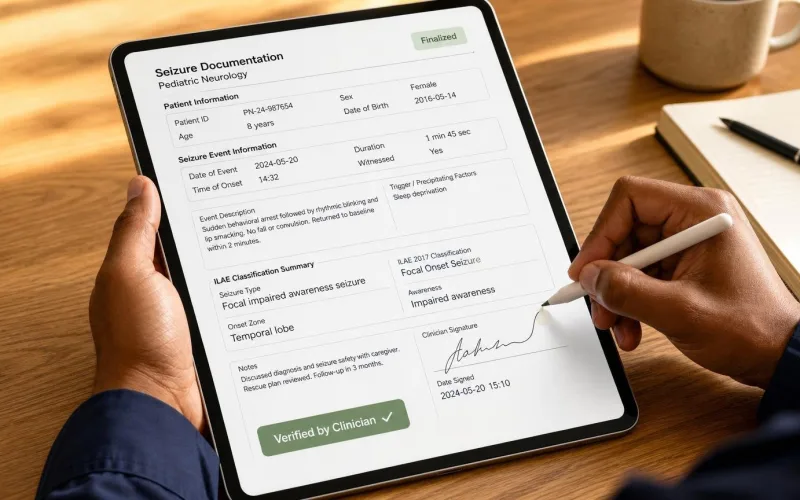
Separate parent, grandparent, child, and clinician voices, then map observable seizure features into ILAE-aligned note sections.
Point-of-Care Flow
Zero IT friction, zero complex API setup, and human-verified attestation on every note.

A pediatric epilepsy visit rarely unfolds in a straight line. A parent recounts the cluster at daycare, a grandparent remembers the nighttime stiffening differently, and the child may describe the aura. Merry listens to the full conversation and attributes each statement to its speaker, so caregiver observation and patient report remain distinct in the chart.
The documentation burden is specific. Seizure frequency, seizure-free days, rescue medication use, antiseizure medication dose in mg/kg/day, and weight and head circumference z-scores all change between visits. When those values live only in narrative prose, the longitudinal picture fades. So does the evidence that the condition is being actively managed over time.
The 2025 ILAE revision retains the focal, generalized, and unknown structure of 2017 while reducing the list from 63 seizure types to 21. 'Awareness' becomes 'consciousness,' defined by both awareness and responsiveness. 'Motor' becomes 'observable,' which matters for non-verbal children whose seizures are described entirely by what a caregiver witnessed. Epileptic negative myoclonus is now recognized as its own type.
Merry drafts the seizure description in chronologic sequence, as the revision recommends. A typical line reads: focal seizure with impaired consciousness, observable tonic posturing of the right arm followed by head version, under two minutes. Epilepsy type, syndrome, and age-at-onset category follow. The peer-reviewed work on implementing this taxonomy in medical software, indexed at https://www.ncbi.nlm.nih.gov/pmc/, informs how these pick-lists stay small and unambiguous.
Priority one is the Plan. Every pediatric neurology note Merry drafts places four elements where coders and auditors look first: monthly seizure count by ILAE type, current antiseizure doses in mg/kg/day, weight and head circumference z-scores with trend direction, and a closing sentence describing longitudinal management.
A representative Plan block reads: 'Seizure activity: 4 focal impaired-consciousness seizures and 2 generalized tonic-clonic seizures in the past 30 days; 23 seizure-free days. Antiseizure dosing: levetiracetam 60 mg/kg/day, clobazam 0.5 mg/kg/day, intranasal midazolam PRN. Growth: weight z-score −1.2, head circumference z-score +0.3, stable versus prior visit.' The clinician edits freely; the structure holds.
Children outgrow their doses quietly. A stable levetiracetam prescription can drift toward subtherapeutic over six months of growth. Merry recalculates mg/kg from total daily dose and the most recent weight, then places that figure beside the z-score. The clinician can see whether breakthrough seizures reflect dilution, adherence, or progression, and whether valproate or topiramate is affecting weight.
| Specialty Diagnostic Metric | Required Clinical Data Points | Billing Evidence |
|---|---|---|
| Monthly seizure frequency | Count per ILAE type, seizure-free days, rescue doses | Ongoing disease activity supporting G2211 |
| ILAE 2025 seizure type | Consciousness, observable features, semiology sequence | Specificity for ICD-10-CM G40 coding |
| ASM dose in mg/kg/day | Total daily dose, current weight, titration date | Prescription drug management in MDM |
| Growth z-scores | Weight, head circumference, CDC/WHO reference | Medication side-effect monitoring over time |
| Care coordination | EEG, neuropsychology, school IEP, rescue plan | Longitudinal complexity narrative |
HCPCS G2211 describes complexity inherent to prolonged longitudinal care of a single serious or complex condition. Chronic epilepsy requiring repeated weight-based titration and growth monitoring fits that description, but only when the note shows it. Merry builds the G2211 sentence from the structured values above, so the claim and its evidence sit together.
Modifier 25 deserves careful handling. CMS generally does not pay G2211 when the base E/M carries modifier 25, except alongside the annual wellness visit, vaccine administration, or Part B preventive services. When a visit includes vagus nerve stimulator programming with full epilepsy management, Merry separates procedure-related assessment from complex epilepsy management under distinct headings. Modifier 59 decisions stay with the billing team.
Recording a minor's visit carries additional obligations. Merry captures caregiver consent as a discrete line in the note and audit trail, and supports opt-out flags. Practices in California and Texas should confirm local requirements with compliance counsel before deployment.
Priority seven is setup simplicity. Pin the Merry Chrome Extension, open the web EHR encounter, and map the Plan field once. The extension recognizes a textarea, editable division, or embedded frame, and scopes every insertion to the active encounter to avoid cross-chart contamination.
After the visit, review deliberately. The draft appears with speaker labels, ILAE classification, and the mg/kg and z-score grid. Confirm, adjust, and attest. A single click delivers the text into the mapped Plan field.
Specialty prompt packs for epilepsy clinic, new-onset seizure evaluation, and infantile spasms follow-up are available at https://templates.scribing.io. Audio is processed in memory and discarded after each session under an executed Business Associate Agreement.
The goal is unhurried attention. When the seizure log assembles itself accurately, the clinician can look at the child rather than the screen, and the family leaves knowing they were heard.

Seizure counts, mg/kg dosing, and EEG dates structured into every plan. Book your audit at https://cal.com/merryai/demo.

Separate BPH E/M work from cystoscopy and track IPSS, PVR, and PSA velocity per year. Book your audit at https://cal.com/merryai/demo.

Structure tissue stages, sub-millimeter margin clearing, defect reconstruction, and distinct procedural defense.