CLINICAL MEMORY
Longitudinal Milestone Memory
Find 40+ prompt packs at templates.scribing.io to generate Bright Futures notes in 5 seconds and surface unresolved developmental concerns.
Specialty Clinical Playbook
Ambient documentation that separates caregiver history from child self-report and auto-tracks Bright Futures milestones. Book your audit at https://cal.com/merryai/demo.
 Dr. Sarah Chen MD
Specialty Architecture
Engineered to mirror the pacing, diagnostic frameworks, and documentation requirements of Pediatrics.
CLINICAL MEMORY
Find 40+ prompt packs at templates.scribing.io to generate Bright Futures notes in 5 seconds and surface unresolved developmental concerns.

CONTEXT RETRIEVAL
Retrieve prior milestone trajectories, CDC/WHO growth curves, and ASQ-3/M-CHAT-R trends in one structured draft without tab bouncing.
WORKFLOW INTELLIGENCE
Capture longitudinal complexity add-on revenue and auto-draft care plans. Claim your 15-Minute Workflow Audit today.
SPECIALTY-AWARE REASONING
Diarize parent, child, and clinician dialogue and map findings into PR/CD/CO-tagged specialty note sections.
Point-of-Care Flow
Zero IT friction, zero complex API setup, and human-verified attestation on every note.

Clinical documentation in Pediatrics is fundamentally a multi-stream problem that most general-purpose scribes fail to solve. A single well-child encounter contains at least three distinct information sources: a caregiver acting as historian, a child who may or may not self-report, and a clinician generating direct observations. The American Academy of Pediatrics and Bright Futures frameworks demand that developmental surveillance be documented as a longitudinal process, not a single-visit snapshot, which means the architecture must preserve provenance across years of encounters.
Merry AI was engineered specifically to route these three streams into the correct note sections without conflation. Parent statements are tagged PR (parent-reported) and land in the developmental history, HPI, and social context sections. Child utterances are tagged CD and route to subjective symptoms where age-appropriate. Clinician findings are tagged CO and populate the objective exam, developmental observations, and assessment. This separation is not cosmetic; it directly supports the medico-legal and coding distinction between secondhand history and direct examination.
| Diagnostic Framework | Required Clinical Data Points | Billing Evidence |
|---|---|---|
| Bright Futures Surveillance | Parent concerns, developmental history, direct observation, risk/protective factors | Preventive visit + G2211 continuity |
| CDC/WHO Percentiles | Weight, length/height, head circumference, BMI trajectory | Growth-tracking medical necessity |
| ASQ-3 | Domain scores (communication, gross/fine motor, problem-solving, personal-social) | 96110 developmental screening |
| M-CHAT-R/F | Autism-specific screen at 18 & 24 months, follow-up interview scoring | 96110 + referral documentation |
| Parent-Child Interaction | Eye contact, responsiveness, co-regulation, attachment observations | MDM complexity for E/M level |
The table above operationalizes what Bright Futures describes narratively. Each framework demands specific data points, and each data point functions as billing evidence when captured with correct attribution. Merry AI auto-populates age-appropriate milestone expectations into the template so clinicians confirm typical development in seconds or mark structured exceptions.
Speaker attribution is the anchor truth of pediatric documentation. A parent describing sleep regression is caregiver history; a clinician observing a child's spontaneous two-word phrases is a direct exam finding. When a scribe collapses these into a single narrative, the note becomes coding-indefensible and clinically ambiguous.
Our diarization engine distinguishes clinician, parent, and child without being told which voice is which. It infers roles acoustically and by conversational pattern, then applies consistent mapping rules. Parent narrative maps to developmental history and social context. Child narrative maps to subjective symptoms and psychosocial history for older children and adolescents. Clinician speech maps to exam, assessment, and plan.
Caregiver-reported history must remain distinct from clinician findings so that the note reflects who observed what. Merry AI verifies that parent statements land as caregiver history, not as clinician observations, which is exactly the failure mode the AAP surveillance framework warns against. This is critical when a parent's stated concern conflicts with the clinician's observed child behavior, a discordance that itself carries diagnostic weight.
Adolescent encounters introduce confidentiality logic that pediatric practices must handle carefully. When a child self-report becomes the primary historian, Merry AI routes sensitive psychosocial disclosures to appropriately access-controlled sections. Combined with zero-retention RAM shredding, this protects the confidential space adolescents require while preserving the structured documentation the encounter demands.
Developmental surveillance is inherently longitudinal, and the AAP mandates that clinicians obtain, document, and maintain a developmental history across every well-child visit rather than treating each encounter in isolation. Merry AI maintains a structured developmental table linking age, date, milestone status by domain, screens performed, results, and planned actions.
This longitudinal record enables rapid detection of plateau or regression, which is often the earliest signal of an emerging concern. Standardized screens layer onto ongoing surveillance at guideline-specified intervals: global developmental screens at 9, 18, and 30 months, autism-specific screens at 18 and 24 months, and maternal depression screens at the 1, 2, 4, and 6 month infant visits per peer-reviewed guidance indexed at https://www.ncbi.nlm.nih.gov/pmc/.
Age-triggered content reduces documentation burden for the large majority of children developing typically. The system surfaces the M-CHAT-R at the 18-month visit, the appropriate ASQ-3 interval automatically, and pulls normative CDC/WHO percentile data into the growth section. Clinicians confirm or mark exceptions rather than building each note from scratch.
Pediatric documentation intersects directly with reimbursement through the clean separation of history, exam, and assessment. Accurate attribution supports correct E/M level selection under the 1995 and 1997 documentation guidelines and the current Medical Decision Making framework. Documented standardized screening results support billing for CPT 96110 developmental screening services.
The HCPCS add-on code G2211 rewards the longitudinal continuity that defines pediatric primary care, since it applies to visits serving as the continuing focal point for a patient's needed health care. Merry AI's longitudinal memory generates precisely the continuity evidence CMS expects. Critically, the system flags Modifier 25 conflicts because CMS edits prevent G2211 payment when the associated O/O E/M visit (99202-99215) is reported with Modifier 25, protecting practices from predictable claim denials.
Beyond coding, documentation must demonstrate adherence to the six AAP surveillance components: eliciting parent concerns, maintaining developmental history, making informed observations, identifying risk and protective factors, recording the process and findings, and sharing opinions with other professionals. Merry AI prompts clinicians for any missing component and records specific planned actions such as early follow-up, repeat screens, and early-intervention referrals with structured coordination notes.
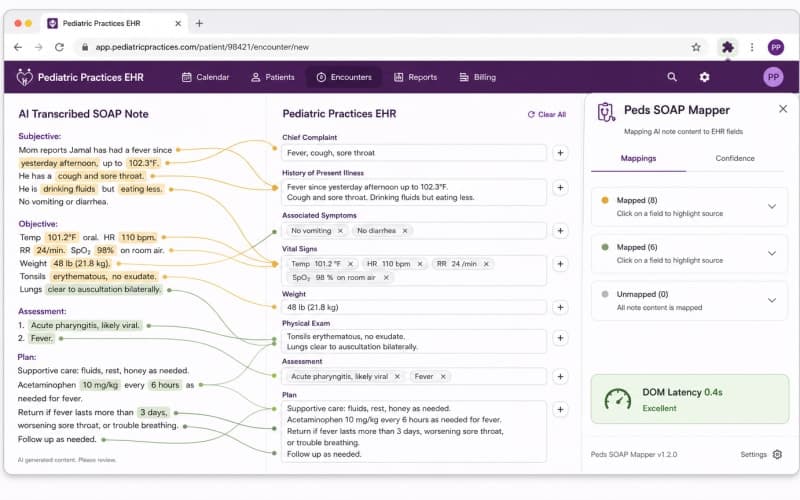
Pediatric EHRs are frequently closed-garden systems and immunization registries that resist traditional HL7 or FHIR integration. Our Chrome Extension sidesteps this entirely by running inside the clinician's existing browser window and injecting finalized notes via DOM insertion with a single click, requiring no IT project and no vendor certification cycle.
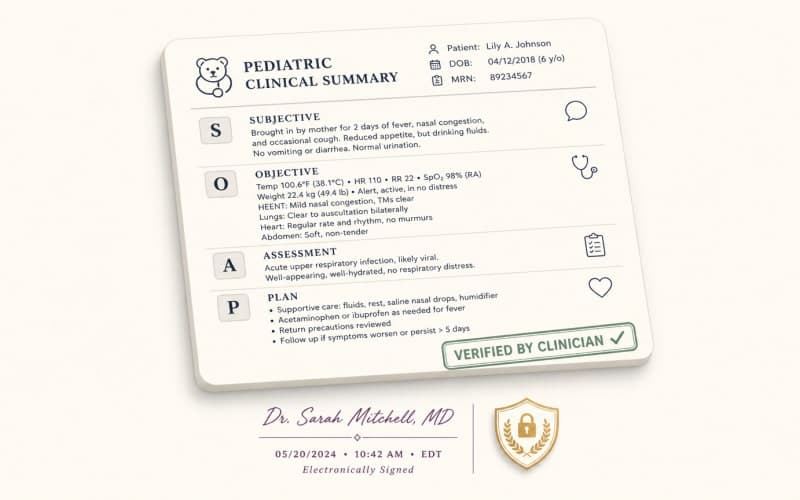
Every note passes through human-verified attestation before it reaches the chart, ensuring the clinician confirms milestone findings, screening results, and speaker attribution. To explore how this fits your practice, Access Specialty Prompts at templates.scribing.io or Schedule a 15-Minute Specialty Workflow Audit to see multi-speaker developmental documentation running against your own well-child workflow.