A Documentation Workflow Built for Behave Health EMR
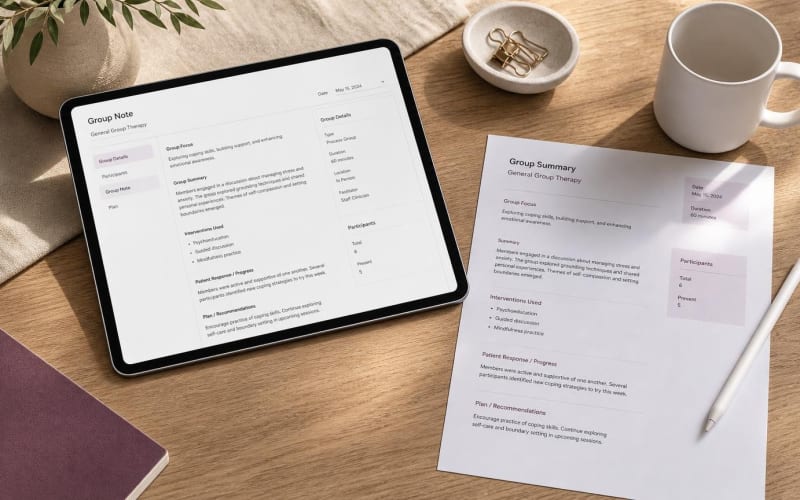
Clinical documentation inside Behave Health EMR rarely fails because clinicians lack dedication—it fails because a single three-hour PHP or IOP group generates ten or more individualized notes that must each link back to a distinct treatment plan. Behave Health is purpose-built for substance use disorder care across detox, residential, PHP, IOP, and outpatient tracks, and it correctly demands that group therapy documentation include individual participation tracking rather than a shared attendance stub. The bottleneck is not the software; it is the human hours required to translate one shared conversation into ten defensible, goal-linked records.
Merry AI addresses this bottleneck by treating the group session as a single acoustic source and the chart as ten separate destinations. Using acoustic speaker voiceprinting, the platform attributes each utterance to an enrolled participant, then drafts an individualized progress note for each patient that documents their specific interventions, response, and plan. Those drafts are then injected directly into the correct Behave Health chart fields through the browser—no marketplace listing, no API keys, no waiting on a vendor security review.
Because addiction recovery records carry the dual weight of HIPAA and 42 CFR Part 2, the workflow is engineered so that the clinician remains the author of record at every step. Merry AI generates a draft; you review, correct, and sign. This positioning as an assistive documentation engine rather than an autonomous author is exactly what Joint Commission surveyors and payer auditors expect to see when they examine a software evidence trail.
Why DOM Injection Beats Marketplace API Integration
Most integration vendors chase the FHIR marketplace path, and for a closed clinical platform like Behave Health that path is often a dead end for real-time note authorship. Behave Health does not publish an open write endpoint that lets a third party silently author signed progress notes on a clinician's behalf, and even where limited read APIs exist, they introduce token management, listing fees, security-review queues, and polling latency measured in seconds. For a facility that simply wants notes to appear in the right field, that overhead is disproportionate.
Merry AI takes the opposite architectural stance. Our Chrome Extension operates inside the clinician's already-authenticated browser session and interacts with the rendered DOM of the active Behave Health note form. It locates the intervention textarea, the response block, the plan field, and the treatment-goal linkage controls by their input selectors, then writes the generated draft into those elements as though the clinician typed it. The EMR sees ordinary keyboard input from an authenticated user, so no privileged backend access is ever required.
The Zero-Install Security Boundary
The extension requests only activeTab and scripting permissions, which scope its reach to the single tab you are actively viewing. It cannot read your other tabs, cannot run in the background, and cannot reach Behave Health servers directly. This narrow permission model is what allows a solo clinician or a PHP program to pilot Merry AI without an IT ticket, a firewall change, or a formal vendor onboarding cycle.
Latency and the Clinical Moment
Sub-second field mapping matters because documentation quality decays the longer it is deferred. Merry AI streams audio processing at roughly 0.4 seconds of latency and maps the resulting structured note into DOM fields immediately after the session, while clinical memory is intact. Deferred API batch writes, by contrast, often surface hours later when the clinician has already moved to the next group.
Integration Architecture Comparison
The table below contrasts three documentation delivery models against the operational realities of a PHP/IOP program. The comparison isolates deployment overhead, the delay between speech and chart, and the recurring cost structure that a facility must budget for.
| Architecture | Deployment Overhead | Latency | Annual Fee |
|---|---|---|---|
| Traditional API Marketplace Integration | Vendor security review, OAuth setup, listing approval, IT provisioning | Seconds to hours (polling/batch) | Per-seat marketplace + API metering fees |
| Manual Copy-Paste | None technical, but heavy clinician cognitive load | Minutes to hours per note | No license fee, high labor cost |
| Merry AI DOM Injection | Single-click Chrome Extension, no IT ticket | ~0.4s streaming to field | Flat practice-partner plan, no API metering |
What the comparison reveals is that the marketplace path optimizes for enterprise governance at the expense of speed, while manual copy-paste optimizes for zero setup at the expense of clinician time. DOM injection is the only model that eliminates both the deployment tax and the labor tax, which is why it fits the high-volume, ten-notes-per-group reality of addiction recovery programs.
Maintaining Joint Commission and 42 CFR Part 2 Integrity
Individualized documentation is the non-negotiable Joint Commission requirement for PHP/IOP group therapy: a group note alone is insufficient, and each patient must have an entry demonstrating how the session related to their treatment plan and their response. Merry AI is built directly around this rule. Each voiceprint-attributed draft opens with correct patient identification, session metadata including the three-hour block duration and modality, the specific goals addressed, the interventions delivered, the patient's documented response, any safety or craving flags, and a forward plan.
Substance use disorder records demand an additional layer of protection under 42 CFR Part 2, which restricts disclosure of identifying SUD treatment information. Because voice data and transcripts are themselves potentially identifying PHI, Merry AI processes all audio transiently under an executed Business Associate Agreement and retains nothing after the draft is written. Research on integrating SUD treatment information into electronic health records, catalogued at the National Library of Medicine, underscores why this consent-and-segregation discipline is essential for safety-net and accredited programs alike.
CPT G2211 and Longitudinal Complexity
Longitudinal outpatient addiction care is precisely the clinical scenario the CMS visit-complexity add-on code G2211 was designed to capture, since it applies when a clinician serves as the continuing focal point for a patient's ongoing serious or complex condition. Merry AI's templates prompt for the continuity language that substantiates G2211 alongside the base office/outpatient E/M code, helping programs document the inherent complexity of sustained recovery management without inflating the note artificially.
The Software Evidence Trail
Surveyors increasingly ask how AI-generated notes are validated, edited, and signed. Merry AI's workflow produces a visible trail: a draft is generated, the clinician reviews and edits it, and the clinician applies their signature and credentials before the note is committed in Behave Health. That sequence preserves version history and demonstrates human oversight, satisfying the continuous-compliance evidence expectations Behave Health and Joint Commission both emphasize.
Deploying Merry AI Across Your PHP/IOP Program
Rolling Merry AI into a program begins with template selection rather than a technical build. Clinicians Access 1,000+ EHR Clinical Templates covering ASAM level-of-care justifications, DAP and BIRP group notes, relapse-prevention structures, and medical-necessity narratives, each mapped to the field order Behave Health expects. From there the Chrome Extension is installed at the individual workstation and is immediately operational inside the authenticated EMR tab.
Because the model scales per clinician rather than per server integration, a facility can begin with one pilot group, validate the voiceprint attribution accuracy and note quality, and expand across the program without renegotiating a vendor contract each time. The recommended first step is a structured review of your existing documentation flow so we can map your specific Behave Health note templates to the injection selectors. You can Schedule a 15-Minute Workflow Audit to walk through your group roster structure and template requirements.
For programs ready to standardize documentation across every PHP and IOP track, the practice-partner plans consolidate template access, the Chrome Extension, and BAA coverage under a single flat structure with no API metering. Review the options and Explore Merry AI Practice Partner Plans to align deployment with your program's volume and accreditation timeline.