A Documentation Workflow Built for TheraNest
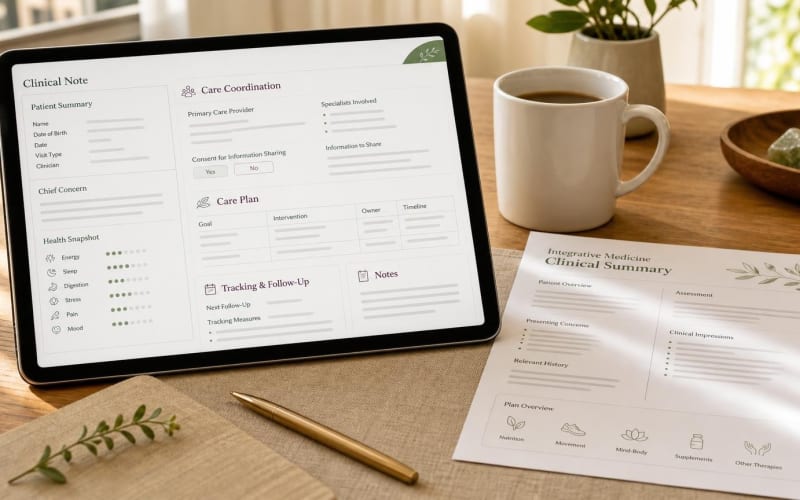
Clinical documentation inside TheraNest follows a predictable path. The clinician opens the Agenda, selects the appointment, clicks Add Progress Note, chooses a Standard, SOAP, or custom template, and types into labeled boxes. The friction is not the path itself. It is the forty minutes after a group session spent reconstructing what each member said, how each member responded, and whether each member moved toward a treatment plan goal.
Merry AI operates as a browser-native Chrome Extension layered on top of that existing charting view. It does not claim native FHIR write access, does not require a marketplace listing, and does not route notes through a vendor API queue. It reads the open Progress Note form in the clinician's own authenticated session and writes the drafted narrative into the same fields the clinician would otherwise type into. TheraNest remains the system of record. Merry AI is an external, clinician-controlled drafting layer that integrates with TheraNest but does not alter its core architecture.
TheraNest's native AI Session Assistant drafts a SOAP note into a dedicated AI field for a session. Merry AI focuses on the workflow where one recording must become several individualized charts, and where audio retention posture matters most.
Field Mapping in the Progress Note Editor
The TheraNest progress note editor exposes stable, human-readable anchors: Mental Status, Session Focus, Therapeutic Intervention, and Planned Intervention, alongside the service date and Appointment dropdown. Merry AI discovers each target by its visible label and surrounding section context rather than hard-coded selectors, which keeps injection resilient when practices customize template layouts. Before any write, the extension confirms that the client name and appointment shown in the note header match the draft it holds.
Injection completes in under 500ms per field because no network round trip to an EHR API is involved. Text lands in each input as editable content, never as a submitted, locked, or signed entry.
Group Sessions: One Recording, Individualized Charts
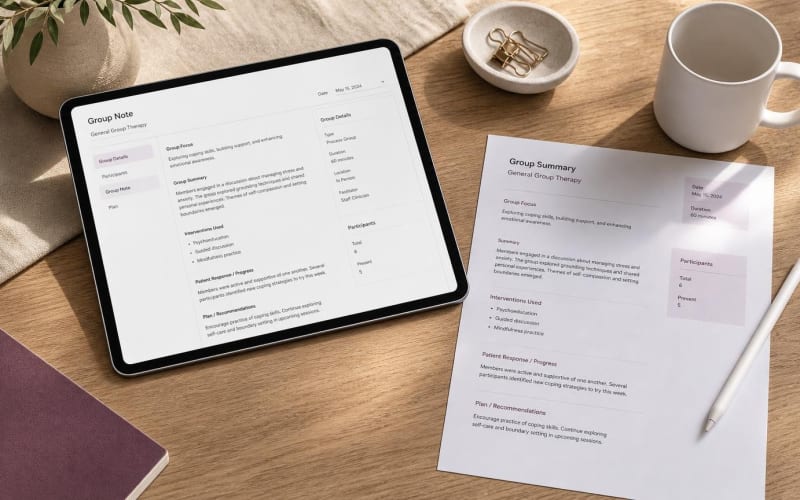
A single group recording is diarized into speaker segments, and the clinician confirms the speaker-to-member mapping before any drafting begins. Merry AI then produces a separate draft for each member describing that individual's participation, contributions, observed affect, response to the intervention, and progress against their own treatment plan goals. The shared group theme appears only as brief context. Group narrative is never cloned across notes, because identical text across charts is both a clinical inaccuracy and a recognized audit red flag.
Sequential Tab Injection Protocol
The clinician opens each TheraNest client note tab in sequence. As each Progress Note form loads, the extension reads the header context, matches it to the corresponding member draft, and injects only that member's note. If the header does not match a confirmed member, nothing is written. This one-tab, one-member rule prevents cross-chart contamination, the primary failure mode of generic web automation applied to group workflows.
Documentation Integrity and Reimbursement Evidence
TheraNest ships DSM-5-ready individual and group templates with diagnostic codes available for pre-selection. Merry AI respects that boundary. It drafts descriptive symptom and behavior language aligned to the clinician-selected diagnosis but never auto-selects DSM-5-TR or ICD-10-CM codes. Clinicians verifying code specificity can reference https://www.cms.gov/medicare/coding-billing/icd-10-codes. Each draft ties interventions and client response to functional impairment and treatment goals, supporting the medical necessity standard that TheraNest training materials emphasize.
For psychiatric prescribers billing E/M, HCPCS G2211 is reportable only as an add-on to office/outpatient codes 99202-99205 and 99211-99215. Beginning January 1, 2026, it is also reportable with home or residence codes 99341, 99342, 99344, 99345, and 99347-99350. Merry AI structures the E/M assessment as a segment distinct from psychotherapy content and surfaces longitudinal elements such as medication adjustments, risk monitoring, and care coordination. That separation also supports Modifier 25 documentation where a separately identifiable service is claimed.
Psychotherapy Note Segregation
Sensitive process content stays separate. Under HIPAA, psychotherapy notes kept apart from the medical record receive heightened protection. Merry AI's behavioral health templates draft progress-note content only: session focus, interventions, client response, risk, and plan. Process observations, working hypotheses, and personal impressions are excluded from injected fields unless the clinician deliberately adds them. Specialty templates are available at https://templates.scribing.io.
Architecture Comparison and Security Posture
Three integration patterns exist for TheraNest practices. The table below compares them on the dimensions that matter most to a behavioral health group practice.
| Dimension | Traditional API Marketplace Integration | Manual Copy-Paste | Merry AI Chrome DOM Injection |
|---|---|---|---|
| TheraNest Write Path | Dependent on vendor partner programs; no native FHIR write assumed | Clinician keyboard | Authenticated browser session |
| Deployment Overhead | Vendor approval, IT configuration, contracts | None, but manual effort on every note | Extension install; no firewall changes |
| Latency | Sync-dependent, often delayed | Minutes per note | <500ms per field |
| Group Note Handling | Typically one visit, one note | Manual rewrite per member; cloning risk | Diarized per-member drafts, header-matched |
| Annual Fee | Marketplace and per-transaction fees | None | No marketplace fees |
| Audio Retention | Vendor-dependent | Not applicable | RAM-only, shredded after transcription |
Audio is held in volatile memory only for transcription and is shredded from RAM immediately after text is produced. No session audio is written to disk or retained in cloud storage, and logs capture only minimal metadata such as session time and provider identifier. Every group member must provide documented consent to recording and AI-assisted documentation before capture begins.
Every draft remains a draft until the clinician reviews, edits, and signs it inside TheraNest. The signature, the timestamp, and the locked record all belong to TheraNest's native workflow.