Browser-native DOM mapping bypasses EHR marketplace paywalls entirely
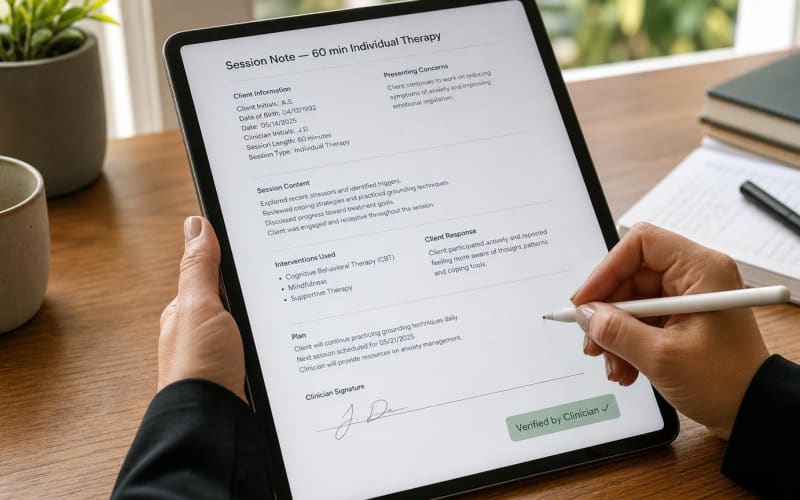
Clinical documentation inside TherapyNotes rarely fails because clinicians lack dedication. It fails because the note is written hours after the session, from memory, against a template that expects discrete mental status selections, objective-level progress ratings, and a defensible time record. Merry AI addresses that gap at the browser layer rather than the server layer.
The Merry Chrome Extension runs inside the clinician's active TherapyNotes tab. It reads the rendered progress note structure, identifies sections by their visible labels, and writes draft content into the same textareas, dropdowns, and checkboxes a clinician would fill by hand. No partner API, no marketplace listing, and no server-to-server data exchange are involved. TherapyNotes receives the content exactly as if the clinician had typed it.
Because every write happens client-side, the native audit trail stays intact. TherapyNotes still records the clinician as author, still links the note to the appointment, and still enforces its own signing workflow. The extension never signs, never submits, and never touches a note that is already locked.
The capture workflow starts inside the open progress note
The operating sequence is deliberately short. The clinician opens the TherapyNotes progress note from the To-Do list, Calendar, or the client Documents tab, activates the Merry extension, and starts capture. Opening the note first matters: it binds the capture session to one client and one appointment, so content cannot drift into the wrong chart when the clinician navigates between tabs.
Session start and stop times are recorded at the moment capture begins and ends. Those timestamps become the time statement in the draft note. This is the single most consequential field for psychotherapy billing, because CPT 90837 requires 53 or more minutes of face-to-face psychotherapy. A session that ends at 51 minutes supports 90834, not 90837, and payers audit that threshold heavily.
When capture stops, audio is processed in memory and discarded. Merry retains zero audio and zero transcript after the draft is produced. The signed TherapyNotes record becomes the sole artifact of the encounter, which reduces breach surface but places full weight on the clinician's review before signature.
Merry writes clinician narrative and leaves system fields alone
TherapyNotes progress notes separate system-controlled data from clinician-authored content. The header auto-populates clinician, client, appointment, insurance, and service code. The Diagnosis section pulls the DSM-5-TR code and description forward from the treatment plan or the most recent note. Merry does not overwrite either area.
Injection targets the sections where clinical judgment lives: the Current Mental Status exam (appearance, mood, affect, thought process, thought content, cognition, insight, judgment), symptoms and challenges since the last session, progress toward each treatment objective, therapeutic interventions, and plan narrative. Interventions are named by modality, such as CBT cognitive restructuring, DBT distress tolerance skills, motivational interviewing, or exposure hierarchy work, so the note reflects what was actually delivered.
Practices using the TherapyNotes template builder can reorder or rename components across SOAP, DAP, BIRP, Play Therapy, and the default TherapyNotes Progress Note. Merry resolves sections by label at runtime and supports per-practice field mapping, so a custom BIRP layout and a standard SOAP layout both receive content in the correct place. Prognosis radio buttons and prescribed frequency of treatment remain clinician decisions.
Three integration models carry different cost and risk profiles
The comparison below summarizes how behavioral health practices typically move draft documentation into TherapyNotes.
| Criterion | Traditional API Marketplace Integration | Manual Copy-Paste | Merry AI Chrome DOM Injection |
|---|---|---|---|
| IT approval required | Yes, vendor contracts and security review | No | No, installs as a browser extension |
| Recurring integration fees | Partner or per-seat API fees | None | None |
| Writes to structured MSE fields | Depends on exposed endpoints | No, clinician re-enters by hand | Yes, maps to native controls |
| Session time capture | Often missing or manual | Manual, prone to rounding | Recorded at capture start and stop |
| Overwrites diagnosis or header | Possible with broad write scopes | Possible through user error | No, system fields are excluded |
| Audio and transcript retention | Vendor dependent | Not applicable | Zero retention after draft |
| Clinician attestation | Native EHR signing | Native EHR signing | Native EHR signing, required |
Time documentation determines which psychotherapy code survives audit
Psychotherapy codes are time-based under CPT rules. 90832 covers 16 to 37 minutes, 90834 covers 38 to 52 minutes, and 90837 covers 53 minutes or more. The initial diagnostic evaluation, 90791, is not time-banded in the same way but still requires documentation of assessment content, history, mental status, and initial diagnostic impression. Interactive complexity, 90785, may be added when communication factors complicate delivery, and the note must describe those factors specifically.
Psychiatric prescribers using TherapyNotes' Psychiatry Progress Note often report an E/M code with a psychotherapy add-on: 90833, 90836, or 90838. The psychotherapy time must be documented separately from the time spent on E/M work, and the E/M level must be supported by medical decision making on its own. Merry drafts these as distinct sections so the separation is visible on the page. Merry never assigns codes or modifiers. That selection stays with the clinician.
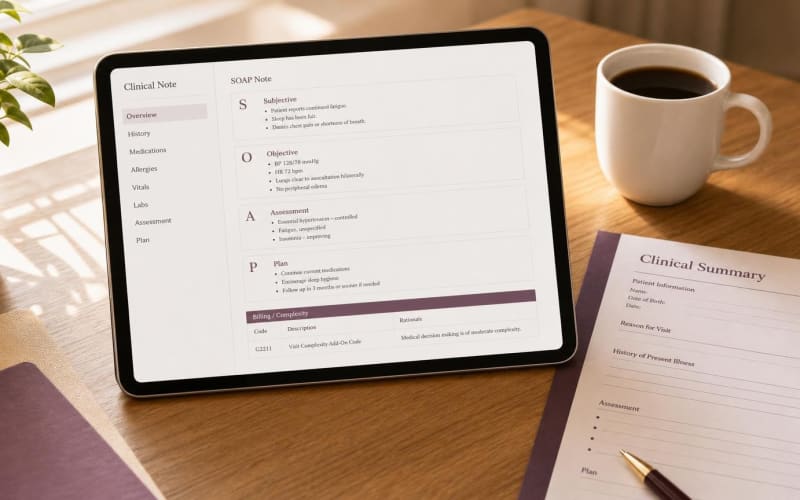
HCPCS G2211 applies only to office or outpatient E/M visits (99202 to 99215) and home or residence E/M visits, when the practitioner is the continuing focal point for care or manages a single serious or complex condition over time. It does not attach to standalone psychotherapy codes. CMS generally does not pay G2211 when the base E/M is billed with modifier 25, with limited exceptions for annual wellness visits, vaccine administration, and Medicare Part B preventive services. For psychiatric medication management, Merry surfaces longitudinal evidence (prior medication trials, ongoing titration, safety planning continuity) so the clinician can judge whether the complexity standard is met.
Psychotherapy notes stay segregated from the progress record
HIPAA defines psychotherapy notes at 45 CFR 164.501 as a clinician's separate process notes, kept apart from the medical record and given heightened protection. TherapyNotes provides a separate free-text Psychotherapy Note for that purpose. Merry writes billing-relevant clinical content to the progress note and does not route process material into it. Specialty templates are built to keep session summaries, mental status, and interventions in the progress note while leaving private process reflections out.
Clinicians can review specialty templates for SOAP, DAP, BIRP, couples, family, and group formats at Access 1,000+ EHR Clinical Templates. Each template maps to TherapyNotes components so the draft lands in the expected fields.
Every draft remains unsigned until the clinician attests
Cloned documentation is a recognized audit trigger. Notes that repeat identical mental status findings or interventions across visits invite payer scrutiny and weaken medical necessity. Merry builds each draft from the specific session, carries forward treatment objectives without copying prior narrative, and highlights injected content so the clinician can see exactly what to verify.
The clinician reviews every field, edits as needed, and signs inside TherapyNotes. That signature is the attestation that the record reflects the service rendered. Practices that want to evaluate fit against their own templates and payer mix can Schedule a 15-Minute Workflow Audit.