The Statutory Anchor: Why §934.03 Governs Every Exam-Room Microphone
Florida's Security of Communications Act, codified at Section 934.03, makes it unlawful to intercept any wire, oral, or electronic communication without the consent of all parties to that communication. This is an all-party consent regime, and it contains no healthcare carve-out. A conversation between a physician and patient in an examination room is a private oral communication carrying a clear reasonable expectation of privacy, which means the statute applies with full force to ambient documentation systems that acquire that audio.
Under the plain language of the statute, unauthorized interception of an oral communication is classified as a third-degree felony, and the companion civil provision at §934.10 exposes the offender to statutory damages of the greater of one hundred dollars per day or one thousand dollars, plus punitive damages and attorney's fees. For a multi-specialty group running dozens of concurrent encounters across internal medicine, pediatrics, orthopedics, and behavioral health, the aggregate liability of a misconfigured capture system is substantial and, unusually, carries individual criminal rather than merely administrative consequences. Interpretive literature on oral communication privacy expectations is indexed at the National Library of Medicine's open repository for teams building their statutory analysis.
Critically for ambient AI architecture, the felony is complete at the moment of interception, not at the moment of storage. A design that relies on deleting recordings after the fact offers no legal shelter, because the acquisition of the non-consented voice into a processing buffer is itself the prohibited act. This single doctrinal point reshapes how a compliant scribe must be engineered: the correct control is prevention of acquisition, not retention hygiene.
Identifying Every Party in a Multi-Specialty Encounter
Every person whose voice is audible to the capture device is a party whose consent the statute requires. In a multi-specialty setting this list is longer and more variable than most vendors assume. It includes the patient, accompanying spouses or partners, parents and legal guardians in pediatric visits, in-person and telephonic interpreters when audible in the room, medical students and residents who speak, home health aides, and any individual who enters mid-visit and is picked up by the microphone array.
Because room composition shifts moment by moment, the audio system cannot treat consent as a single pre-visit checkbox. A behavioral health session may require granular, session-type-specific opt-out, while a pediatric visit may involve multiple caregivers plus a sibling, and a teaching clinic introduces residents who become parties the instant they speak. The consent model must therefore be dynamic and per-party rather than per-encounter.
The Consent Ledger as a Live Compliance State
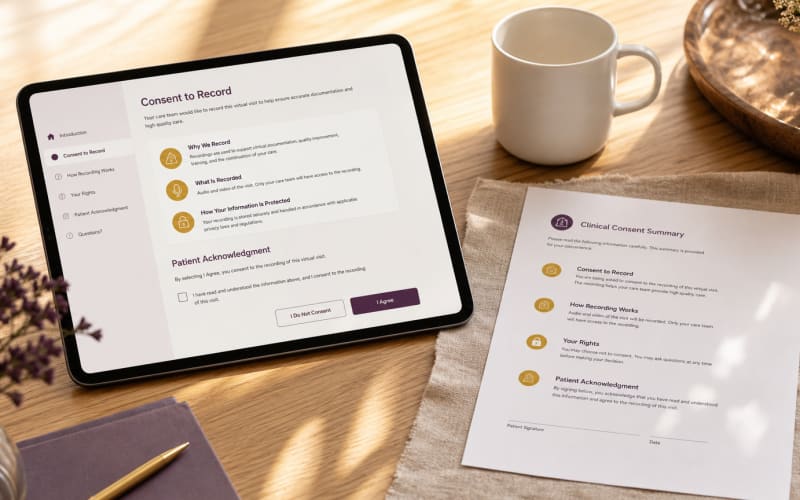
Merry AI maintains a per-encounter consent ledger that enumerates each expected party with an individual status flag: not eligible, pending consent, or compliant. The scribe engine holds the microphone-to-processing link logically severed until every required party shows green. When a consent is missing, the clinician interface surfaces the specific gap—for example, 'AI OFF: pending consent from Parent, Interpreter'—so staff resolve the deficiency before the visit proceeds rather than discovering it during a later audit.
Room-Entry Disclosure Scripting
At the start of each encounter a clinician or medical assistant performs an all-party disclosure step before the system goes live. The script identifies Merry AI as an ambient documentation tool that uses microphones, states that Florida law requires everyone in the room to consent before any recording, and clarifies that consent is voluntary and that care will not be affected by refusal. Practices should validate their specialty-specific scripts and consent prompts against the vetted Scribing Template Directory before go-live, because a poorly worded disclosure can invalidate an otherwise sound technical control.
Technical Controls: Proximity Arrays and Buffer Shredding
Proximity-aware microphone arrays are the primary compliance safeguard in a Florida deployment, not a comfort feature. The room is mapped into zones—provider, patient, and doorway—and multi-microphone beamforming focuses on the patient-provider axis while attenuating peripheral zones where family members and staff tend to stand. Real-time speaker diarization compares each detected voice against the consent ledger, and any unregistered speaker triggers an immediate compliance event.
When a non-consenting voice is detected, the system executes three actions in sequence within milliseconds: it pauses interception, it purges the pre-roll RAM buffer that may contain that voice, and it presents a re-consent workflow while audio remains disabled. Holding that buffer would itself violate §934.03, so the shred step is not optional cleanup—it is the mechanism that prevents the felony from occurring. Every transition is time-stamped in an immutable audit trail so the group can later demonstrate that no non-consented audio was ever acquired.
Data Minimization and HIPAA Alignment
Under HIPAA's technical safeguards at 45 C.F.R. §164.312, buffers carry strict sub-second lifetimes with immediate discard once processed, transcripts and any retained audio are encrypted at rest and in transit, and access is governed by role-based controls under the minimum-necessary standard. Each segment is tagged with speaker identifiers, timestamps, and consent status, so any fragment created without full consent is structurally incapable of entering the documentation pipeline.
Comparing Documentation Architectures
The following table contrasts the three dominant documentation approaches against the specific obligations that Florida §934.03 imposes on outpatient groups.
| Compliance Dimension | Manual Charting | Standard Generic AI Scribe | Merry AI Compliance Architecture |
|---|---|---|---|
| Interception risk under §934.03 | None; no audio acquired | High; rolling buffer acquires all audible voices | Controlled; capture gated until all-party consent confirmed |
| Non-consenting entrant handling | Not applicable | Continues buffering; entrant voice intercepted | Pauses, purges RAM buffer, triggers re-consent within milliseconds |
| Ephemeral buffer treatment | Not applicable | Retained transiently; still an interception | Sub-second lifetime with forced shred on any consent change |
| Per-party consent tracking | Paper form, often patient-only | Absent or single blanket toggle | Live ledger with named status for every audible party |
| Audit defensibility | Handwritten note only | Sparse or reconstructed logs | Time-stamped consent, pause, and attestation events |
| Clinician time cost | Highest; full manual entry | Low but legally exposed | Low with preserved statutory defensibility |
Governance, Attestation, and Billing Integrity
Because unauthorized interception is a felony, governance cannot be treated as an afterthought. Groups should adopt a formal ambient documentation policy that references both §934.03 and HIPAA, specifies which encounter types permit audio capture, and defines the handling of refusals and mid-visit composition changes. Clinicians and staff require training on the meaning of a party to a communication and on the correct use of the pause and gating features, since the statute is criminal law and not merely internal policy.
The attested note, not the AI transcript, remains the legal medical record. The signing clinician reviews the generated documentation, corrects inaccuracies, and attests that the content reflects services personally performed. When a group reports CPT add-on code G2211 for the complexity inherent to serving as the continuing focal point of a patient's care, the attestation must independently substantiate that longitudinal relationship, and any short consent-only audio segment must be excluded from billable E/M time so it does not distort time-based coding.
A defensible deployment ultimately produces a continuous chain of evidence: the disclosure script, the per-party consent ledger, the interception gate, any pause-and-shred events, and the final review-and-sign attestation. Groups preparing to operationalize these controls across multiple sites and specialties should Book a 15-Minute Workflow Audit so each room's microphone placement, consent scripting, and EHR integration can be validated against Florida's statutory requirements before the first live encounter.