How Ontario PHIPA governs AI scribes in family medicine
Ontario PHIPA section 17 permits a family physician, as health information custodian, to use an AI scribe vendor only as an agent acting within the custodian's authority. The custodian remains responsible for every collection, use, retention and disposal the agent performs. A vendor contract does not transfer accountability. The clinic remains answerable for whatever the vendor's architecture does with encounter audio, transcripts and drafts.
The core problem for Ontario custodians is proof. Most clinics cannot show a privacy assessor or the Information and Privacy Commissioner that their scribe vendor handles consent in a defined way and enforces a hard limit on audio retention. Encryption claims do not settle the agency question. Encryption describes how data is stored. It does not address whether the data should be stored at all.
What counts as a record of personal health information
In PHIPA Decision 286, the Commissioner treated written notes, interview scripts and audio or video recordings about a patient as personal health information, separate from the hospital's EMR chart. This matters directly for family medicine. An encounter recording that persists on a vendor server can become a second record of personal health information. That record sits outside the EMR and outside the custodian's routine access, correction and disposal processes.
How to prove your AI scribe vendor is a compliant PHIPA agent
A compliant PHIPA agent leaves a narrow, verifiable footprint: transient processing, no parallel chart and a single signed note in the custodian's EMR. The table below compares three documentation models against the statutory points an assessor will examine.
| Compliance Dimension | Manual Charting | Standard Generic AI Scribes | Merry AI Compliance Architecture |
|---|---|---|---|
| Encounter audio retention (s. 13) | No audio created | Retention may support quality review, note re-generation or training; varies by vendor | Processed in volatile memory, shredded from RAM at note completion, 0-day storage |
| Records outside the EMR (Decision 286) | None | Vendor workspaces may hold drafts or final notes | None; only the clinician-signed note persists |
| Agent accountability (s. 17) | No agent involved | Depends on contract and retention settings | Limited to ephemeral processing under custodian control |
| Consent evidence (s. 18) | Free-text entry, if any | Depends on vendor template | Verbal consent and custodian name recorded at the top of each note |
| Safeguards (s. 12) | Existing EMR controls | Vendor storage adds exposure | No persistent audio or transcript to protect |
| Clinician attestation | Clinician signs | Clinician signs | Clinician reviews and signs before anything persists |
Clinician attestation marks the boundary. Until the physician reviews and signs, nothing the scribe generates should exist as a durable record anywhere.
Consent capture at the start of every note
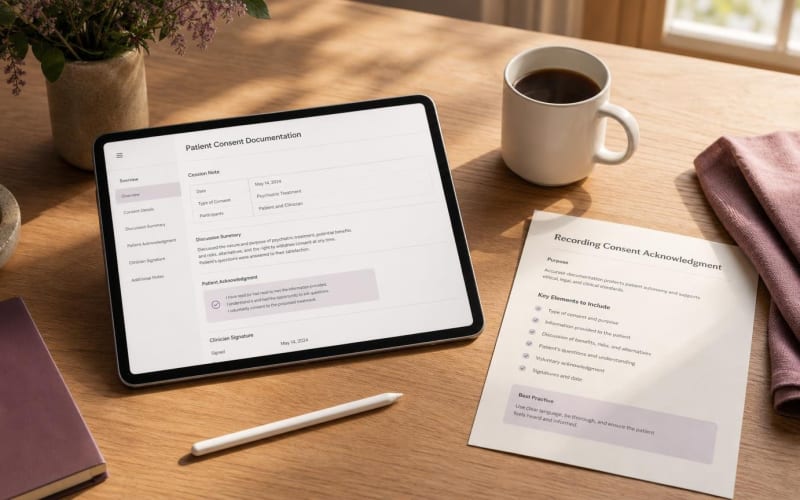
Record verbal patient consent and the custodian name in the first line of each note. Name the custodian as the physician or the family health team, whichever applies. This line gives contemporaneous evidence that consent was knowledgeable under section 18. Without it, the clinic relies only on assumed implied consent within the circle of care under section 20(2).
Enable the consent banner before the first encounter of the day. Turning on the banner in Merry AI settings puts the consent step ahead of audio processing. As a result, the consent line is not added as an afterthought at sign-off.
How zero-day audio storage supports PHIPA sections 12 and 13
Zero-day audio storage supports PHIPA sections 12 and 13 by removing the retained recording the custodian would otherwise have to protect, retain and securely dispose of. Section 12 requires reasonable steps against theft, loss and unauthorized use. Section 13 requires secure retention, transfer and disposal of records.
Here is the point most vendors leave unstated: an AI scribe that keeps encounter audio for even one day has created a second record of personal health information the custodian must answer for, while a scribe with 0-day storage leaves only the signed note to answer for.
Shredding encounter audio from RAM at note completion
Merry AI processes encounter audio in volatile memory only. At note completion, the audio is shredded from RAM, so no audio file or transcript persists. The only remaining artifact is the clinician-signed note, held in the EMR under custodian control. This design does not remove the custodian's obligations. It narrows them to the record the clinic already governs.
What a PHIPA privacy audit of your scribe workflow should check
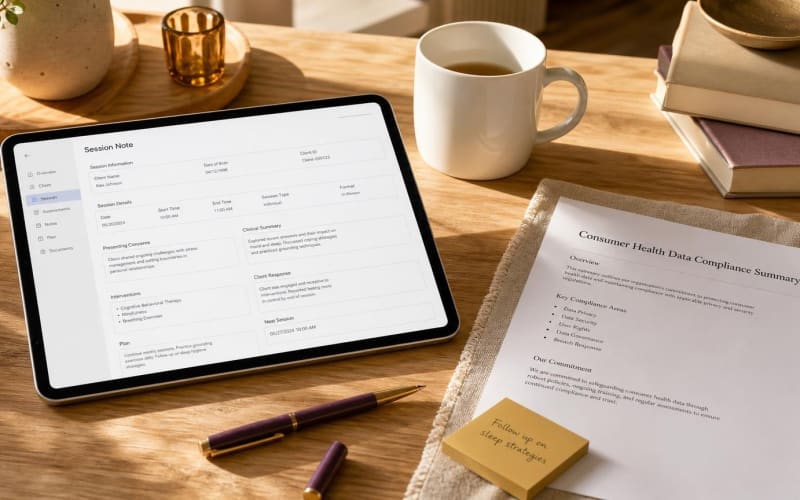
A PHIPA privacy audit should confirm four facts:
- Where audio exists, and for how long.
- Whether any note or transcript exists outside the EMR.
- How consent is captured.
- Who signs before anything persists.
Record each finding in your privacy impact assessment so the agent relationship can be demonstrated, not just asserted.
The Merry AI team estimates savings of about $4,800 per clinic per year. This figure is a modeled estimate, not a guaranteed result. It assumes the clinic avoids privacy assessment and breach remediation overhead that retained audio would otherwise create. Actual results depend on clinic size, existing controls and assessor scope.
For peer-reviewed context on Canadian primary care EMR use, search PubMed Central at https://www.ncbi.nlm.nih.gov/pmc/. To review your own consent and retention evidence with our team, Schedule a 15-Minute Workflow Audit.