CLINICAL MEMORY
Longitudinal Patient Memory
Find 40+ prompt packs at templates.scribing.io to generate ADIME drafts in seconds and surface unresolved referral and medical-necessity questions.
Specialty Clinical Playbook
Convert dietetic assessments into clinician-reviewed ADIME drafts with transparent G0270 unit logic. Book your audit at https://cal.com/merryai/demo.
 Dr. Sarah Chen, MD
Specialty Architecture
Engineered to mirror the pacing, diagnostic frameworks, and documentation requirements of Clinical Nutrition.
CLINICAL MEMORY
Find 40+ prompt packs at templates.scribing.io to generate ADIME drafts in seconds and surface unresolved referral and medical-necessity questions.
CONTEXT RETRIEVAL
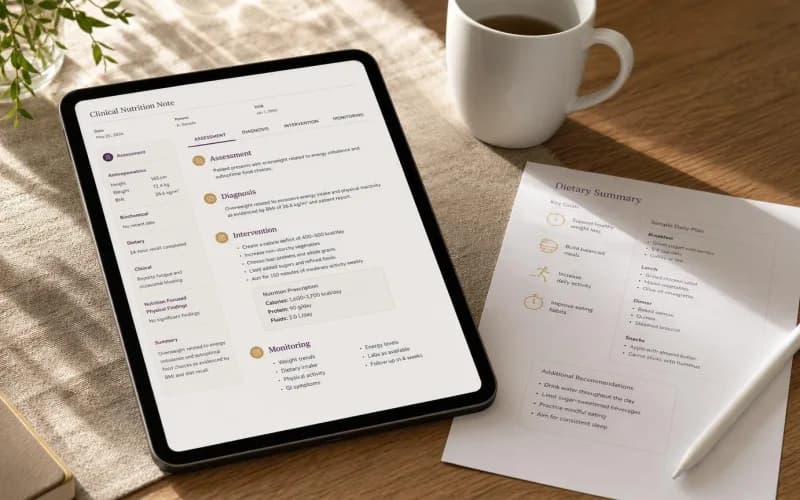
Retrieve prior weight trends, biochemical flowsheets, and cumulative MNT time in one structured draft without tab bouncing.
WORKFLOW INTELLIGENCE
Surface second-referral reassessment logic and transparent unit math with defensible medical-necessity evidence. Claim your 15-Minute Workflow Audit today.
SPECIALTY-AWARE REASONING
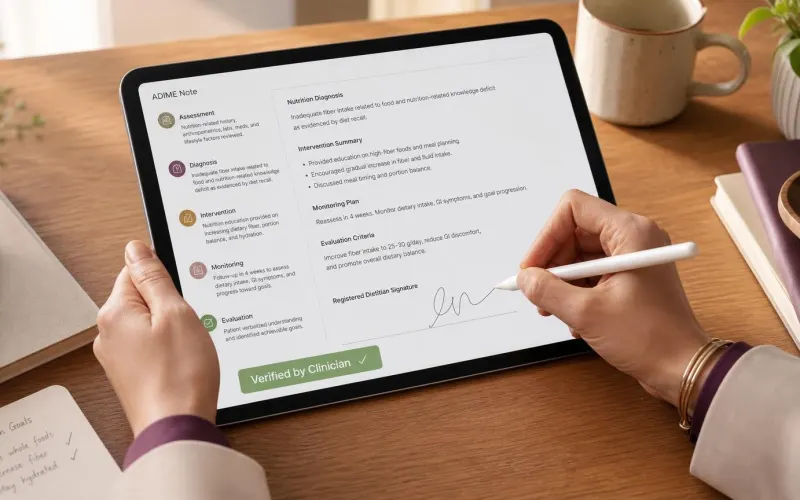
Diarize dietitian, patient, and caregiver dialogue and map findings directly into ADIME-approved note sections.
Point-of-Care Flow
Zero IT friction, zero complex API setup, and human-verified attestation on every note.

Clinical documentation in Clinical Nutrition demands a workflow that respects the Nutrition Care Process end to end, from referral and eligibility verification through assessment, nutrition diagnosis, intervention, and monitoring. Merry AI is built to preserve the dietetic narrative while simultaneously populating the structured fields required for quality reporting, payer audit, and billing defense. The ADIME format—Assessment, Diagnosis, Intervention, Monitoring and Evaluation—maps directly onto this process, which is why it anchors every note the system drafts.
Registered dietitians juggle multiple data streams that no single narrative box can hold cleanly: anthropometrics, biochemical trends, dietary intake records, behavioral readiness, and payer-specific referral requirements. The architecture separates extracted facts stated by the patient or chart, clinician-entered facts supplied manually, AI-generated draft suggestions, and the final signed legal record. Nothing generated is silently inserted; every candidate statement is editable, traceable to its source segment, and visibly marked as a draft until a qualified clinician reviews it.
Peer-reviewed integration research confirms this discipline. Work published through the National Library of Medicine's PMC archive on integrating a dietetic care process into a health information system demonstrates that structured NCP fields must coexist with narrative clinical reasoning rather than replace it. Merry AI honors that finding by keeping the PES statement and monitoring indicators as discrete, queryable data while the surrounding assessment remains a readable story.
The following matrix demonstrates how each dietetic framework element ties documented clinical data points to the billing evidence a payer auditor expects to find. This mapping is what separates a plausible note from a defensible one.
| Nutrition Care Framework | Required Clinical Data Points | Billing Evidence |
|---|---|---|
| Nutrition Assessment (ADIME 'A') | Weight, BMI, weight history, lab trends, usual intake, allergies, medications, readiness to change, source and date of data | Medical necessity basis, referral date, encounter type (initial vs reassessment) |
| Nutrition Diagnosis (PES) | Problem, Etiology, Signs/Symptoms supported by assessment findings, not a repeat of the medical diagnosis | Diagnosis-to-service linkage, distinct nutrition problem justifying dietitian intervention |
| Intervention (ADIME 'I') | Individualized education, counseling, meal planning, behavior-change strategy, care-team coordination, measurable goals | Face-to-face service confirmation, individual vs group classification, delivered content |
| Monitoring & Evaluation (ADIME 'M/E') | Weight trend, glucose readings, oral intake, lab values, adherence, follow-up interval | Reassessment rationale, change in diagnosis/condition/regimen for G0270 eligibility |
| Billing Closeout | Start time, stop time, total billable clinical minutes, cumulative visit number, provider credentials | HCPCS/CPT code, 15-minute unit calculation, second-referral evidence, payer rules |
This matrix is enforced at draft time. When the change-in-condition element required for G0270 is absent, the system prompts the dietitian rather than fabricating a rationale, preventing both false-positive and false-negative code recommendations.
HCPCS G0270 is frequently misapplied because clinicians treat any follow-up as billable under the code. In fact, G0270 covers medical nutrition therapy reassessment and subsequent intervention only after a second referral within the same calendar year for a documented change in diagnosis, medical condition, or treatment regimen, delivered as an individual face-to-face encounter in 15-minute increments.
Merry AI refuses to assign G0270 merely because a visit is labeled 'follow-up.' The system requires the distinguishing elements before it will surface the code as a candidate: evidence of a second referral where required, an explicit change in diagnosis or regimen, individual rather than group service, and documented start and stop times. The unit math is displayed transparently as documented billable minutes divided by fifteen, and the platform never infers units from scheduled appointment duration alone.
Accurate time capture requires distinguishing total encounter duration from clinical service time, nonbillable administrative time, time attributable to other providers, and time spent on coding itself. A scheduled sixty-minute slot is not automatically sixty billable MNT minutes. Merry AI segments these categories and shows the calculation for clinician confirmation, which is precisely the transparency a Medicare administrative contractor audit demands.
Code tables carry effective dates and are version-controlled so that a code valid at the time of service remains identifiable after later table updates. This matters because CMS revises the Physician Fee Schedule annually, and reassessments occurring near a coding transition must reference the rules in force on the date of service, not the date of chart review.
Configurable ADIME templates adapt across subspecialties—diabetes, renal nutrition, oncology, pediatric, critical care, bariatric, and enteral or parenteral nutrition—without altering the underlying legal record structure. A renal template surfaces additional dialysis-related hours and phosphorus trends, while a bariatric template emphasizes staged post-operative intake progression, yet both resolve to the same auditable ADIME skeleton.
Parenteral nutrition workflows benefit particularly from structured integration. A narrative review in the Journal of Parenteral and Enteral Nutrition, indexed through the PMC archive, documents how linking electronic health records with compounding data reduces transcription error—an argument for keeping structured nutrition-support fields discrete rather than buried in free text. Merry AI mirrors this by capturing macronutrient targets and laboratory triggers as queryable observations.
No note or claim submits without explicit clinician approval. The model is constrained to supplied chart and encounter data, missing information produces a prompt rather than an invented value, and the system suggests but never independently establishes a medical diagnosis. Retaining the model version, template version, original draft, clinician edits, and final signed note preserves a complete change history for medico-legal defense.
As a business associate handling protected health information, Merry AI executes a Business Associate Agreement and operates unique user IDs, multifactor authentication, role-based least-privilege access, encryption in transit and at rest, automatic session timeout, and comprehensive audit logging across every view, edit, export, and deletion. Zero-retention RAM shredding removes ambient audio and transcripts once the note is signed, and customer data is never used for model training absent explicit contractual controls.
Deployment carries no IT burden because the Chrome Extension injects finalized notes directly into your active Nutrition Software browser window, defining the EHR as the single source of truth without creating an uncontrolled parallel copy. Registered dietitians can Access Specialty Prompts at templates.scribing.io to load subspecialty ADIME packs in seconds, then Schedule a 15-Minute Specialty Workflow Audit to validate G0270 unit logic against a representative test set of initial encounters, ordinary follow-ups, eligible reassessments, renal cases, and denied-claim corrections before production use.

Convert member priorities and verified data into traceable, clinician-reviewed longitudinal summaries and care-goal records. Book your audit at https://cal.com/merryai/demo.

Structured GLP-1 documentation, BMI-indexed milestone tracking, and payer-ready prior-auth evidence built for metabolic medicine. Book your audit at https://cal.com/merryai/demo.

Merry AI assembles payer-defensible six-month medical-necessity packets with source-linked provenance and surgeon attestation. Book your audit at https://cal.com/merryai/demo.