
CLINICAL MEMORY
Longitudinal Diagnostic Memory
Carries LVEF trends, stent dates, and DAPT timelines from one visit to the next. Access Specialty Prompts at templates.scribing.io for post-PCI follow-up packs.
Specialty Clinical Playbook
Discrete LVEF, stent date, and DAPT capture, with G2211 gated on modifier 25. Book your audit at https://cal.com/merryai/demo.
 Dr. Sarah Chen, MD
Specialty Architecture
Engineered to mirror the pacing, diagnostic frameworks, and documentation requirements of Interventional Cardiology.
CLINICAL MEMORY
Carries LVEF trends, stent dates, and DAPT timelines from one visit to the next. Access Specialty Prompts at templates.scribing.io for post-PCI follow-up packs.

CONTEXT RETRIEVAL
Retrieve prior LVEF values, index PCI details, NYHA class, and bleeding risk factors without moving between tabs.
COMPLEXITY CAPTURE
Longitudinal attestation is suggested only when modifier 25 rules allow it. Schedule a 15-Minute Specialty Workflow Audit to review your clinic days.

SPEAKER ROUTING
Separates cardiologist, patient, and family voices, then maps angina history, DAPT adherence, and symptom reports into the correct note sections.
Point-of-Care Flow
Zero IT friction, zero complex API setup, and human-verified attestation on every note.
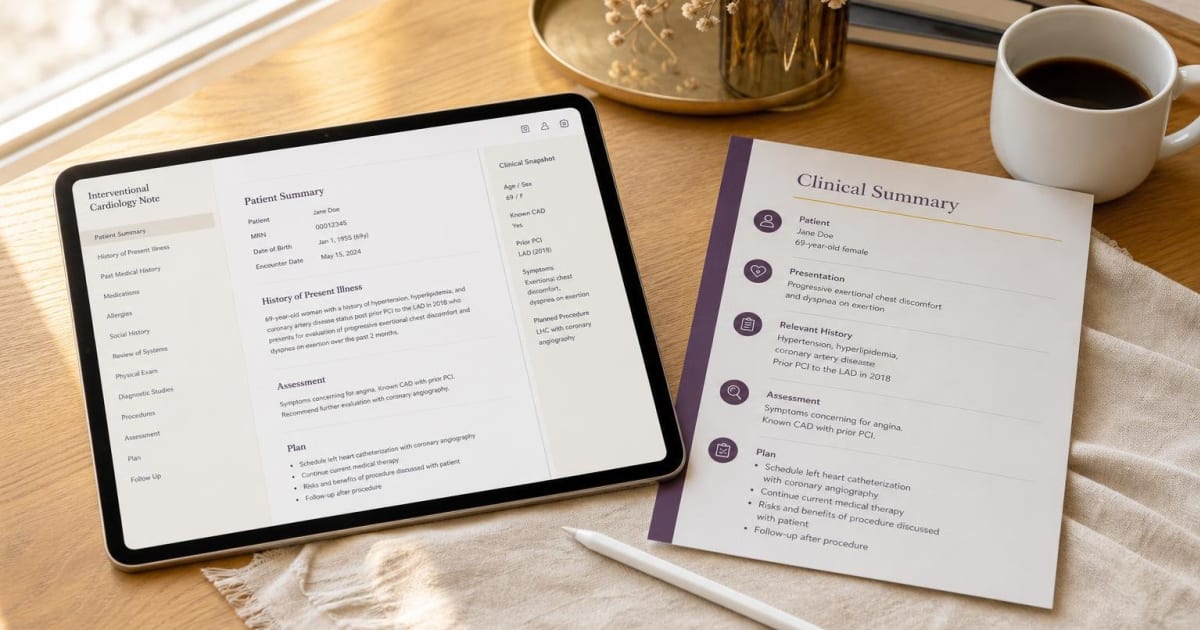
The interventional cardiologist's clinic is rarely a one-off visit. After a drug-eluting stent to the proximal LAD, the same physician usually titrates guideline-directed medical therapy, decides when dual antiplatelet therapy can be de-escalated, follows ventricular recovery on serial echocardiograms, and remains the accountable clinician for recurrent angina. CMS describes HCPCS add-on code G2211 as covering this kind of ongoing care for a single serious or complex condition.
Yet most post-PCI notes fail to show it. A line such as 'doing well, continue meds' documents a visit, but it does not document a longitudinal relationship. When an auditor reviews the chart, the burden of proof sits in the note itself. The note must show what is being managed, since when, and what decisions remain open. Merry makes that evidence explicit at every follow-up without asking the physician to dictate a paragraph of billing language.
G2211 is reported only alongside office or outpatient E/M codes 99202–99205 and 99211–99215, or alongside home and residence E/M visits. It cannot be reported alone. The base E/M level must still be supported by medical decision making under the current CPT framework, available through the AMA at https://www.ama-assn.org/practice-management/cpt.
Every interventional follow-up note that Merry drafts states four things plainly: the current LVEF percent, the stent date, the planned DAPT duration, and a statement of ongoing longitudinal cardiac management. The physician speaks these anchors naturally during the visit. Merry captures them as discrete values, so the narrative and the structured fields agree.
When the physician states 'EF thirty-five percent on today's echo,' Merry records 35% with the modality and date, then places it beside the prior value so the trajectory is visible. A patient whose LVEF has improved from 30% after an anterior STEMI to 40% on GDMT needs a very different plan than a patient with preserved function. Merry captures NYHA class and ACC/AHA heart failure stage with the same care, because both shape medical decision making and the longitudinal narrative.
The index procedure anchors everything. Merry documents the stent date, target vessel, and device type. It also records lesion descriptors when they are stated, such as bifurcation involvement, left main disease, chronic total occlusion, final TIMI flow, or SYNTAX score. Prior CABG, staged PCI plans, and FFR or iFR findings on non-culprit lesions are preserved, so the next visit begins where the last one ended.
Antiplatelet decisions are inherently longitudinal. Merry captures the agent pair, typically aspirin with clopidogrel, ticagrelor, or prasugrel, along with the start date and intended duration. It also records the reasoning behind that duration, such as twelve months after acute coronary syndrome, a shorter course in stable ischemic heart disease, or abbreviated therapy for high bleeding risk. When the visit covers a PRECISE-DAPT or DAPT score, prior GI bleed, anemia, or concurrent oral anticoagulation, those factors are written into the plan rather than lost in conversation.
This matrix shows how Merry links each specialty metric to the data a reviewer expects and the billing evidence that data supports.
| Specialty Diagnostic Metric | Required Clinical Data Points | Billing Evidence |
|---|---|---|
| LVEF percent | Value, modality (TTE, ventriculography, CMR), date, prior value | Supports MDM data review and chronic illness severity |
| Stent history | Stent date, vessel, DES vs BMS, final TIMI flow, complications | Establishes the single serious condition under ongoing care |
| DAPT duration | Agent pair, start date, planned months, de-escalation plan | Prescription drug management as an MDM risk element |
| Bleeding risk | PRECISE-DAPT score, prior bleed, hemoglobin, anticoagulant use | Documents risk weighed in management decisions |
| Angina and HF status | CCS class, NYHA class, ACC/AHA stage, stress findings | Chronic illness with progression or exacerbation |
| Longitudinal attestation | Accountable cardiologist, continuity statement, open decisions | G2211 add-on support when no modifier 25 applies |
Diagnosis codes travel with the evidence. Typical codes include I25.10 or I25.119 for coronary atherosclerosis, I25.2 for prior myocardial infarction, Z95.5 for coronary stent status, and Z79.02 for long-term antiplatelet therapy. Each code is linked to the problem it describes.
Modifier 25 changes the math. On a cath lab day, the E/M service is usually reported with modifier 25 alongside the procedure, and CMS edits deny G2211 in that combination. Since January 1, 2025, a narrow exception applies when the modifier 25 visit is furnished with an annual wellness visit, vaccine administration, or another Medicare Part B preventive service. Merry reads the visit context and suggests the longitudinal attestation only when the base E/M carries no modifier 25 or a qualifying preventive service is present. The physician confirms every suggestion before signing.
Modifier 59 is handled separately. G2211 describes longitudinal complexity, not additional procedural work. For that reason, Merry never offers G2211 as a substitute for reporting distinct procedural services.
Starting a session takes less than a minute. Open your cardiology encounter template in the EHR, enable the Merry overlay from the Chrome Extension, and confirm microphone permission when the browser asks. The visit then proceeds as a normal conversation. Merry separates physician, patient, and family voices and drafts the note into your template sections.
Specialty prompt packs for post-PCI follow-up, heart failure with reduced ejection fraction, and DAPT de-escalation visits are available at https://templates.scribing.io. Each pack keeps the four anchors in place. As a result, every signed note answers the questions a reviewer will ask: what was placed, when it was placed, how the ventricle is doing, and who is managing the patient going forward.

Separate Mohs stage maps from distinct E/M problems so modifier 25 holds under review. Book your audit at https://cal.com/merryai/demo.

Discrete LVEF, stent date, and DAPT capture, with G2211 gated on modifier 25. Book your audit at https://cal.com/merryai/demo.

Document TIR, GMI, and hypoglycemia with rationale for defensible 95251 reports. Book your audit at https://cal.com/merryai/demo.