
CLINICAL MEMORY
Longitudinal Diagnostic Memory
Histology, prior treatment, and stage maps for each lesion carry forward between visits. Access Specialty Prompts at templates.scribing.io for Mohs-ready templates.
Specialty Clinical Playbook
Separate Mohs stage maps from distinct E/M problems so modifier 25 holds under review. Book your audit at https://cal.com/merryai/demo.
 Dr. Sarah Chen, MD
Specialty Architecture
Engineered to mirror the pacing, diagnostic frameworks, and documentation requirements of Mohs Dermatology.
CLINICAL MEMORY
Histology, prior treatment, and stage maps for each lesion carry forward between visits. Access Specialty Prompts at templates.scribing.io for Mohs-ready templates.
CONTEXT RETRIEVAL
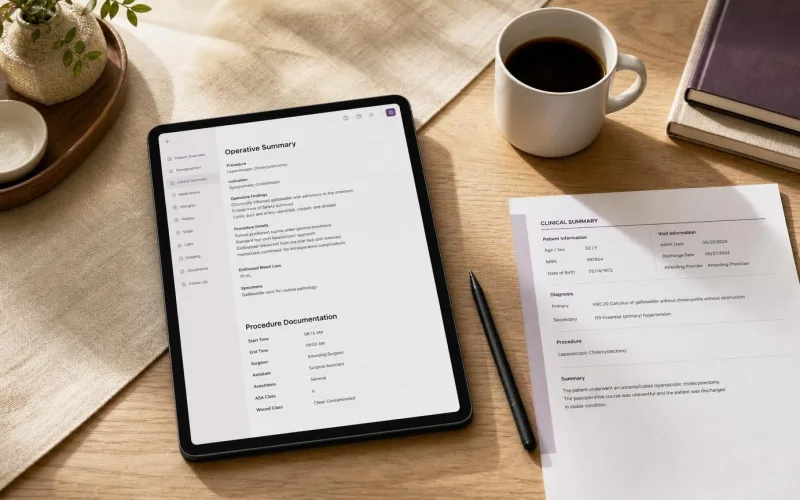
Retrieve prior pathology, recurrence history, and earlier stage maps without leaving the active procedure note.
COMPLEXITY CAPTURE
Isolates separate E/M decision making from inherent Mohs work and withholds G2211 on modifier 25 days. Schedule a 15-Minute Specialty Workflow Audit today.
SPEAKER ROUTING
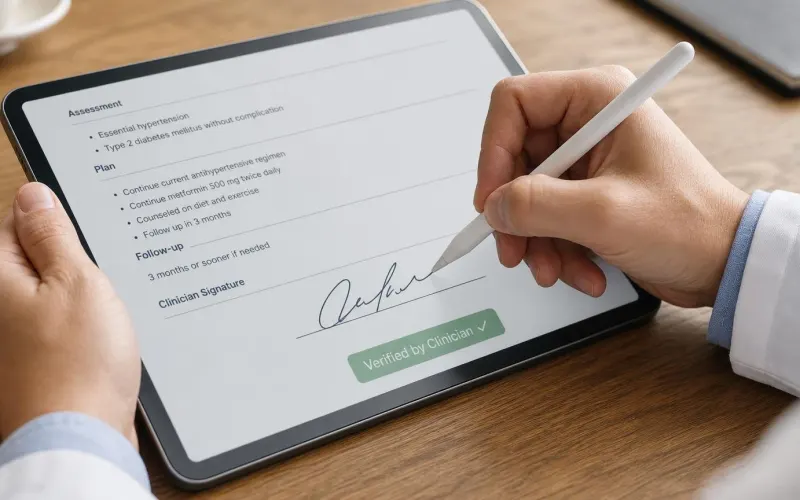
Diarize surgeon, staff, patient, and family dialogue, then map findings into Mohs procedure fields or distinct E/M sections.
Point-of-Care Flow
Zero IT friction, zero complex API setup, and human-verified attestation on every note.
Mohs micrographic surgery carries a zero-day global period, and the work inherent to the procedure includes evaluating the lesion being treated, deciding to proceed, and routine pre-operative counseling. When a same-day E/M service is reported with modifier 25, the payer expects something beyond that inherent work: a significant, separately identifiable problem with its own history, examination, assessment, and plan.
Most denied claims share a single flaw. The lesion description, the biopsy confirmation of an infiltrative basal cell carcinoma on the nasal ala, the discussion of anticoagulation before surgery, and the evaluation of new actinic keratoses on the scalp all appear in one narrative block. A reviewer cannot tell where procedural work ends and distinct medical decision making begins, so the E/M is bundled and the payment is recouped.
Reviewers tend to read the chart backwards, starting from the claim. They look for a problem that was not the reason for surgery, an exam element not limited to the operative site, and a plan that would have existed even if Mohs had been cancelled that morning. A new-patient visit alone does not qualify, and neither does confirming that a lesion meets Appropriate Use Criteria. Distinctness must be visible on the page.
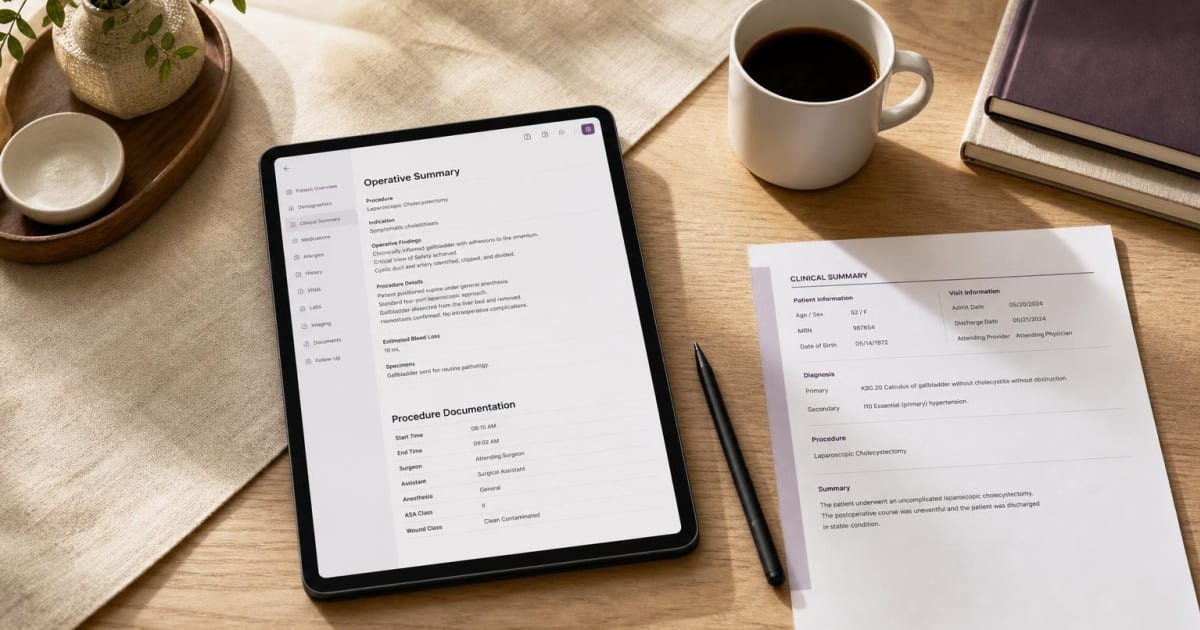
Merry listens to the full encounter and routes each spoken segment to a discrete field rather than a single text blob. A phrase such as 'lesion one, left nasal ala, biopsy-proven infiltrative BCC, primary, eight millimeters' lands in the Mohs procedure section. Stage counts, tissue blocks, and margin status for each stage land in the stage map. These details remain with the procedure note and never bleed into the E/M assessment.
Distinct problems receive their own structure. When the surgeon examines a changing pigmented lesion on the back, evaluates hypertrophic actinic keratoses on the dorsal hands, or counsels a transplant recipient on field therapy for widespread actinic damage, Merry places that work in a separate HPI, exam, assessment, and plan. The surgeon sees two clearly bounded documents before signing, which is exactly what a modifier 25 review expects.
The matrix below maps each Mohs diagnostic indicator to the data points the chart must hold and the billing evidence that data supports.
| Specialty Diagnostic Metric | Required Clinical Data Points | Billing Evidence |
|---|---|---|
| Lesion count and numbering | Lesion index, biopsy accession, histologic subtype per lesion | Correct first-stage reporting of 17311 or 17313 per lesion |
| Anatomic site | Precise location, head/neck/hands/feet/genitalia versus trunk/extremity designation | Supports 17311-17312 versus 17313-17314 selection |
| Stage and tissue map | Number of stages, blocks per stage, residual tumor by margin | Support for 17312, 17314, and 17315 add-on codes |
| Appropriate Use Criteria | Histology, size, primary versus recurrent, immune status | Medical necessity for Mohs itself |
| Distinct E/M problem | Separate HPI, exam beyond operative site, independent plan | Modifier 25 on the E/M code |
| Longitudinal relationship | Ongoing management of a serious condition on non-procedural visits | G2211 only when modifier 25 is absent |
Each row creates a defensible boundary. If a stage map shows two stages on the left nasal ala, the coder can support 17311 and 17312 without parsing prose, and the E/M section stands independently for its own level of medical decision making.
The workflow begins inside the dermatology procedure note already open in your browser. The surgeon enables Merry from the Chrome Extension, then assigns the Mohs fields and the E/M fields before the patient speaks. That assignment tells Merry which parts of the template hold lesion, site, and stage data, and which hold the separately identifiable visit. No API setup or IT ticket is required.
During the encounter, Merry tags each segment in real time. Discussion of wound care and surgical risk for the treated lesion stays with the procedure. Discussion of a new concern on the forearm moves to the E/M problem list. If the conversation contains only the decision to operate and routine counseling, Merry does not flag the visit as modifier 25 eligible, and it explains why.
Medicare edits generally deny G2211 when the associated office E/M is reported with modifier 25 on a day with a separately payable procedure. Merry therefore withholds G2211 suggestions on Mohs days and surfaces longitudinal complexity only on non-procedural follow-up visits, such as surveillance of a patient with multiple prior squamous cell carcinomas, where documentation supports an ongoing relationship.
Audio never leaves volatile memory. Once speech is converted into structured text and placed in the chart, the buffer is overwritten through zero-day RAM shredding. No recordings are stored locally or in the cloud, and the audit trail lives where it belongs: inside the EHR, with timestamps and the surgeon's signature.
Patient-facing text carries a disclosure where state law requires it. In California, AB 3030 requires a notice when generative AI produces clinical communication to patients, so Merry appends that disclaimer to post-operative instructions and visit summaries it drafts for California practices. Every note still passes through human review before it is signed.
Code selection remains the surgeon's judgment. Merry organizes the evidence; it does not assign levels on your behalf. For current descriptor language covering the 17311 through 17315 family and E/M guidelines, consult https://www.ama-assn.org/practice-management/cpt alongside your MAC guidance and the current NCCI policy manual.
Specialty prompt packs shorten setup. Mohs templates with lesion indexing, stage map scaffolding, and a separate E/M block are available at https://templates.scribing.io. Most surgeons adjust one or two field labels to match their EHR and are documenting the same afternoon.
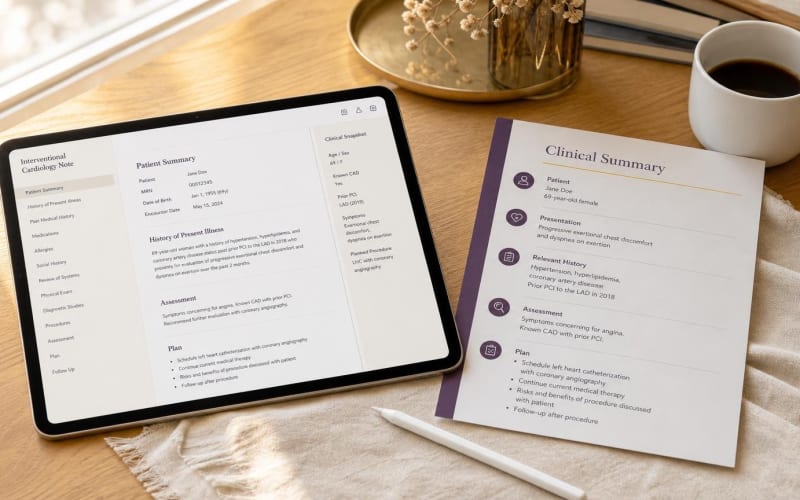
Discrete LVEF, stent date, and DAPT capture, with G2211 gated on modifier 25. Book your audit at https://cal.com/merryai/demo.

Discrete LVEF, stent date, and DAPT capture, with G2211 gated on modifier 25. Book your audit at https://cal.com/merryai/demo.

Document TIR, GMI, and hypoglycemia with rationale for defensible 95251 reports. Book your audit at https://cal.com/merryai/demo.