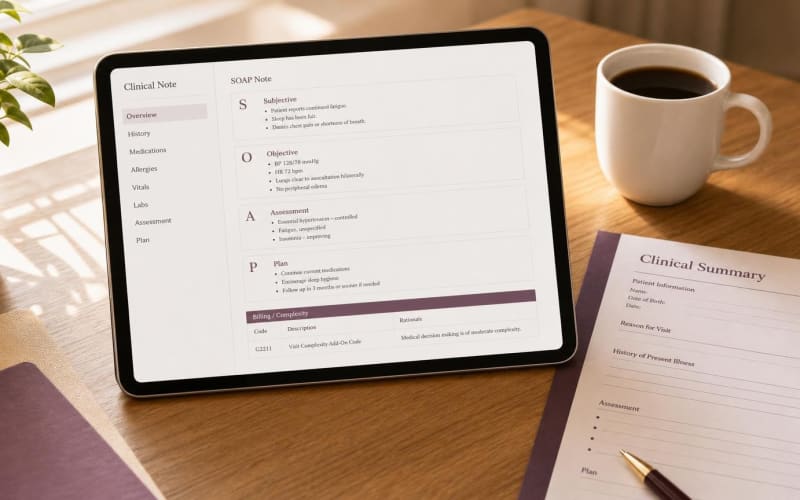
Functional medicine notes in Cerbo EMR break down at the supplement line, not the assessment
Clinical documentation inside Cerbo EMR rarely fails because clinicians lack dedication. It fails because a single functional medicine follow-up can carry eight supplements, three lab panels, and a phased protocol that must be retyped by hand into the chart note editor after the patient leaves.
Merry AI closes that gap by binding a Chrome Extension overlay to the active Cerbo chart note editor. The overlay drafts the note from the encounter, then writes supplement protocols, lab interpretations, and plan text into the matching fields on screen. The clinician reviews, edits, and saves through Cerbo's normal workflow.
The Chrome Extension binds to the Cerbo chart note editor through the browser DOM
The overlay runs as a content script inside the clinician's existing Chrome session. It locates the editable note container, whether a standard textarea or a contentEditable rich-text editor, using DOM queries keyed to visible section headers such as Assessment, Plan, and Supplements.
A MutationObserver watches for encounter changes. When a clinician switches patients, opens a new tab, or navigates to a historical visit, the field map is rebuilt before any write occurs. Locked, signed, and historical notes are never written to.
Each write dispatches native input and change events, so Cerbo's own change tracking and autosave register the text exactly as if it had been typed. No data reaches Cerbo servers except through the clinician's own save action.
Browser-native DOM mapping bypasses EHR marketplace paywalls entirely
Traditional integrations route through vendor APIs, partner contracts, and IT security reviews before a single note is written. Manual copy-paste avoids that overhead but pushes formatting work back onto the clinician. The comparison below shows where each approach lands for a Cerbo functional medicine practice.
| Criterion | Traditional API Marketplace Integration | Manual Copy-Paste | Merry AI Chrome DOM Injection |
|---|---|---|---|
| Setup time | Weeks to months of vendor and IT review | None | Under 10 minutes, extension install only |
| Recurring integration fees | Marketplace or per-connection fees common | None | Zero API or marketplace fees |
| IT or firewall changes | Credentials, endpoints, and security review | None | None, runs in the existing browser session |
| Field-level placement | Depends on exposed endpoints | Clinician places text by hand | Writes to mapped Assessment, Plan, and Supplement fields |
| Supplement dose and frequency structure | Often a single text blob | Retyped line by line | Agent, dose, frequency, and lab rationale per line |
| Audio retention | Varies by vendor, often cloud stored | Not applicable | RAM only, shredded at session close |
| Clinician attestation | Varies | Implicit | Required before every chart commit |
Every supplement line carries dose, frequency, and the lab value that justifies it
Functional medicine protocols are longitudinal by design. A supplement started at visit one is titrated at visit three against a repeat lab, so the chart must show why each agent exists, at what dose, and when it will be rechecked. Merry AI structures every dictated supplement into that pattern.
The table below shows the output format the overlay injects into the Cerbo Plan field. Values are illustrative and reflect what a clinician dictates during the visit. Merry AI does not recommend, select, or alter doses; it records the clinician's stated protocol and links it to the cited lab.
| Agent | Dose | Frequency | Lab Rationale | Recheck |
|---|---|---|---|---|
| Vitamin D3 with K2 | 5,000 IU D3 plus 100 mcg K2 | Once daily with a fat-containing meal | 25-OH vitamin D 18 ng/mL, below the 30 ng/mL sufficiency threshold | 25-OH vitamin D at 12 weeks |
| Iron bisglycinate | 25 mg elemental iron | Every other day, apart from calcium and coffee | Ferritin 12 ng/mL with low transferrin saturation | Ferritin and CBC at 8 to 12 weeks |
| Methylcobalamin | 1,000 mcg | Once daily, sublingual | Serum B12 240 pg/mL with elevated methylmalonic acid | B12 and MMA at 12 weeks |
| Magnesium glycinate | 200 mg elemental magnesium | Twice daily | RBC magnesium below laboratory reference range | RBC magnesium at 12 weeks |
| Omega-3 (EPA plus DHA) | 2 g combined EPA and DHA | Once daily with food | Triglycerides 210 mg/dL, omega-3 index 3.8% | Lipid panel and omega-3 index at 12 to 16 weeks |
Lab interpretations write to narrative fields such as Assessment or Lab Interpretation, never to raw result tables. Each statement carries the test name, value, unit, reference range, and collection date inline, so an auditor can trace every interpretive sentence back to its source result.
Conventional diagnoses stay separate from functional explanatory models. Codable ICD-10 diagnoses supported by recognized criteria appear in one block, while systems-level reasoning, such as a suspected gut-immune contribution to systemic inflammation, appears as assessment narrative. This separation protects the practice from claims that non-standard constructs were used to justify visit complexity.
Specialty criteria gate what the overlay is allowed to state
Functional medicine overlays conventional specialties, so the overlay applies the same gold-standard criteria a conventional reviewer would. For behavioral health, it records PHQ-9 and GAD-7 scores and symptom inventories but leaves formal DSM-5-TR diagnoses and specifiers to the clinician.
Cardiometabolic patients receive the same discipline. NYHA functional class and LVEF are written only when the clinician dictates them or they exist in Cerbo, with the echo date cited. The overlay never infers a higher NYHA class from a BNP value alone.
Musculoskeletal and pediatric findings follow the same rule. Range of motion appears as degrees only when stated aloud, and special tests such as Lachman or FABER are recorded with their dictated result. Pediatric anticipatory guidance is labeled by topic and never claims Bright Futures compliance unless the clinician covered the required elements.
G2211 documentation must show longitudinal complexity, and modifier 25 changes the payment outcome
HCPCS G2211 is a Medicare add-on code reported with office or outpatient E/M visits 99202 to 99205 and 99211 to 99215, and with home or residence E/M codes. It describes visits that serve as the continuing focal point for care or as ongoing care for a single serious or complex condition, per the CMS G2211 FAQ.
CMS generally denies G2211 when the base E/M carries modifier 25 on the same date. Effective January 1, 2025, CMS allows G2211 with a modifier 25 office or outpatient E/M when the other same-day service is an annual wellness visit, vaccine administration, or a Medicare Part B preventive service. Beginning January 1, 2026, that policy extends to home or residence E/M visits.
Merry AI never selects billing codes or appends modifiers. It surfaces the documentation evidence that supports longitudinal management, such as multi-system protocols with scheduled lab rechecks, and flags any same-day procedure that would trigger the modifier 25 rule so the clinician can document a significant, separately identifiable E/M service.
Procedures such as IV nutrition or trigger point injections raise NCCI edit questions. When modifier 59 or an X-modifier is contemplated, the overlay prompts for distinct site, session, or organ system language, because the NCCI Policy Manual prohibits using these modifiers solely to bypass an edit.
The $15,600+ figure is illustrative. It assumes roughly 975 eligible Medicare visits per clinician per year at about $16 per G2211 add-on. Actual payment varies by locality, payer mix, and fee schedule year, and depends entirely on documentation that meets CMS criteria.
Audio lives in RAM and is shredded when the session closes
Encounter audio is processed transiently. Buffers exist only in browser process memory, are never written to disk, and are zeroed and released when the clinician stops recording or closes the encounter. Only the text the clinician saves into Cerbo persists, and Merry AI operates under an executed Business Associate Agreement.
Psychotherapy and sensitive process notes use segregated templates. Under HIPAA, psychotherapy notes kept separate from the medical record carry heightened protection, so Merry AI drafts them in a distinct template that is never merged into the general chart note or patient-facing summaries.
Multi-party group sessions are diarized by speaker before drafting. Each participant's statements are attributed separately, and the clinician confirms which content belongs in each individual Cerbo chart, preventing one patient's information from appearing in another patient's record.
Patient-facing text carries AI disclosure where state law requires it
California AB 3030 requires a disclaimer when generative AI produces patient communications about clinical information, plus clear instructions for reaching a human provider. When Merry AI drafts after-visit summaries or supplement instructions for California practices, both elements are inserted automatically, and disclosure language is configurable for other states.
The clinician remains the author of record
Every injected section is visually flagged in the Cerbo editor with accept, edit, and reject controls. Nothing commits to the chart until the clinician reviews and attests, which keeps authorship demonstrable and signature integrity intact.
Clinics evaluating Cerbo documentation workflows can browse specialty templates at templates.scribing.io or Schedule a 15-Minute Workflow Audit to map their current supplement and lab charting process.