A Documentation Workflow Built for Cerner Millennium / Oracle Health
Clinical documentation inside Cerner Millennium rarely fails because clinicians lack dedication—it fails because the friction between what happened in the room and what lands in PowerChart is enormous. Hospitalists rotate through venue-specific workflows, select the correct encounter FIN, and navigate MPages layouts before they ever type a word. Multi-specialty outpatient groups juggle clinic workflow tabs, AutoText shortcuts, and specialty templates that demand structured ROS and PE elements. Merry AI was engineered to collapse that friction without asking Oracle Health for a single line of custom code.
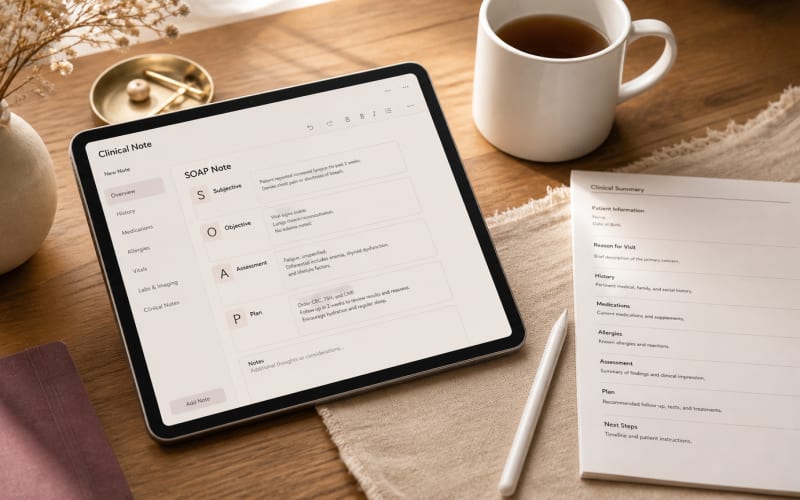
Merry AI positions itself as an overlay, not a replacement. The Chrome Extension reads the ambient conversation, structures it against your existing PowerNote and Dynamic Documentation sections, and proposes a draft that you insert with one click. Because the extension mimics normal keyboard and control interactions at the DOM level, PowerChart treats the inserted text exactly as if you had typed it. This preserves the vendor-supported boundary between Merry AI and Cerner's Millennium stack while eliminating the marketplace certification cycle entirely.
The distinction matters for hospitalists managing copy-forward augmentation. Instead of dragging tagged text across a split-screen editor, Merry AI summarizes the interval hospital course, highlights changes since the prior note, and drafts an updated Assessment & Plan aligned to your existing note sections. The clinician reviews, edits, and signs natively—Merry AI never touches the signature event.
Why DOM Injection Beats API Marketplaces and Copy-Paste
Traditional API marketplace integrations promise structured write-back but exact a heavy price: certification fees, per-transaction API costs, latency introduced by round-trips to hosted endpoints, and months of MPages development billed by consulting resources. For a mid-sized multi-specialty group, that overhead often exceeds the value of the integration itself. Merry AI avoids this by treating Cerner's existing field layouts as configuration, not code.
Manual copy-paste remains the default fallback in most practices, and it is precisely where documentation integrity erodes. Text pasted from an external window loses context, structured fields go unpopulated, and discrete data required for E/M coding and APCM audits never makes it into the chart. The result is under-coded encounters and quality-measure gaps. DOM injection restores that discrete population by setting checkboxes, dropdowns, and problem-list entries the way a clinician would.
| Architecture | Deployment Overhead | Latency | Annual Fee |
|---|---|---|---|
| Traditional API Marketplace | 3-9 months certification + MPage build | 1-3s API round-trip | Certification + per-call fees |
| Manual Copy-Paste | None | Human-speed, error-prone | $0 but high labor cost |
| Merry AI DOM Injection | Under 5 min browser install | 0.4s local field mapping | Flat practice partner plan |
This architecture is deliberately reversible. Every field Merry AI populates can be edited or cleared by the clinician before signature, and nothing commits to the permanent record automatically. The overlay is a proposal engine, and the human remains the decision-maker at every step—a design principle that satisfies both clinical safety expectations and HITECH accountability requirements.
Configuration, Not Custom MPages
Merry AI maintains per-venue selector maps that pair a CSS/DOM path with a semantic meaning—the HPI free-text box, the hospital course field, the Assessment & Plan problem list. These maps are configuration files maintained per client site, not new MPages components. You are mapping the forms that already exist rather than building anything, which is exactly why no MPage programming fee ever appears on your invoice.
Encounter-Aware Context Binding
Because the extension reads the open PowerChart context, it always knows the active encounter FIN, MRN, and venue type before it inserts anything. This context binding prevents the single most dangerous class of documentation error—content landing in the wrong patient's chart—and it enables clean multi-encounter handling for hospitalists rounding across many admissions in a single session.
Structured Data Integrity for E/M and G2211 Capture
Accurate reimbursement depends on discrete documentation that clearly supports HPI, ROS, PE, and medical decision-making elements. The 2021 and 2023 E/M reforms shifted emphasis toward MDM and total time, and the AMA's own workflow guidance acknowledges that the EHR itself contributes to clinician burnout when documentation friction is high. Merry AI ensures required sections are present and complete without fabricating findings, letting you code the level of service you actually delivered.
CPT add-on code G2211 captures the inherent visit complexity derived from the longitudinal practitioner-patient relationship, and per CMS guidance it applies regardless of specialty when the practitioner serves as the continuing focal point for care or manages a single serious or complex condition. Merry AI surfaces G2211 eligibility prompts during outpatient encounters so that longitudinal care complexity is documented and captured rather than silently forfeited. This directly benefits multi-specialty groups managing chronic conditions across recurring visits.
For value-based programs such as APCM, discrete fields for care plans, consent, and coordination activities are mandatory for CMS audit compliance. Merry AI populates these structured elements—goals, interventions, follow-up intervals—rather than dumping everything into free text, keeping your program documentation defensible under audit. Clinicians and auditors can always trace which content was AI-assisted, preserving provenance transparency.
Guardrails Against Upcoding and Hallucination
Documentation integrity requires active governance, so Merry AI is designed to never systematically inflate complexity. Governance teams can monitor E/M distributions before and after deployment, and the mandatory human-review step means no fabricated finding survives to signature. The model proposes; the clinician disposes.
Compliance, Identity, and Audit Architecture
Every organization processing PHI through Merry AI executes a Business Associate Agreement before go-live, and all transmission occurs over TLS 1.2+ with zero retention of audio or transcript. Any document created, modified, or accessed is traceable at the user, patient, encounter, and timestamp level. This audit granularity aligns with the inpatient EHR documentation consensus published through the National Library of Medicine at https://www.ncbi.nlm.nih.gov/pmc/, which stresses attribution and integrity in electronic clinical notes.
Merry AI operates strictly inside authenticated sessions and never circumvents Oracle Health's MFA or EPCS flows. It cannot impersonate a clinician for medication orders or e-prescribing, and it never triggers a signature event—those remain native Cerner actions tied to your authenticated identity. This separation keeps identity assurance intact while still delivering the documentation acceleration your clinicians need. A rollback plan lets IT disable the integration instantly if any concern arises.
Getting Started With Your Hospitalist and Outpatient Rollout
Deployment begins with a workflow assessment rather than a procurement negotiation. We map your existing PowerNote and Dynamic Documentation sections, confirm your venue types, and build the selector configuration—typically within days, not the quarters that native API certification demands. To see this against your own charts, Schedule a 15-Minute Workflow Audit and we will walk your team through live DOM injection in a sandbox.
Once configured, clinicians simply install the Chrome Extension and begin documenting. Pre-built specialty templates accelerate the first week—you can Access 1,000+ EHR Clinical Templates covering hospitalist admission notes, discharge summaries, and specialty-specific outpatient formats mapped to PowerChart fields. For groups evaluating scale across multiple sites and specialties, Explore Merry AI Practice Partner Plans to understand flat-fee pricing that replaces per-transaction API costs. The result is a documentation workflow that respects your clinicians, your compliance obligations, and your budget in equal measure.