Merry AI writes Internal Medicine notes directly into the eClinicalWorks v12 progress note iFrame
Clinical documentation inside eClinicalWorks v12 rarely fails because clinicians lack dedication. It fails because a primary care visit covering diabetes, hypertension, CKD, and three medication changes generates far more narrative than a 15-minute slot allows. eClinicalWorks v12 runs as a Chrome-optimized HTML application. Its progress note is the central record for each encounter, which means the note editor already exists as live, editable elements in the browser.
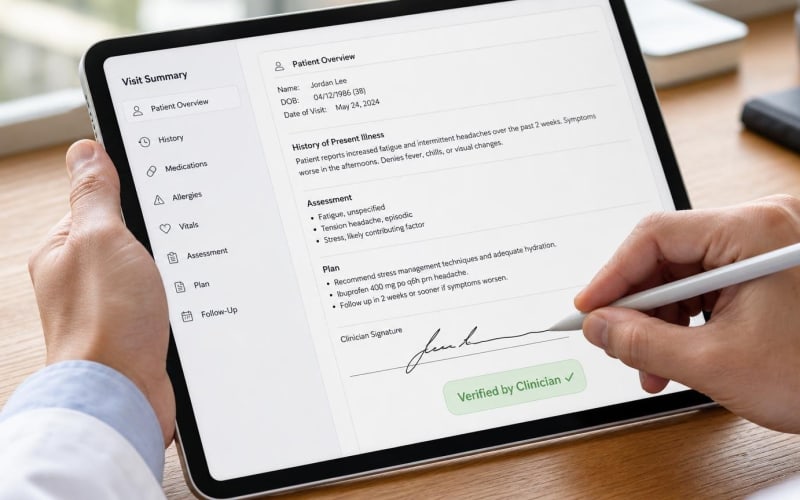
Merry AI's Chrome Extension operates at that browser layer. After the visit, the clinician reviews a structured draft in the extension panel. The extension then writes each section into the matching editable field of the active progress note using standard client-side DOM methods. No HL7 interface, FHIR endpoint, or vendor marketplace connector is involved, and the practice's eCW server never receives a third-party API call.
Browser-native DOM mapping bypasses EHR marketplace paywalls entirely
Traditional EHR integrations route through vendor partner programs, interface engines, and per-provider connector fees. That process can take months of IT scoping before a single note moves. Because Merry AI writes into fields the clinician can already type into, it inherits the clinician's existing session, permissions, and audit trail. It does not require new credentials or server access.
The extension is pinned to the eCW v12 progress note iFrame selector
Directive P7 governs targeting. eClinicalWorks v12 can render the note editor inside an embedded iFrame. It can also show prior notes in the Encounter Tab while the current note is open. A loosely targeted extension could write into the wrong frame. Merry AI pins injection to the progress note editor iFrame through a practice-validated selector profile, which is confirmed against your eCW build during onboarding.
Each write follows four checks. First, the extension confirms it is on a progress note route and that landmark elements such as the Progress Notes header are present. Second, it resolves the pinned iFrame and accesses its document context. Third, it verifies the target field is editable and belongs to the currently open encounter, not a read-only historical view. Fourth, it inserts text at the mapped section, such as HPI, Assessment, or Plan, and highlights the inserted block for review.
If any landmark is missing, for example after an eCW layout update, the extension halts and copies the draft to the clipboard rather than guessing. A failed write is visible and recoverable. A misplaced write into another patient's frame is not acceptable, so the system is designed to fail closed.
G2211 attestations name the continuing focal point and state the prior visit count
HCPCS add-on code G2211 recognizes the complexity inherent to an E/M visit when the practitioner serves as the continuing focal point for all needed health care services, or provides ongoing care for a single serious or complex condition. It is reported with office or outpatient E/M codes 99202-99205 and 99211-99215. It is also reported with home or residence codes 99341, 99342, 99344, 99345, and 99347-99350. Severity of illness alone does not qualify a visit. The relationship and the longitudinal management role do.
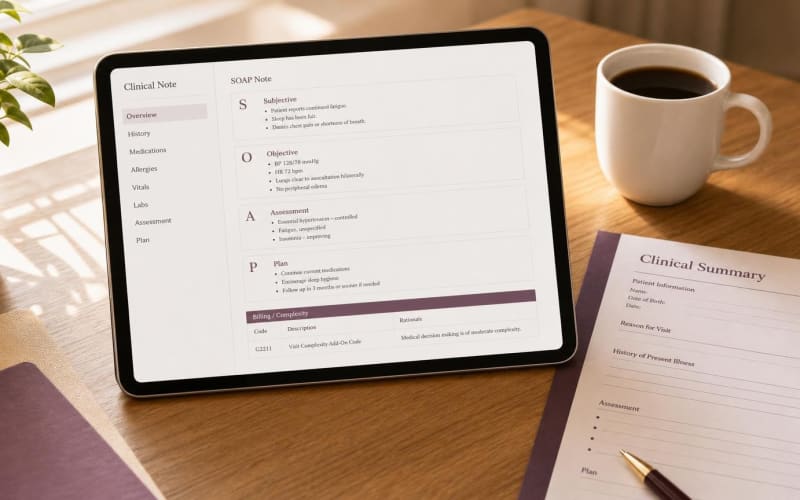
Directive P1 defines the attestation format. When the encounter supports longitudinal care, Merry AI appends a G2211 attestation to the Assessment and Plan. The attestation names the treating clinician and states the number of prior visits with that clinician. The count is read from the visit history visible in the clinician's eCW session and shown to the clinician for confirmation before injection. A representative draft reads as follows.
A zero prior visit count does not automatically block the code. CMS allows G2211 at a new patient visit when that visit begins an ongoing longitudinal relationship. In that case, the draft states the intent to serve as the continuing focal point rather than citing history, and the clinician confirms that intent.
The attestation is never boilerplate. Generic text such as 'I coordinated complex care today' reads as cloned documentation and invites payer scrutiny. Merry AI fills each bracket from content actually discussed in the encounter. If the transcript shows an episodic visit, such as an isolated URI in a patient who sees another PCP, no G2211 draft is generated.
Modifier 25 interacts with G2211. CMS does not pay G2211 when the E/M visit is reported with modifier 25. The exception, effective CY 2025, is when the modifier 25 E/M occurs on the same day as an Annual Wellness Visit, vaccine administration, or a Medicare Part B preventive service. Merry AI flags same-day procedure encounters so the clinician and coder resolve eligibility before claim submission.
Direct DOM injection outperforms copy-paste and marketplace APIs on eCW v12
| Criterion | Traditional API Marketplace Integration | Manual Copy-Paste | Merry AI Chrome DOM Injection |
|---|---|---|---|
| Time to go live | Weeks to months of vendor and IT scoping | Immediate | Same day, extension install only |
| IT and firewall changes | Interface engine, credentials, network review | None | None |
| Recurring connector fees | Per-provider or per-transaction fees common | None | None |
| Field targeting | Structured, limited to fields the API exposes | Clinician pastes, often into one free-text box | Section-mapped writes into the pinned progress note iFrame |
| G2211 attestation | Rarely generated; typically left to clinician | Manual typing or reused phrases | Drafted with clinician name and prior visit count, eligibility-gated |
| Wrong-chart risk | Low, patient context passed by API | Moderate, depends on clipboard discipline | Low, active-encounter verification before every write |
| Behavior after EHR UI updates | Stable until API version changes | Unaffected | Fails closed and falls back to clipboard until selector profile is revalidated |
| AI provenance labeling | Varies by vendor | None | AI-assisted label on every injected block until signature |
| Audio retention | Varies by vendor | Not applicable | Zero-day retention under executed BAA |
The trade-off is explicit. API integrations offer stable structured exchange but cost time and money. Copy-paste costs nothing but scatters text into the wrong sections and adds clicks. DOM injection removes the IT burden while keeping section-level placement, provided it is pinned and fails safely.
Internal Medicine notes must carry the longitudinal evidence that supports the code
A G2211 attestation is only as strong as the note beneath it. CMS and MAC guidance expects the record to show a medically necessary E/M visit, an assessment and plan for ongoing management, and evidence that the practitioner is the continuing focal point. In Internal Medicine, that evidence comes from specific clinical content.
Merry AI's Internal Medicine prompts capture the elements auditors look for. These include control metrics such as A1c trajectory and home blood pressure trends, staging such as CKD stage, NYHA class, and LVEF for heart failure, and polypharmacy reconciliation with the reason for each change. They also capture coordination with cardiology, nephrology, home health, or behavioral health, plus preventive planning for screening intervals and immunizations. When these elements are present in the note, the attestation summarizes them. When they are absent, the attestation is not drafted.
Zero-day audio retention shifts audit defense to the signed text
Merry AI processes session audio in transient memory and discards it after the draft is generated. No audio file or transcript persists under the executed BAA. This minimizes PHI exposure. It also means no recording exists to corroborate the visit if a claim is challenged, so the signed note and eCW's own edit metadata become the evidentiary record.
That is why attestation design matters. Specific, encounter-derived language, a confirmed visit count, and the clinician's signature create a defensible record. Generic text with no audio behind it does not. Practices should also run periodic internal audits that compare G2211 frequency, documentation quality, and denial patterns against CMS guidance.
Modifier 25 and 59 justifications are never auto-inserted
Billing modifiers require clinician judgment. Modifier 25 requires a significant, separately identifiable E/M service beyond the work of a same-day procedure. Modifier 59 requires a distinct procedural service under NCCI rules. Merry AI does not inject justification phrases for either modifier. It surfaces the relevant documentation for the clinician to confirm and leaves modifier selection to the clinician and coding team.
AI provenance labeling supports California and Texas disclosure expectations
California AB 3030 requires disclosure when generative AI produces patient clinical communications, unless a licensed provider reads and reviews the content first. Merry AI's mandatory review step satisfies that pathway for any patient-facing text, and every injected block carries an AI-assisted label in the review state. Texas has advanced its own AI transparency measures for health care. Practices in both states should align after-visit summaries and portal templates with local counsel guidance. The design principle is that no AI-generated text reaches the record or the patient without a named human reviewer.
A 15-minute workflow audit confirms selector fit and G2211 eligibility logic
The onboarding audit covers three items. First, we validate the progress note iFrame selector profile against your eCW v12 build. Second, we map your Internal Medicine template sections to injection targets. Third, we review the G2211 eligibility rules against your visit mix. Book your session at https://cal.com/merryai/demo, and browse specialty templates at https://templates.scribing.io.