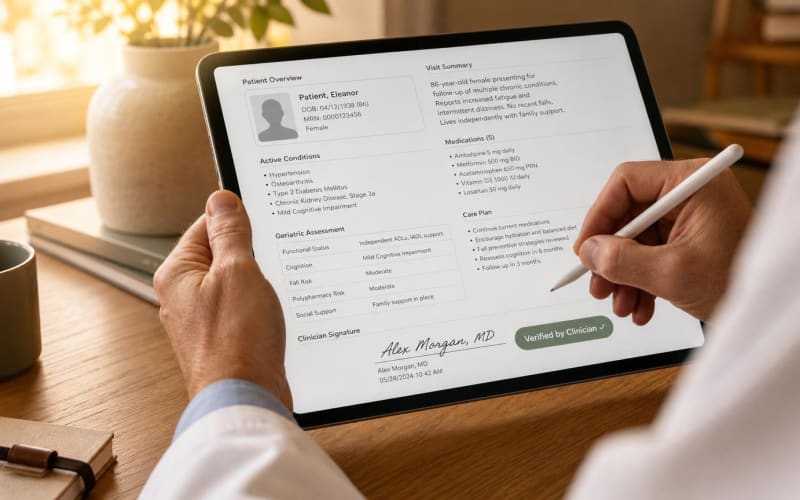
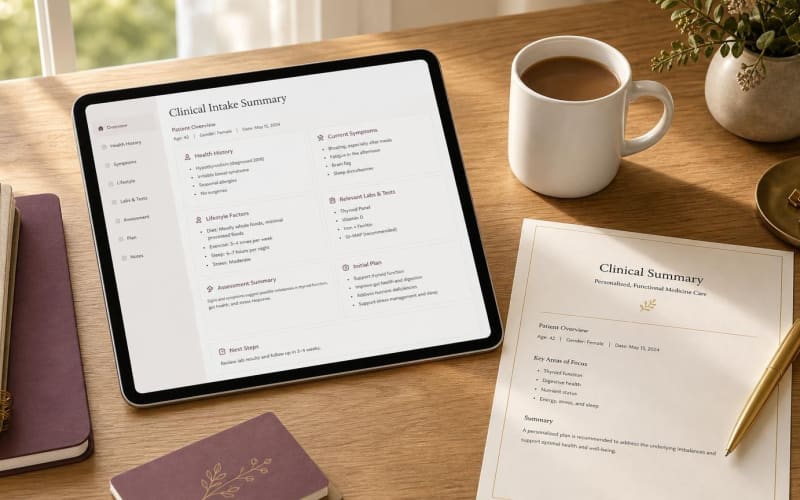
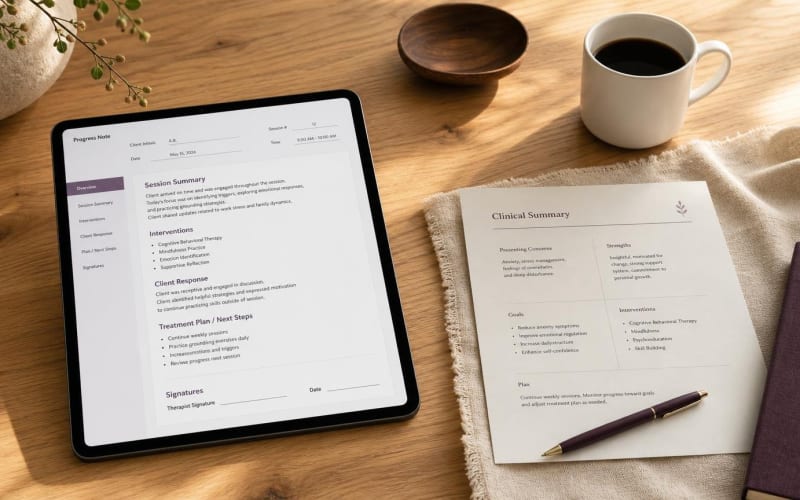
Merry AI writes geriatric Assessment and Plan text directly into Elation visit note blocks
Geriatric documentation inside Elation Health carries a heavier load than most primary care charting. A single visit for an 84-year-old patient may touch mild neurocognitive disorder, heart failure, recurrent falls, chronic kidney disease, and a ten-drug medication list. Each problem needs its own interval history, its own decision, and its own plan, and the note must still read as one coherent record of longitudinal care.
Merry AI's Chrome Extension reads the Elation visit note open in the clinician's browser and identifies the editable fields in the Document Object Model (DOM). After the visit, the extension writes a problem-by-problem draft into the Assessment and Plan block of the SOAP Note, the Complete H&P, or the block-based Elation Note editor. No server API credentials, marketplace listing, or practice-wide integration project is required, because the text enters the same fields a clinician would type into.
Browser-native DOM mapping places each chronic problem in its own Assessment and Plan entry
Elation stores every visit note as a parent encounter record with child lines, one per bullet of content. When Merry AI injects text, each problem becomes discrete lines that persist exactly as typed content does once the clinician saves. That structure matters in geriatrics: an auditor reading the chart sees "Heart failure with reduced ejection fraction" followed by its own interval course, NYHA class, weight trend, and diuretic decision, rather than a single undifferentiated paragraph.
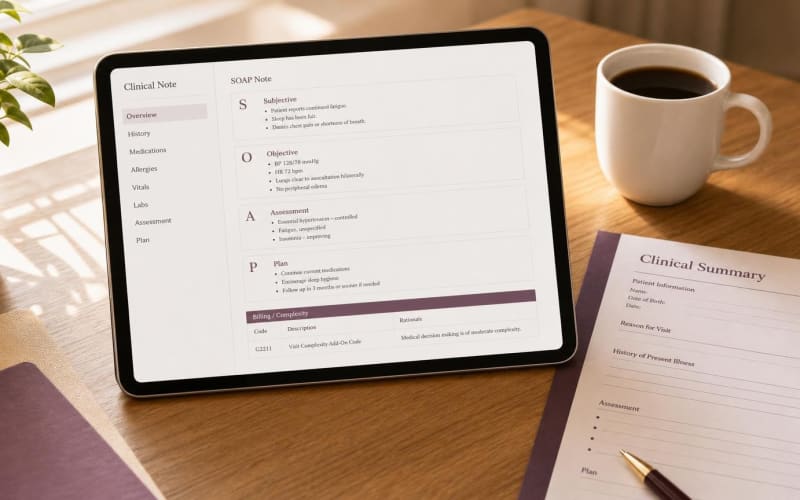
The extension maps content by note format. In the SOAP Note, problem narratives go to Assessment and plans go to Plan. In the Complete H&P two-column layout and the Elation Note editor, Merry AI targets the Assessment and Plan block, pairing each assessment line with its plan line. Problems already imported from the Clinical Profile into HPI are detected and matched, so the draft does not duplicate or contradict the active problem list.
Geriatric domains receive structured prompts rather than generic narrative. Merry AI templates cover the domains geriatric clinicians document most often:
- Cognition and mood tracking: serial MoCA or MMSE scores, DSM-5-TR framing for mild or major neurocognitive disorder, and PHQ-9 and GAD-7 trends.
- Function and frailty status: ADL and IADL changes, gait speed, grip strength, unintentional weight loss, assistive devices, and caregiver support.
- Falls and mobility risk: falls since the last visit, resulting injuries, balance testing, and home safety referrals.
- Polypharmacy and deprescribing decisions: Beers Criteria and STOPP/START flags, plus the rationale for continuing or tapering each flagged medication.
- Goals of care documentation: advance care planning discussions, surrogate decision-makers, and patient-stated priorities.
Every G2211 visit must state the focal point role and the serious condition trajectory
CMS describes HCPCS add-on code G2211 as visit complexity inherent to E/M services that serve as the continuing focal point for all needed health care services, or that are part of ongoing care related to a patient's single, serious condition or a complex condition. The code may be reported with office and outpatient E/M visits (99202-99205, 99211-99215) and with home or residence E/M visits (99341, 99342, 99344, 99345, 99347-99350), which makes it directly relevant to geriatric house-call programs.
Merry AI drafts a continuity statement for every visit where the clinician enables G2211 support. The statement has two required elements. First, it names the clinician's role as the continuing focal point, for example: "I serve as this patient's primary geriatrician and coordinate her care with cardiology, nephrology, and her daughter as health care proxy." Second, it states the trajectory of the serious or complex condition, for example: "Heart failure has progressed from NYHA class II to class III over 9 months, with two diuretic adjustments since January."
Boilerplate continuity language weakens audits. The draft pulls trajectory details from the visit conversation and the prior notes the clinician references, so the statement changes from encounter to encounter. If a visit does not reflect longitudinal complexity, such as an isolated acute complaint, the clinician can turn the continuity block off for that note. Merry AI never adds codes to the Elation billing section. Code selection stays with the clinician.
Modifier 25 requires careful separation. Under current CMS policy, G2211 is payable with a modifier 25 E/M only when the same-day service is an annual wellness visit, vaccine administration, or a Medicare Part B preventive service. When a procedure such as cerumen removal occurs on the same day, G2211 is not payable with that E/M. Merry AI labels separately identifiable E/M content in its own section, so coders can see where procedure documentation ends and chronic disease management begins.
Documentation errors carry measurable cost. According to CMS's 2024 Medicare Fee-for-Service Supplemental Improper Payment Data, the improper payment rate for E/M codes was 10.3 percent. Incorrect coding accounted for 49.1 percent of those improper payments, and insufficient documentation accounted for 34.1 percent. Structured, problem-level Assessment and Plan text addresses the documentation side of that gap.
Chrome DOM injection removes the API marketplace step without removing clinician control
The three integration paths compare as follows:
| Criteria | Traditional API Marketplace Integration | Manual Copy-Paste | Merry AI Chrome DOM Injection |
|---|---|---|---|
| Setup requirement | Vendor partnership, API credentials, server build | None | Chrome Extension install |
| Cost model | Marketplace or partner fees often apply | Clinician time per note | No API fees |
| Write-back speed | Depends on server sync cycle | Minutes per note | Under 500ms per field |
| Field placement | Mapped to API objects | Clinician pastes by hand, error prone | Assessment and Plan block, problem by problem |
| Audio retention | Varies by vendor | Varies by source tool | Processed in RAM, discarded after draft |
| G2211 continuity support | Rarely structured | Typed manually | Focal point and trajectory statement per visit |
| Clinician attestation | Required | Required | Required before signature |
| IT involvement | Integration project | None | Security review and formal approval |
Transient audio and clinician attestation keep the final Elation record defensible
Audio from the visit exists only in volatile memory while the draft is generated, and then it is discarded. No audio file and no transcript are stored after the note is produced, and processing occurs under an executed Business Associate Agreement. For geriatric practices serving patients with cognitive impairment, this reduces the number of places protected health information can persist outside Elation.
Injected text remains fully visible and editable in Elation's native editor. Nothing is placed in hidden or off-screen fields. The clinician reviews each assessment, edits clinical judgment where needed, and signs the note in Elation, which preserves the signature as the clinician's attestation of the content.
State AI transparency rules continue to evolve, including California AB 3030 and related legislation in Texas. Practices should confirm disclosure obligations with counsel, add the extension to their HIPAA security risk analysis, and approve it formally rather than allowing unvetted browser tools to handle PHI.
Geriatric practices can pilot Elation DOM injection through a focused 15-minute audit
A practical rollout starts small. Pick one visit type, such as chronic care follow-ups configured through Elation's appointment-to-visit-note automation, and enable Merry AI's Assessment and Plan mapping for that template only. After two weeks, review a sample of signed notes with your coder and confirm that every G2211 visit names the focal point role and the condition trajectory. Templates are available at templates.scribing.io, and workflow audits can be booked at cal.com/merryai/demo.