Merry AI writes primary care drafts directly into the Elation visit note body
Clinical documentation inside Elation Health rarely fails because clinicians lack dedication. It fails because the visit note body is still open at 9 p.m., long after the last patient has left. Primary care visits routinely cover three to six problems, and each one needs an assessment, a plan, and a thread back to the last time it was discussed.
Merry AI closes that gap by attaching a Chrome Extension overlay to the Elation visit note body. The overlay listens to the encounter, drafts a problem-oriented note, and, after the clinician approves it, writes the text into the open chart through the browser DOM. Nothing routes through an Elation server API, and the clinician never leaves the chart.
Browser-native DOM mapping bypasses EHR marketplace paywalls entirely
The extension's content script reads the Elation page the clinician already has open. It identifies the patient context from the chart header, detects which of Elation's three note layouts is in use (SOAP, Single Narrative, or H&P Two-Column), and maps each drafted section to its matching field: HPI, ROS, physical exam, data, assessment and plan, and follow-up.
After the clinician clicks Apply, Merry AI writes into those fields and dispatches native input and change events. This step matters for medico-legal defensibility. Elation's autosave and audit logging record the content as text the clinician accepted in the chart, not as an opaque payload pushed from outside the application.
Because the integration lives in the browser, there is no marketplace listing, no partner contract, no per-call fee, and no IT credentialing cycle. Merry AI maintains a versioned map of Elation field selectors and revalidates it whenever Elation ships a UI change, so write targets stay accurate between releases.
The note must state that your practice is the continuing focal point
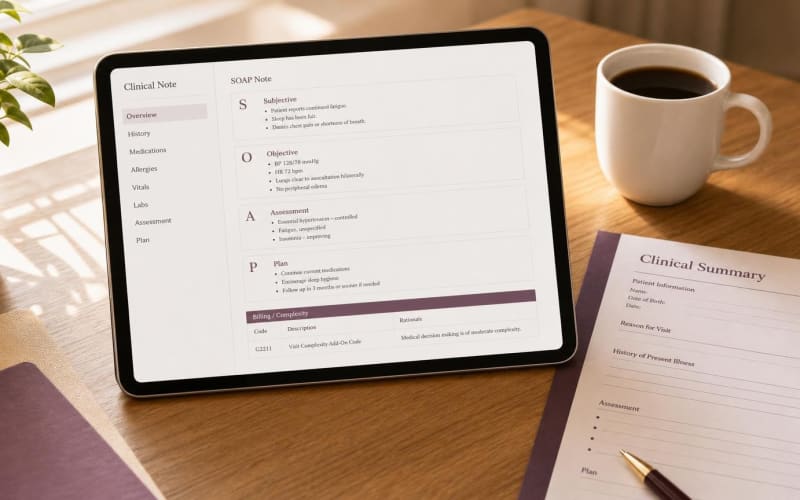
CMS defines HCPCS G2211 as visit complexity tied to medical care services that serve as the continuing focal point for all needed health care services, or ongoing care for a single serious or complex condition. The complexity must come from the longitudinal relationship itself. A one-off travel vaccine visit does not qualify.
Merry AI's primary care template therefore writes an explicit continuity statement into the assessment and plan: that this practice holds responsibility for the patient's ongoing care and coordinates with outside specialists. The statement is drafted from what was actually discussed, such as medication reconciliation, specialist coordination, or chronic disease titration, rather than pasted as boilerplate.
Every plan item links back to the prior visit that started it
Longitudinal complexity is only defensible when the chart shows continuity. Before drafting, the overlay reads the prior visit notes visible in the Elation chart and the active problem list. Each plan item in the new note then references the earlier decision it continues, for example: metformin increased to 1000 mg twice daily on the prior visit, A1c now 7.4%, continue current dose and recheck in 3 months.
This prior-visit linkage gives auditors a readable trail across encounters. A reviewer can see that hypertension, diabetes, and depression were each managed by the same practice over time, which is the pattern the G2211 definition describes.
Chrome DOM injection outperforms API marketplaces and copy-paste on three axes
The table below compares the three ways a scribe draft can reach an Elation chart today. The decisive differences are setup cost, write accuracy, and wrong-chart risk.
| Criterion | Traditional API Marketplace Integration | Manual Copy-Paste | Merry AI Chrome DOM Injection |
|---|---|---|---|
| Setup path | Vendor contract, marketplace listing, IT credentialing | None | Chrome Extension install with existing Elation login |
| Recurring integration fees | Partner or usage fees are common | None | No API fees |
| Write target | Only fields the API exposes | Whatever field the clinician clicks | Visit note body and section fields in the active chart |
| Elation layout awareness | Limited to the API schema | Clinician sorts sections by hand | Detects SOAP, Single Narrative, and H&P Two-Column |
| Wrong-chart risk | Low, server-matched patient IDs | High, clipboard can carry the prior patient's text | Controlled by binding each audio session to one chart tab |
| Audit trail | API transaction log | Native Elation edit log | Native Elation edit log plus internal encounter log |
| Time to chart after approval | Batch or near real time | Minutes per note | Under 500ms field write-back |
Wrong-chart risk deserves particular attention. Primary care clinicians often keep several patient charts open in separate tabs. Merry AI binds each recording session to a single Elation tab and encounter date, and it refuses to write if the active chart header no longer matches the bound patient.
Audio lives only in volatile memory and is purged once the draft is built
Visit audio is held in RAM during the encounter and cleared when the draft is generated. No audio is written to local disk, IndexedDB, browser storage, or cloud storage, and no audio is retained for model training. Merry AI operates under an executed Business Associate Agreement.
The drafted note is still PHI. Once it is written into Elation, it falls under the practice's existing access controls and Elation's own safeguards. Merry AI also excludes audio fragments and verbatim transcripts from crash reports and telemetry.
G2211 attestations appear only when longitudinal signals exist in the encounter
G2211 is reportable only alongside an office or outpatient E/M base code (99202-99205, 99211-99215) or a home or residence E/M code (99341, 99342, 99344, 99345, 99347-99350). Merry AI confirms an eligible base code is present before it suggests any attestation language.
Modifier 25 claims need extra care. CMS originally barred G2211 on E/M visits reported with modifier 25. Beginning in CY 2025, CMS allows the pairing when the same-day service is an annual wellness visit, vaccine administration, or a Medicare Part B preventive service. Merry AI flags those cases for review instead of assuming eligibility.
Merry AI never adds modifiers automatically. It does not apply modifier 25 or modifier 59 on its own. Instead it structures the note so separately identifiable E/M work, distinct sites, and timing are clear, and the clinician or biller makes the coding decision.
Specialty criteria inside primary care scope keep problem lists audit-ready
Primary care absorbs specialty-level documentation every day, and the draft reflects the criteria auditors expect. Depression follow-ups capture DSM-5-TR symptom duration, functional impairment, and bipolar screening. Heart failure visits record NYHA class and the most recent LVEF to distinguish HFrEF from HFpEF. Musculoskeletal exams record range of motion in degrees, strength grades, and named special tests with laterality. Well-child visits follow Bright Futures periodicity for screenings, milestones, and anticipatory guidance.
Behavioral health process content stays in a separate template. HIPAA psychotherapy notes are never injected into the shared visit note body, which keeps sensitive material out of the general medical record.
The clinician signature remains the only path to a final Elation record
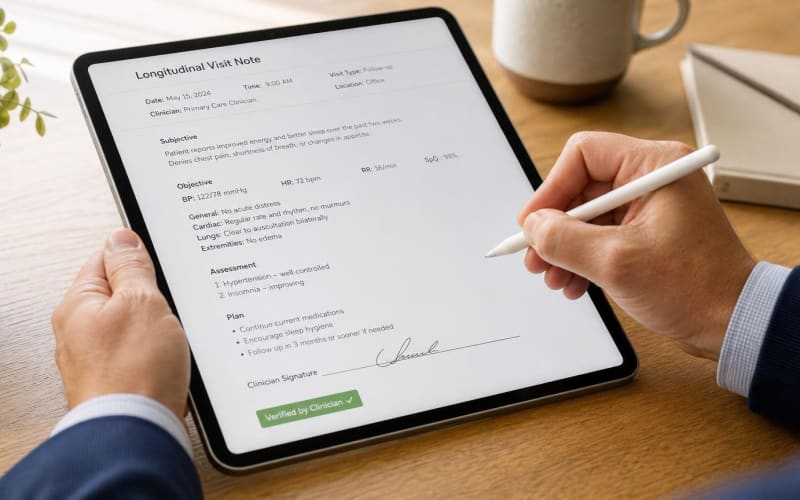
Merry AI drafts, the clinician decides. No text reaches the chart until the clinician reviews it and clicks Apply, and no note is final until the clinician signs it in Elation. That keeps authorship, liability, and signature integrity exactly where they belong, and returns the evening hours to the clinician.