A Documentation Workflow Built for Epic Systems (Hyperdrive)
Clinical documentation inside Epic Systems (Hyperdrive) rarely fails because clinicians lack dedication. It fails because the distance between a spoken encounter and a signed note is filled with friction: template hunting, SmartPhrase expansion, flowsheet navigation, and the cognitive tax of translating a fluid conversation into structured fields. For hospital-owned specialty groups running cardiology, oncology, and orthopedic service lines, that friction compounds across dozens of longitudinal encounters per day, each demanding disease-activity scores, procedural checklists, and E/M-coherent narratives.
Merry AI approaches this problem as a distributed systems engineer would: identify the lowest-latency, lowest-overhead surface where a drafted note can meet the clinician, and write there. In Hyperdrive, that surface is the DOM itself. Because Hyperdrive is a Chromium-based front end hosting Epic activities and embedded web experiences, every note textarea and flowsheet input cell is a live, addressable element inside the clinician's already-authenticated session. Our Chrome Extension operates precisely there, injecting reviewed drafts without ever pretending to be a certified system-of-record integration.
This distinction matters more than marketing convenience. We are explicit with hospital informatics teams: Merry AI does not claim native FHIR write access to your Epic environment, and it does not create DocumentReference resources through Epic's APIs on its own authority. It performs assistive typing under the clinician's identity, and the clinician performs the review, the sign-off, and the commit. That architectural honesty is what keeps the workflow defensible under CMS documentation-integrity guidance and HIPAA governance alike.
Why DOM Injection Beats the Integration Queue
The traditional path to writing into Epic runs through the hospital IT integration queue: App Orchard registration, SMART-on-FHIR launch configuration, scoped OAuth token provisioning, security review, and change-control scheduling. Each stage is legitimate, and for system-of-record data flows it is the correct path. But for a specialty group that simply wants a scribe to draft today's notes, that queue can mean six-to-twelve months of project time and recurring marketplace fees before a single note is written.
Merry AI sidesteps that timeline by refusing to compete in the integration queue at all. The extension runs inside the clinician's browser window, maps the relevant Hyperdrive input selectors, and streams a finished draft into the focused field. There is no interface to build, no FHIR endpoint to certify, and no per-seat marketplace tax collected by an intermediary. Deployment is measured in minutes, not quarters, and it degrades gracefully: if a clinician closes the extension, Epic behaves exactly as it did before.
The honest tradeoff we disclose is that DOM-based writing is UI assistance, not canonical structured integration. A pure browser overlay does not, by itself, register Merry AI as a contributing system in Epic's audit log the way a certified FHIR app would. We compensate for this deliberately: the clinician remains the acting identity, our own infrastructure maintains an independent audit record of every proposed and applied draft, and nothing enters the chart without human review and signature. For groups that later want certified structured write-back, the same drafting engine can operate through Epic FHIR once that path is provisioned, with an identical review-and-sign flow.
Mapping Flowsheet Fields Without Breaking Coherence
Specialty flowsheets present the highest-risk surface for any automated writer, because CMS documentation-integrity rules explicitly warn against mass pre-population of normal findings and canned negative review-of-systems sections. Merry AI honors this by never auto-filling a flowsheet row the clinician has not opened and never applying a batch of values without an explicit fill trigger. Derived values such as calculated disease-activity scores are surfaced as suggestions, and the clinician confirms each entry before it lands.
This restraint aligns directly with the peer-reviewed and regulatory literature on documentation integrity indexed through resources like the National Library of Medicine's PMC archive, which repeatedly emphasizes that carry-forward and template content must be revalidated each encounter to remain clinically and medico-legally sound. Our provenance markers make the assistant's contribution visible rather than silent, so the signed note always reflects the clinician's deliberate judgment.
Preserving the Author of Record
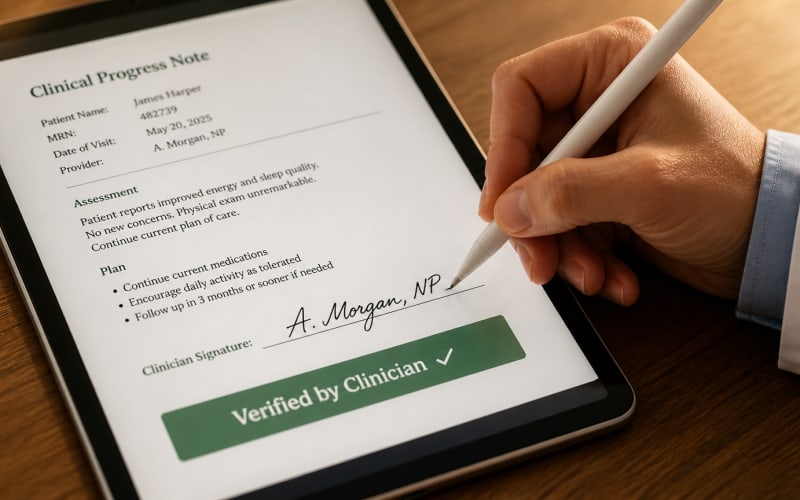
Every draft Merry AI produces is exactly that: a draft. The clinician reviews it inside Hyperdrive, edits freely, and signs through Epic's native signature workflow. This is not a cosmetic gesture toward compliance; it is the structural core of the design. Because the write occurs under the clinician's authenticated session and the signature is applied by the human, the legally accountable author of record is never in question, and Epic's signature metadata and attestation remain intact.
The Integration Architecture Table
The clearest way to understand where Merry AI sits is to compare it against the two alternatives specialty groups actually face today: the certified marketplace integration and the manual copy-paste habit that scribing shortcuts so often become.
| Architecture | Deployment Overhead | Latency | Annual Fee | Audit Attribution |
|---|---|---|---|---|
| Traditional API Marketplace Integration | 6-12 months, IT queue, App Orchard certification, security review | API round-trip plus interface processing | Marketplace + per-seat fees | Native system-level audit |
| Manual Copy-Paste | None, but pure clinician labor | Human transcription speed | None | Clinician identity only |
| Merry AI DOM Injection | Minutes, browser-level install, no interface build | 0.4s streaming into focused field | No marketplace fee, flat practice plan | Clinician identity + independent Merry AI draft log |
Read across that table and the position becomes obvious. Marketplace integration offers the strongest native audit posture but at a cost and timeline that stalls most specialty-group adoption. Manual copy-paste has zero deployment cost but taxes the clinician exactly where burnout accumulates. DOM injection captures the speed of automation while keeping the clinician as the deliberate, signing author, and it does so without the recurring intermediary fees that erode the economics of scribing.
Compliance, BAA Coverage, and G2211 Capture
Because Merry AI reads spoken encounter content and generates documentation, it functions as a HIPAA Business Associate, and we execute a Business Associate Agreement before any PHI is processed. Under that BAA, zero audio and zero transcript are retained on our infrastructure once the note is drafted, encryption protects data in transit, and access is bound to the minimum necessary for drafting. This posture is designed to survive a hospital vendor-risk assessment rather than to escape one.
For longitudinal specialty care, accurate capture of the E/M complexity add-on code G2211 is a meaningful revenue-integrity concern. Per CMS guidance, G2211 is reportable with office and outpatient E/M visits (CPT 99202-99205 and 99211-99215) when the visit serves as the continuing focal point for a patient's care or as ongoing management of a single serious or complex condition. Merry AI surfaces the documentation that substantiates that continuing-focal-point relationship so the clinician can justify the add-on where clinically appropriate, while respecting the CMS edit that blocks G2211 when the associated E/M visit is reported with modifier 25.
Where Templates and Onboarding Meet
The fastest way to see this workflow is to start with a template. You can Access 1,000+ EHR Clinical Templates spanning SOAP, DAP, and BIRP formats plus specialty-specific structures, generate a ready-to-inject draft in about five seconds, and watch it land in your Hyperdrive Notes tab. When you are ready to evaluate the fit against your own service line, Schedule a 15-Minute Workflow Audit and we will map your highest-friction documentation lane end to end. To review deployment economics for a hospital-owned group, Explore Merry AI Practice Partner Plans.
The Quiet Case for Browser-Native Scribing
None of this is loud. Merry AI does not promise to rewire your Epic environment or to displace the clinician's judgment. It promises something narrower and more durable: to close the distance between a spoken specialty encounter and a signed Hyperdrive note, with sub-second latency, zero retained PHI, and an architecture honest enough to name its own boundaries. DOM injection is assistive typing, not FHIR write access, and we say so plainly because that clarity is what makes the workflow trustworthy over years, not just impressive in a demo.
For hospital-owned specialty groups weighing the integration queue against clinician burnout, the calculus is straightforward. You can wait quarters for a certified interface, keep absorbing the cost of manual documentation, or install a browser-native extension this afternoon that drafts into your existing fields while preserving your signature authority. The unhurried path is often the one that respects both the clinician's time and the record's integrity, and that is the path we have engineered toward.