A Documentation Workflow Built for Urgent Care EHRs (Experity / DocuTAP)
Clinical documentation inside Experity and DocuTAP rarely fails because clinicians lack diagnostic skill. It fails because the platform is engineered for velocity—complaint-driven charting logic, left-hand tabbed navigation, and picklist defaults that push the 80% of routine visits to sub-minute charting and roughly 45-minute door-to-door throughput. That same velocity, ideal for a sprained ankle, quietly under-documents the high-acuity encounters where the money and the medico-legal risk actually live: chest pain, shortness of breath, syncope, head trauma.
Merry AI operates as a reasoning layer that rides on top of this existing velocity rather than replacing it. Our approach is deliberately narrow and honest about what is technically possible. Experity and DocuTAP are closed systems; there is no open marketplace FHIR write endpoint a vendor can simply call to drop a note into a chart. So we do not pretend to. Instead we inject structured drafts directly into the platform's rendered DOM fields through a browser-native Chrome Extension, preserving the clinician as author of record while raising the documentation floor on complex visits.
Why Native API Write Access Is a Myth for Closed Urgent Care EMRs
Vendors love to claim native integration, but for Experity/DocuTAP that claim collapses under scrutiny. These platforms expose CCDA and HL7-based document exchange through internal interface engines and Corepoint/IHE workflows—mechanisms built for aggregating visit reports and routing them to primary care, not for a third-party scribe to perform real-time field-level writes. A genuine API integration would require marketplace onboarding, credential provisioning, an interface-engine project, and per-transaction latency that is fundamentally incompatible with sub-minute charting.
Merry AI takes the opposite architectural stance. Because the clinician is already authenticated inside the browser, the chart's input elements are already rendered in the DOM. Our extension maps those selectors—the HPI textarea, the assessment/plan editor, the MDM block—and writes the generated draft into them exactly as keyboard input would. There is no backend handshake, no marketplace fee, and no API round-trip lag. The injection is client-side, session-bound, and observable by the clinician in real time.
DOM Field Mapping Without Marketplace Fees
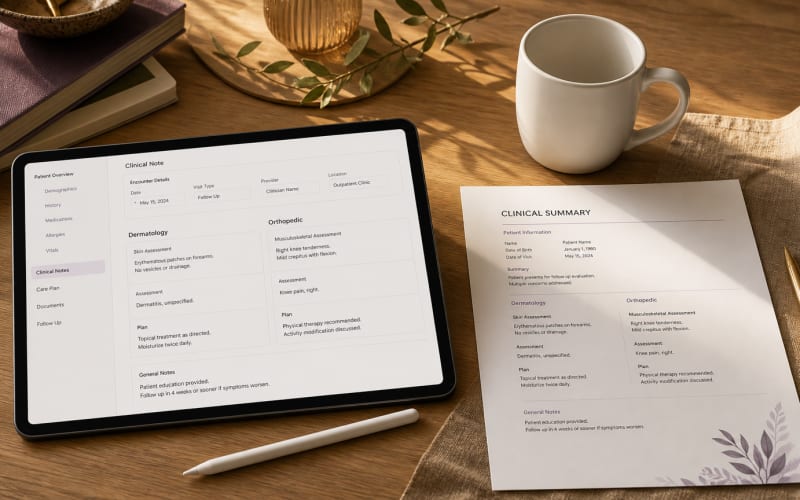
Field mapping is the core of the engine. When a provider opens a complaint-driven chart, the extension identifies the stable DOM selectors for each documentation region within Experity's tabbed structure. The generated note is decomposed to match that structure: history flows to the HPI field, structured MDM to the assessment region, and disposition to the discharge editor. This selector-based approach means we adapt to the chart the clinician actually sees, with no per-integration licensing and no dependency on a vendor's release calendar.
Sub-Second Latency in High-Volume Surges
Latency discipline is non-negotiable in an urgent care surge. Our streaming ASR pipeline processes ambient audio and produces field-ready drafts at roughly 0.4-second latency, so the structured note is waiting the moment the clinician finishes the encounter. Because DOM injection is local, there is no network penalty added to that budget. The clinician reviews, edits, and signs—the throughput governed by Experity's own workflow, never by our infrastructure.
Integration Architecture Compared
The practical differences between approaches are best seen side by side. Traditional API marketplace integrations promise depth but demand IT resources and introduce latency; manual copy-paste is free but destroys throughput and invites transcription error. DOM injection sits deliberately between them, capturing the speed of automation without the overhead of a backend project.
| Architecture | Deployment Overhead | Latency | Annual Fee | Throughput Impact |
|---|---|---|---|---|
| Traditional API Marketplace | Interface-engine project, IT credentials, change control (weeks to months) | API round-trip lag per write | Marketplace + per-transaction fees | Configuration-dependent |
| Manual Copy-Paste | None | Human transcription time (minutes) | None | Severely negative |
| Merry AI DOM Injection | Chrome Extension install (minutes), no IT ticket | ~0.4s local, no API round-trip | No marketplace or API fees | Neutral to positive |
This comparison reflects a design constraint, not a marketing preference. Experity's value proposition is throughput; any tool that adds required clicks or backend latency undermines the platform's reason for existing. DOM injection is the only architecture that augments documentation quality while remaining invisible to the throughput budget.
Capturing Level 4-5 E/M and MDM Without Adding Clicks
The commercial case is straightforward. Urgent care and ED encounters are selected under the 2021+ MDM framework, where the level is driven by the number and complexity of problems addressed, the amount and complexity of data reviewed, and the risk of complications or mortality. Experity's built-in coding engine reads discrete data—orders, diagnoses, prescriptions—but it cannot infer the reasoning narrative behind a high-risk decision. That narrative is precisely what payers demand when they request records to support a 99285 or a Level 5 outpatient visit.
Merry AI structures that reasoning explicitly. For an exertional chest pain presentation with diaphoresis, borderline hypotension, and a CAD history, the engine enumerates the problems addressed with acuity tags, counts the unique data points (EKG, troponin, CXR), and states the risk category with the clinical facts that justify it. It then surfaces a concise, auditable E/M justification that feeds the existing coding engine. Clinicians should always cross-reference the current AMA CPT E/M and MDM guidelines when finalizing level selection, since Merry AI functions as decision support, not an autonomous coder.
G2211 and Longitudinal Complexity Capture
Add-on code G2211 is frequently missed in fast-moving outpatient settings because its complexity is inherent rather than procedural. For office/outpatient E/M visits (99202-99215) that serve as a continuing focal point of care or address a single serious or complex condition, G2211 may be reportable per CMS guidance effective January 1, 2024. Merry AI flags qualifying longitudinal encounters and drafts supporting language so the add-on is captured with documentation, not guesswork.
Compliance and the Clinician as Author of Record
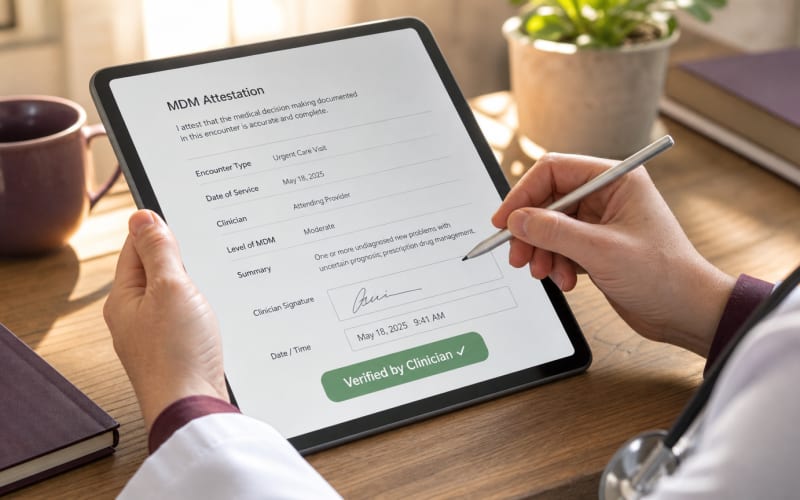
Auditability is the anchor of the design. Merry AI never alters the record autonomously—it produces a draft that the clinician reviews, edits, and attests, keeping the provider as the definitive author. Under our executed BAA, the pipeline retains zero audio and zero transcript, and every injected suggestion is a reviewable artifact rather than a silent write. This posture aligns with payer expectations that Level 4-5 documentation clearly and defensibly supports the level of care rendered.
Getting Started Without an IT Project
Onboarding is measured in minutes, not procurement cycles. A single clinician can install the Chrome Extension, grant host permission for the Experity/DocuTAP domain, and begin injecting structured drafts in the same session—no firewall change, no interface engine, no marketplace contract. When you are ready to scale, Explore Merry AI Practice Partner Plans to extend the workflow across a full clinic or multi-site urgent care group.
The fastest way to evaluate fit is to watch the engine work against your own complaint templates. Schedule a 15-Minute Workflow Audit and we will map your live DOM selectors, demonstrate a high-acuity injection end to end, and show how structured MDM raises your documentation floor without costing a single second of throughput. To prepare, you can Access 1,000+ EHR Clinical Templates and preview the structured notes your team will inject on day one.