A Documentation Workflow Built for GI EHRs (gMed / Epic GI)
Clinical documentation inside GI EHRs (gMed / Epic GI) rarely fails because clinicians lack dedication. It fails because the endoscopy narrative and the structured registry fields live in two different mental models. An endoscopist dictates "7 mm sessile polyp in the transverse colon, cold-snared" in fluid prose, then someone—often an administrator—later transcribes that same information into a GIQuIC form inside the endowriter to update the quality registry. That double-handling is where guideline-concordant recall intervals get lost and where MIPS numerators quietly drift out of compliance.
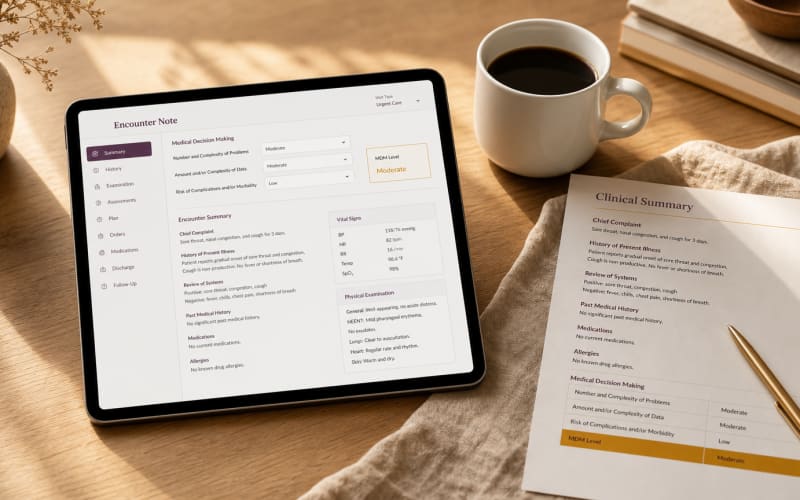
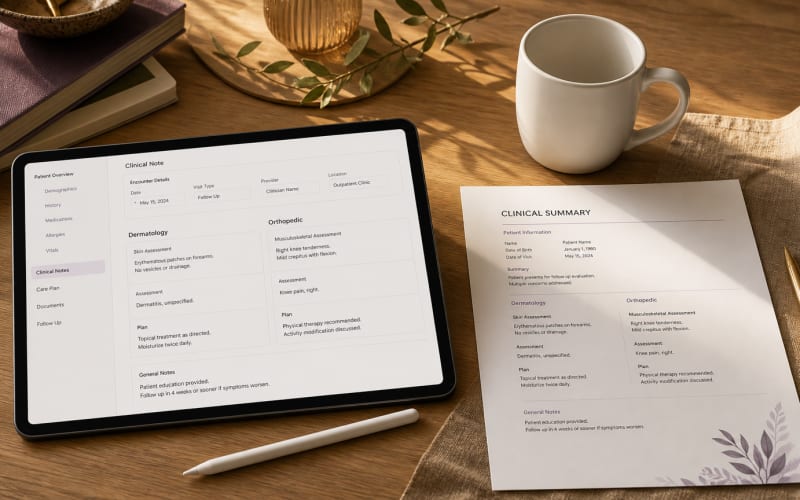
Merry AI positions itself as an upstream clinical intelligence layer that converts endoscopy narrative into GI-specific structured data—Prague classification, polyp count and morphology, dysplasia statements—and routes it into the exact DOM fields your gMed/gGastro Endoscopy Report Writer or Epic GI SmartData Elements already expose. The engine does not pretend to hold a privileged FHIR write channel into these systems. It works where the clinician works: inside the rendered browser window, injecting reviewed text into the fields you can already edit.
This architecture matters most in a specialty where the report is simultaneously a clinical document, a billing artifact, and a registry submission. When your colonoscopy findings must feed ADR calculations, Barrett's surveillance recall, and Quality ID #249 all at once, the fidelity of the first draft determines the quality of every downstream report. Merry AI treats that first draft as structured from the moment it is spoken.
Why DOM Injection Beats API Marketplaces for GI EHRs (gMed / Epic GI)
Traditional integration doctrine assumes the answer to interoperability is always an API. For open, modern platforms that is often true. But gMed/gGastro and many Epic GI configurations are effectively closed to fast, clinician-level write access: the marketplace path involves procurement, connector licensing, interface-engine builds, and validation cycles measured in quarters, not afternoons. During that time, your endoscopists keep copy-pasting.
The browser-native alternative sidesteps that entire procurement stack. Because Merry AI's Chrome Extension operates inside the authenticated session, it inherits the clinician's existing permissions and writes through the same DOM input selectors a human would use. There is no service account to provision, no HL7 ORU feed to certify, and no per-transaction API metering. The result is sub-second field mapping instead of the batch-oriented lag that server-side interfaces introduce.
Consider the cost asymmetry directly. A marketplace integration carries setup fees, annual connector maintenance, and the opportunity cost of an interface team's backlog. DOM injection carries the cost of a Chrome Web Store install. For a mid-sized endoscopy center running dozens of procedures per day across gMed and Epic GI, the difference is the ability to standardize documentation this month versus next fiscal year.
| Architecture | Deployment Overhead | Latency | Annual Fee |
|---|---|---|---|
| Traditional API Marketplace | Procurement, connector license, HL7/FHIR interface build, validation cycles (weeks to quarters) | Batch or near-real-time with queue lag | High: setup fee plus recurring per-connector and maintenance cost |
| Manual Copy-Paste | None, but permanent human transcription burden | Human speed; error-prone re-entry into GIQuIC forms | Hidden: administrator hours and rework |
| Merry AI DOM Injection | Chrome Web Store install; optional group-policy whitelist | Sub-second (0.4s) field mapping in-session | Flat practice-partner subscription; no marketplace or API metering |
DOM Field Mapping for Endoscopy Report Writers
Field mapping is the technical heart of the system. When an endoscopist finishes an EGD with Barrett's surveillance, Merry AI has already parsed the dictated narrative into normalized elements: circumferential extent, maximal extent, presence of nodularity, biopsy protocol adherence. The extension then locates the corresponding selectors in the gGastro ERW or Epic flowsheet DOM and populates each one. "Barrett's segment from 33 to 37 centimeters, circumferential from 34 to 36" resolves cleanly into discrete C2M4 fields rather than trapped prose.
Zero-IT Deployment Across Multi-Provider Centers
Multi-provider endoscopy centers benefit disproportionately from a client-side model. Each physician installs once, and their own browser session governs access. There is no central interface that must be re-validated every time a new provider joins or a new gMed build ships. This decoupling is precisely why zero-IT deployment scales in busy screening practices where staffing changes constantly.
Structuring Barrett's, Polyps, and MIPS-Ready Data
Gastroenterology quality reporting in 2026 is unforgiving about structure. Quality ID #249 requires that every esophageal biopsy report documenting Barrett's mucosa—ICD-10-CM K22.70, K22.710, K22.711, K22.719—include an explicit statement about dysplasia. Merry AI's rule engine detects Barrett's mucosa in the narrative and confirms that a discrete dysplasia statement ("no dysplasia identified," "low-grade dysplasia present") exists before the draft is eligible for commit, hardening your #249 numerator at the point of care.
Polyp metrics receive the same discipline. Count, largest size in millimeters, morphology, colon segment, resection technique, and pathology category are extracted and mapped to the fields GIQuIC and QCDR measures depend on for adenoma detection rate and interval-appropriateness scoring. Because Quality #185 was retired from the 2026 Gastroenterology MVP, the burden of demonstrating guideline-concordant colonoscopy intervals now leans harder on GIQuIC-based measures—making clean structured capture more consequential, not less.
Coding accuracy travels alongside clinical structure. For longitudinal outpatient GI care, Merry AI supports capture of the CPT G2211 visit-complexity add-on where the encounter serves as the continuing focal point for a patient's serious or complex condition, consistent with CMS guidance. Clinicians who want to verify current coding rules can consult the AMA CPT resources directly; Merry AI simply surfaces the structured evidence that supports the code rather than asserting it on your behalf.
Prague Classification Auto-Extraction
Prague terminology is notoriously variable in dictation, and that variability is exactly what NLP tuned to GI language is built to absorb. Whether the endoscopist says "C2M4" outright or describes segment boundaries in centimeters, the engine normalizes both into consistent circumferential and maximal-extent fields, then links them to the Barrett's problem-list diagnosis and surveillance-interval logic.
Governance, BAA Coverage, and Clinician Authorship
Every injected draft is provisional until the clinician reviews and signs it. This is not a compliance footnote—it is the architectural principle that keeps the physician as author of record. Merry AI never commits a note autonomously; it prepares a structured, guideline-aware draft and waits for human judgment. The EHR's native audit trail captures the signature exactly as it always has.
Data governance is equally deliberate. Under an executed BAA, Merry AI retains zero audio and zero transcript once a draft is handed off, and protected health information is never used to train models. Transport is encrypted, browser permissions are scoped to the tabs you grant, and the extension cannot reach any DOM you have not explicitly authorized. To see how this maps onto your specific gMed or Epic GI configuration, Schedule a 15-Minute Workflow Audit and we will trace your endoscopy documentation path field by field.
Getting Started With GI EHRs (gMed / Epic GI) Integration
Onboarding follows an unhurried sequence because rushing clinical tooling is how errors enter charts. First, install the Chrome Extension on the endoscopist's workstation. Second, load your preferred endoscopy templates from the Template Center so colonoscopy, polypectomy, and Barrett's surveillance structures are ready. Third, run a handful of dictations against a test chart to confirm DOM field mapping into your gGastro ERW or Epic GI flowsheet.
From there the workflow disappears into the background, which is the point. To standardize documentation quality across your center you can Access 1,000+ EHR Clinical Templates and adapt them to your local smart phrases, or review deployment tiers and Explore Merry AI Practice Partner Plans to match the model to your provider count. The goal is a quiet documentation layer that turns spoken endoscopy findings into structured, MIPS-ready, signed records—without a single marketplace invoice.