Merry AI writes dermatology drafts directly into ModMed EMA procedure note fields
Dermatology documentation inside ModMed EMA usually breaks down at the procedure note. A clinician treats eleven actinic keratoses across the scalp and dorsal hands. Afterward, the clinician spends several minutes reconstructing which sites were treated, how many lesions were destroyed, how many freeze-thaw cycles were used, and which topicals the patient already failed. Payers read that procedure note line by line during a destruction claim review. Missing lesion counts or vague anatomic sites are a common reason destruction services get downcoded or denied.
Merry AI's Chrome Extension operates inside the clinician's existing browser session. It listens to the encounter, drafts a structured dermatology note, and maps each section to the visible ModMed EMA input elements on screen. When the clinician approves the draft, the extension writes text into the procedure note free-text nodes and exam narrative fields through standard client-side input events. The text arrives the same way typed keystrokes would. Merry makes no server API call to ModMed, the practice buys no marketplace connector, and no interface engine sits between the practice and its chart.
Every CPT 17000 destruction note must state lesion count, anatomic site, and failed topicals
CPT 17000 reports destruction of the first premalignant lesion, such as an actinic keratosis. CPT 17003 is the add-on code for lesions two through fourteen, reported once per lesion. CPT 17004 replaces both codes when fifteen or more lesions are destroyed. Billed units depend entirely on the documented count. For that reason, the Merry AI dermatology template will not finalize a destruction block until three elements are present: the exact lesion count, the anatomic site for each lesion or cluster, and the topical therapies previously tried and failed.
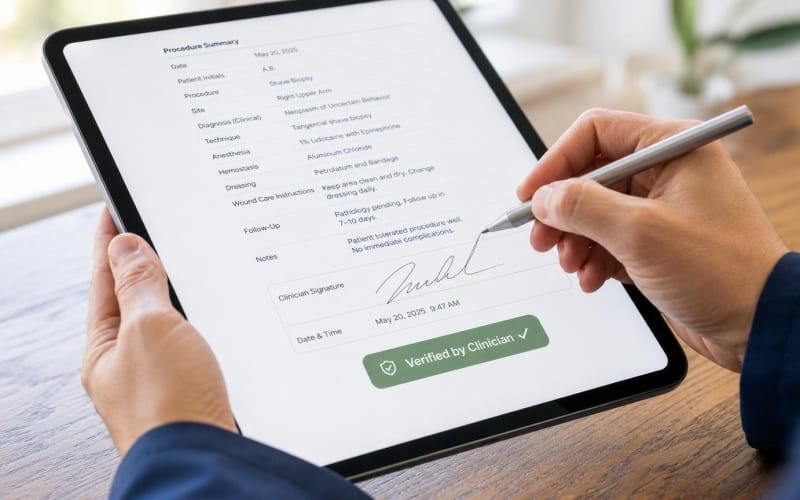
A compliant Merry AI draft for a cryotherapy session reads like this: Destruction of 11 actinic keratoses by liquid nitrogen cryotherapy, two freeze-thaw cycles. Sites: 6 lesions vertex scalp, 3 lesions right dorsal hand, 2 lesions left dorsal hand. Prior therapy: topical 5-fluorouracil 5% cream for 4 weeks, discontinued for intolerance; imiquimod 5% cream for 8 weeks with persistent lesions. Consent obtained, patient tolerated procedure well. That block supports 17000 x1 and 17003 x10. It lands in the EMA procedure note free-text node, not the general exam narrative.
Failed topical documentation matters because many payer policies tie medical necessity for destruction to symptoms, malignancy risk, or failure of conservative therapy. This applies especially to benign lesion destruction under CPT 17110 and to some commercial actinic keratosis policies. The ambient engine listens for phrases such as 'the Efudex burned too much' or 'she used the Aldara all summer.' It converts them into named agents, durations, and outcomes. When the conversation contains no topical history, the draft flags the gap for the clinician instead of inventing one.
A separate E/M assessment protects modifier 25 and determines G2211 eligibility
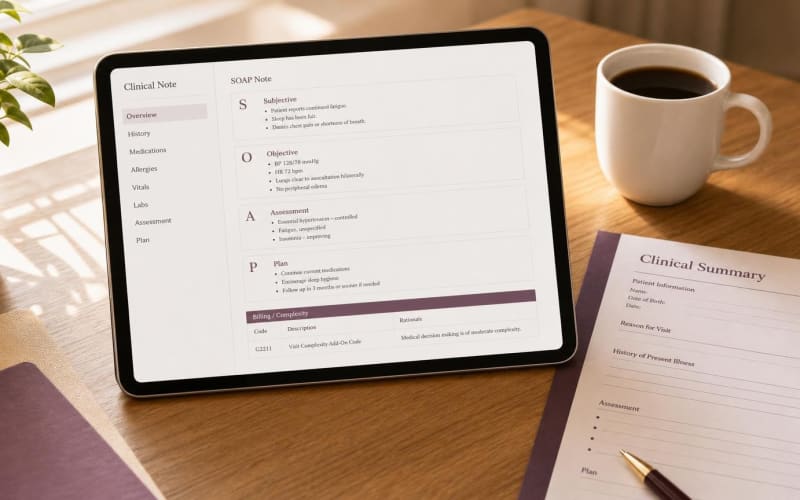
The NCCI Policy Manual defines modifier 25 as a significant, separately identifiable E/M service performed on the same day as a procedure. A pre-procedure look at the lesions about to be frozen is part of the procedure itself. Merry AI therefore drafts the E/M assessment and plan as a distinct block that addresses the separate problem. One example is a new psoriasis flare with body surface area involvement and systemic therapy planning. This keeps the E/M narrative from duplicating the destruction note.
G2211 has a dermatology-specific trap. CMS generally does not pay the G2211 complexity add-on when the base office E/M code carries modifier 25. The exceptions are limited to listed Part B preventive services, such as annual wellness visits and vaccine administration. A melanoma surveillance or biologic management visit without a same-day procedure can support G2211 when longitudinal complexity is documented. A visit that adds a 17000 destruction and bills 99214-25 usually cannot. Merry AI surfaces this distinction in the draft so the clinician makes the coding decision with the rule in view.
Modifier 59 and XS depend on anatomic site detail. Suppose a tangential biopsy (CPT 11102) is performed on one lesion and cryodestruction on a different lesion at a different site. The note must show separate sites so the payer can see that distinct structures were treated. Merry AI keeps each procedure in its own entry with its own site description, so modifier 59 or XS documentation stays clear.
Browser-level DOM mapping removes the marketplace integration layer
| Dimension | Traditional API Marketplace Integration | Manual Copy-Paste | Merry AI Chrome DOM Injection |
|---|---|---|---|
| Setup path | Vendor contract, connector fees, IT project | None | Chrome Extension install per clinician |
| Time to first note | Weeks to months | Immediate | Same day |
| Target fields | Whatever the API exposes, often a single note blob | Wherever the clinician pastes | Procedure note free-text nodes and exam narrative fields mapped on screen |
| Lesion count and site structure | Depends on API scope | Depends on clinician memory | Required before draft completes for 17000, 17003, 17004 |
| Failed topical capture | Not handled by the transport layer | Often omitted | Extracted from conversation, flagged when absent |
| E/M and procedure separation | Possible if fields are exposed | Frequently blended | Distinct blocks for modifier 25 review |
| Ongoing maintenance | Vendor manages API versions | None | Merry maintains selector maps when EMA screens change |
| Audio retention | Varies by vendor | Not applicable | Processed in memory, discarded after drafting under BAA |
DOM injection requires ongoing maintenance that practices should weigh
Browser-level mapping is not maintenance-free. ModMed can change EMA screen layouts at any time. A selector that pointed at the procedure note yesterday could point elsewhere after an update. Merry AI verifies each target field label before writing, stops the write when a mapping does not match, and shows the clinician exactly where text will land. Before deploying any extension that interacts with the chart, practices should review their ModMed agreement and internal security policy. Practices that already license ModMed's native Scribe should compare the two approaches directly.
Audio handling follows a minimal-retention design. Merry processes encounter audio in memory to generate the draft, then discards it. Under its executed Business Associate Agreement, Merry does not store raw audio or full transcripts. Only clinician-approved note text enters the ModMed EMA chart.
The clinician signature remains the only path into the legal record
No draft reaches the chart without clinician review. The clinician reads the procedure block, confirms the lesion count against what was treated, edits sites if needed, and attests. This follows the same principle found in California SB 1120, which governs health plans: licensed professionals, not software, make medical necessity determinations. The signing clinician owns every word in the record.
Practices evaluating this workflow can start with a short audit of recent destruction claims. Schedule a 15-Minute Workflow Audit or browse dermatology procedure templates at templates.scribing.io.