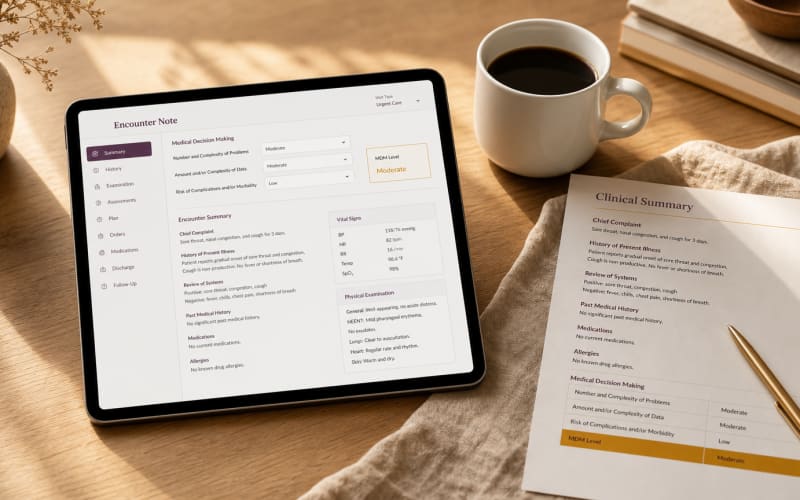
A Documentation Workflow Built for NextGen Enterprise EHR
Clinical documentation inside NextGen Enterprise EHR rarely fails because clinicians lack dedication. It fails because the encounter is grid-driven and dense—Chief Complaint, HPI, ROS, Exam, Assessment, Plan, Orders—each rendered as configurable checkboxes, dropdowns, and narrative fields tuned to roughly 26 to 30 specialties. In a multi-specialty ambulatory group, a cardiologist, a dermatologist, and an internist may each open a different template layout within the same platform, and the cognitive load of navigating those grids after every patient is a documented contributor to burnout.
Merry AI approaches this problem as a distributed systems challenge rather than an integration-marketplace transaction. We listen to the clinician-patient conversation, structure the narrative into a USCDI v4-aligned DocumentReference object, and inject the resulting HPI and Plan content directly into the corresponding NextGen encounter grids using browser DOM selectors. There is no server-side API call, no HL7 document-import agent, and no queue latency between the moment you finish speaking and the moment your draft appears in the chart.
This overlay-style architecture matters because NextGen Enterprise itself already expects AI to generate structured content and place it into existing documentation workflows pending clinician review. Our method sits alongside that expectation—the difference is that Merry AI achieves it without touching a single API endpoint, without provisioning an OAuth client, and without waiting weeks for interface-engine configuration. The clinician remains the author of record at every step.
Why DOM Injection Beats API Marketplace Integration
Traditional integration paths for closed and enterprise EHRs impose real friction. NextGen Office exposes OAuth 2.0 APIs, but NextGen Enterprise deployments in ambulatory groups typically rely on interface engines, HL7 feeds, and CCD-based document exchange—each carrying provisioning cycles, queue lag, and per-connection maintenance. For a group that simply wants ambient notes to land in the HPI and Plan fields, that overhead is disproportionate to the goal.
Manual copy-paste, the fallback most clinicians default to, is worse. It moves PHI through the clipboard, breaks structured section boundaries, and reintroduces exactly the transcription burden the AI was meant to eliminate. It also scales poorly across a multi-specialty roster where each template layout differs.
The table below compares the three deployment models against the metrics that matter to an ambulatory operations lead—overhead, latency, and recurring cost.
| Architecture | Deployment Overhead | Latency | Annual Fee |
|---|---|---|---|
| Traditional API Marketplace Integration | Weeks to months; OAuth client registration, interface-engine build, IT provisioning | API rate limits + queue lag | Marketplace + per-connection fees |
| Manual Copy-Paste | None, but full clinician effort every note | Human typing speed | $0, paid in burnout |
| Merry AI DOM Injection | Under 48 hours per specialty template; zero-IT Chrome Extension | 0.4s streaming, direct field write | Flat practice-partner plan |
Because the extension writes into the same editable fields a clinician would type into, NextGen's native audit trail, authorship attribution, and sign-off workflow remain fully intact. We do not auto-sign, we do not bypass authentication, and we do not silently commit orders or diagnoses—injected content lands as a reviewable draft.
Mapping Clinical Narratives Into NextGen Grids
The core of our engine is the translation from spoken encounter to structured grid population. Merry AI produces a canonical DocumentReference-style object aligned to USCDI v4 Clinical Notes categories—History & Physical, Office Visit Note—complete with encounter metadata, author, timestamp, and clearly separated Subjective, Objective, Assessment, and Plan sections.
Template-to-Field Selector Mapping
For each specialty template in a pilot, our engineers identify the DOM selectors for the HPI narrative field, the Assessment and Plan grid narrative fields, and optional ROS and Exam fields. These mappings are versioned—template version maps to selector set maps to DocumentReference section—so that when NextGen ships a UI update, we adapt selectors rapidly rather than breaking silently. We prioritize high-burden specialties like internal medicine, cardiology, and orthopedics first to deliver visible value within the 48-hour window.
Runtime Injection And Chart Detection
When a clinician opens an encounter, the extension detects the loaded template via DOM markers, retrieves the corresponding DocumentReference for that patient and visit, and injects HPI text into the HPI field and Plan text into the Plan grid. Structured suggestions—ICD-10 candidates, medication mentions—are placed as reviewable text for reconciliation rather than committed directly, keeping unsafe automation off the table.
Coding Integrity and CPT G2211 Capture
Multi-specialty ambulatory groups increasingly depend on accurate evaluation and management coding under the 2021 CPT framework, where visit level is driven by medical decision-making rather than history and exam volume. Merry AI's structured Plan and Assessment output surfaces the complexity-of-problems and risk elements that support appropriate E/M selection, giving your coders defensible narrative documentation.
A specific opportunity is CPT add-on code G2211, which Medicare permits for the inherent complexity of longitudinal, continuous care relationships in office and outpatient E/M visits. Per CMS guidance (MM13473), the code recognizes ongoing responsibility for a patient's overall care. Merry AI structures the longitudinal-relationship context into the Plan narrative so that clinicians can substantiate G2211 when clinically appropriate. For the underlying clinical and reimbursement literature, the NCBI PMC archive (https://www.ncbi.nlm.nih.gov/pmc/) is a useful reference alongside the AMA's E/M revision materials.
Provenance And Audit Readiness
Every injection event is logged in an internal provenance store that links the source audio, the AI model version, the generated DocumentReference, and the user session and timestamp of the DOM write. Although NextGen may not record that content originated from Merry AI, we can reproduce a full provenance chain for medico-legal or compliance audit—satisfying expectations for transparent AI involvement in documentation.
Deployment, Compliance, and Getting Started
Standing up Merry AI in a NextGen Enterprise environment is a targeted overlay, not an enterprise rewrite. The Chrome Extension installs inside the clinician's existing browser session with no firewall changes, no VPN reconfiguration, and no marketplace setup fee. Selector maps for the first target templates are validated in under 48 hours, and additional specialties are added incrementally.
Security And Regulatory Alignment
All PHI handling occurs under an executed Business Associate Agreement with zero retention of audio or transcripts. Data is encrypted in transit and at rest, the injection component follows least-privilege access limited to mapped fields, and clinician review with signature is enforced before any note becomes part of the legal record. This aligns with HIPAA obligations and with the professional expectation that clinicians remain responsible for accuracy and clinical decisions.
To move forward, browse our structured template library and generate a NextGen-ready note in seconds: Access 1,000+ EHR Clinical Templates at https://templates.scribing.io. When you want a mapping strategy for your specific specialty template versions, Schedule a 15-Minute Workflow Audit at https://cal.com/merryai/demo. And to review commercial terms for your group, Explore Merry AI Practice Partner Plans at https://merryscribe.com/#pricing.