Browser-native DOM mapping writes orthopedic notes into NextGen Enterprise without a server API
Clinical documentation inside NextGen Enterprise rarely fails because orthopedic surgeons lack dedication. It fails because a 12-minute follow-up for a degenerative knee generates HPI, goniometric exam findings, imaging correlation, and a staged plan that must be typed into separate template fields between cases. Merry AI closes that gap at the browser layer.
The Merry AI Chrome Extension runs as a content script inside the clinician's active NextGen Enterprise tab. It reads the rendered template, identifies the progress note textarea and the adjacent HPI, exam, and assessment fields by their labels, and writes the clinician-reviewed draft into those fields through standard DOM value assignment. NextGen's own save logic then persists the text exactly as if the surgeon had typed it.
No HL7 interface, FHIR endpoint, or marketplace enrollment is involved. Because nothing is exchanged server to server, there is no integration fee, no interface engine to maintain, and no change request queued with the EHR vendor.
Site-specific selector maps keep injection accurate across customized NextGen templates
NextGen Enterprise is template driven. Its data entry fields accept text, dates, times, and numeric values, and practices can configure up to 14 client-defined fields. Two orthopedic groups running the same Post-Op Rapid Note template can therefore render different labels and layouts.
Merry AI ships a configuration layer that maps each site's field labels to DOM selectors instead of assuming fixed element IDs. During onboarding, the map covers:
- History of present illness fields, including surgical history on post-op templates.
- Orthopedic physical exam fields, for ROM, strength, and stability findings.
- Assessment and plan fields, including the progress note textarea targeted by default.
- Client-defined fields used locally, such as ROM degrees or functional outcome scores.
The extension is tab aware. It watches panel selection state and injects only into fields visible on the active tab, so exam content never lands in an HPI box. When templates render inside same-origin frames, the content script runs inside those frames as well. Injection is also sequenced after any NextGen-native note generation completes, so neither source overwrites the other.
One deployment requirement matters here. DOM injection works where NextGen Enterprise renders inside Chrome. Practices running the Windows thick client or a Citrix-published desktop session receive a structured clipboard fallback until browser access is enabled.
Orthopedic notes need degrees, named tests, and staging rather than general impressions
Generic ambient scribes often write phrases such as 'good range of motion' that weaken both clinical quality and E/M support. Merry AI's orthopedic prompt logic structures each encounter around these elements:
- Anatomy and pathology specificity: laterality, structure, and lesion, such as a right medial meniscus tear.
- Mechanism and chronicity detail: acute trauma versus degenerative onset, duration, and prior injections, therapy, or surgery.
- Objective exam metrics captured: goniometric ROM in degrees, manual muscle testing grades, and named maneuvers such as Lachman, pivot shift, and anterior drawer with explicit positive or negative results.
- Imaging and staging references: Kellgren-Lawrence grade, fracture classification, MRI findings, and hardware status.
- Validated functional outcome scores: KOOS, Oxford Knee Score, or DASH where collected.
- Comorbidity context for perioperative risk: NYHA class and LVEF for heart failure, DSM-5-TR aligned behavioral diagnoses, and Bright Futures surveillance in pediatric orthopedics.
G2211 focal point language is appended only when longitudinal criteria are documented
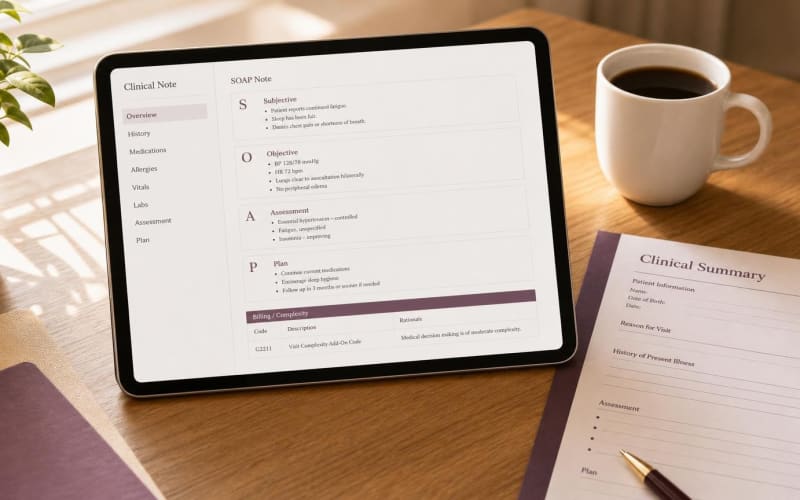
HCPCS add-on code G2211 recognizes visit complexity tied to the practitioner serving as the continuing focal point for needed care, or to ongoing care of a single serious or complex condition. It attaches to office/outpatient E/M codes 99202 through 99205 and 99211 through 99215, and beginning January 1, 2026, to eligible home or residence E/M codes 99341 through 99350.
Merry AI appends a G2211 statement to the assessment and plan only when the encounter shows a chronic condition managed across prior visits, such as staged osteoarthritis care or ongoing hardware surveillance. The statement names the surgeon's continuing role, the longitudinal risks, and the coordination performed with primary care or cardiology. Clinicians can toggle it off for any encounter.
Orthopedic billing rules narrow eligibility. Post-operative visits inside a 90-day global period are reported with 99024 and do not carry G2211. CMS also denies G2211 when the E/M is billed with modifier 25 on the same day as a separately payable procedure, such as a joint injection or aspiration. The 2025 exception is limited to same-day annual wellness visits, vaccine administration, and Part B preventive services. Merry AI therefore writes procedure documentation in a separate block, so modifier 25 and modifier 59 decisions rest on visibly distinct work.
Merry AI Chrome DOM Injection removes the trade-off between API cost and manual re-entry
| Capability | Traditional API Marketplace Integration | Manual Copy-Paste | Merry AI Chrome DOM Injection |
|---|---|---|---|
| Setup path | Vendor partnership, interface build, IT change control | None | Chrome Extension install plus site field mapping |
| Recurring integration fees | Marketplace or interface fees are common | None | None |
| Field-level placement | Often a single document or note section | Clinician pastes field by field | Mapped to HPI, exam, assessment, and progress note textarea |
| Orthopedic structure | Depends on vendor model | Depends on clinician recall | ROM degrees, named tests, and staging by default |
| G2211 focal point language | Rarely specialty specific | Typed manually | Appended when longitudinal criteria are present |
| Clinician time per note | Low after go-live | High | Low: review and attest |
| Audio retention | Vendor dependent | Not applicable | 0-day retention, RAM only |
The comparison reflects a structural difference. API marketplace integrations depend on vendor partnerships and interface staffing. Copy-paste depends on clinician time after hours. DOM injection depends only on the browser the clinician already uses.
Encounter audio is processed in memory and shredded with 0-day retention
Encounter audio streams are held in process memory only, transcribed in real time, and zeroized from RAM after note injection. Raw audio is never written to disk or cloud storage, and Merry AI operates under an executed BAA. Text-based audit logs record what was generated and what the clinician changed.
California AB 3030 governs outputs, not audio inputs. When the extension drafts patient-facing content such as after-visit instructions or portal messages, it attaches a generative AI disclaimer for clinician verification, a requirement that does not apply once a licensed provider has read and reviewed the communication. California SB 1120 addresses utilization review by health plans, so clear medical necessity documentation for orthopedic indications supports coverage review. Jurisdiction-aware disclosure settings let compliance teams adapt as Texas AI legislation takes effect.
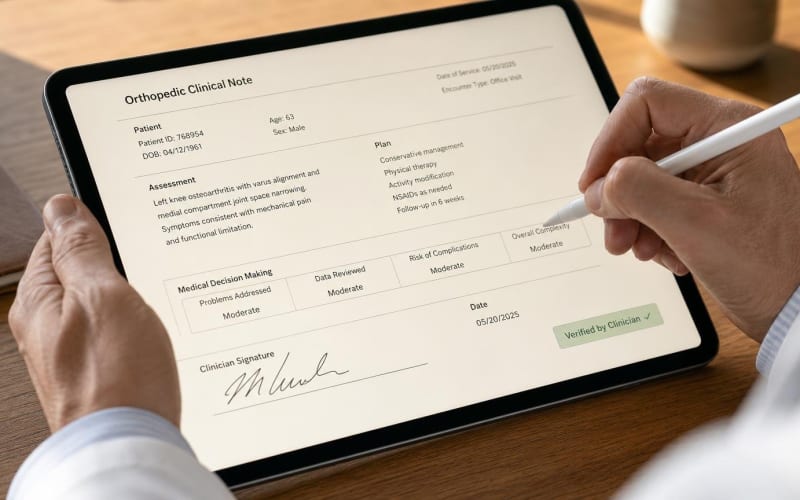
Clinician attestation remains the final control on every NextGen chart
Every injected draft stays editable until the surgeon reviews, edits, and signs. Merry AI never signs notes, never commits charts, and never submits claims. The clinician remains the author of record, which preserves signature integrity and keeps coding decisions with the people accountable for them.