Browser-native DOM mapping bypasses EHR marketplace paywalls entirely
Clinical documentation inside Practice Fusion rarely fails because clinicians lack dedication. It fails because family physicians close 20 to 30 encounters a day across pediatrics, chronic disease, behavioral health, and procedures, then retype the same reasoning into four SOAP boxes after clinic. Merry AI removes the retyping step without asking Practice Fusion for an API.
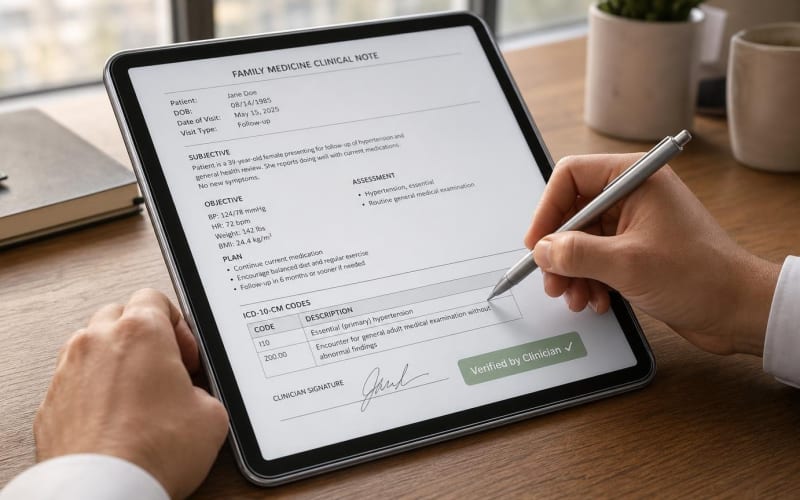
The Chrome Extension runs inside the clinician's active Practice Fusion tab. It confirms the page is a chart note, waits for the SOAP sections to finish rendering, and locates Subjective, Objective, Assessment, and Plan by their visible labels and layout rather than by class names or IDs that change with UI releases.
Text enters each field through standard browser input and change events, the same events produced by typing. Practice Fusion's own autosave and template logic respond exactly as they would to manual entry, and the note persists only through the clinician's normal save actions.
Merry re-validates the Practice Fusion field map on every page load
Practice Fusion does not publish its DOM selectors or frame structure. Merry therefore rebuilds the label-to-field map each time a chart loads, each time the clinician switches tabs between encounters, labs, or messages, and each time a late-rendering component appears. Queries are scoped to the chart note container the clinician is viewing, not to global selectors.
When field confidence is low, automation stops. The draft appears in the overlay for manual placement instead of being guessed into the wrong box, so misfiled text never reaches the chart silently.
The diagnosis search input receives clinical phrases, and the clinician selects the code
For the diagnosis search input, Merry focuses the Practice Fusion field, injects a specific search phrase derived from the transcript, and lets Practice Fusion's native search return candidate codes. The clinician selects the final code. No direct database write occurs.
The following ICD-10 codes are extracted as a discrete list from the family medicine narrative used in this workflow:
- A08.4: Viral intestinal infection, unspecified
- Z32.01: Encounter for pregnancy test, result positive
- F33.1: Major depressive disorder, recurrent, moderate
- I50.22: Chronic systolic heart failure, with NYHA class and LVEF documented in Assessment
Each extracted code remains a search suggestion until the clinician confirms it in Practice Fusion. A08.4 and Z32.01 illustrate why: a same-day gastroenteritis complaint and a positive pregnancy test change medication and imaging safety, so the clinician, not the extension, decides how each one sits on the problem list.
Family medicine notes must carry five diagnostic frameworks at once
Family medicine spans more frameworks than any single specialty template covers. Merry's Practice Fusion templates structure the transcript around the criteria each domain requires before anything is written to a field:
- Behavioral health under DSM-5-TR: duration, severity, functional impairment, and specifiers such as recurrent or with panic attacks.
- Heart failure by NYHA class: exertional symptoms in Subjective, recent LVEF in Objective, and both class and ejection fraction in Assessment.
- Musculoskeletal exams with ROM degrees: quantified abduction and flexion linked to conservative or surgical thresholds.
- Pediatric visits under Bright Futures: nutrition, sleep, school, behavior, safety, growth percentiles, and developmental milestones.
- Preventive care under USPSTF recommendations: screening rationale, risk factors, and longitudinal care plans.
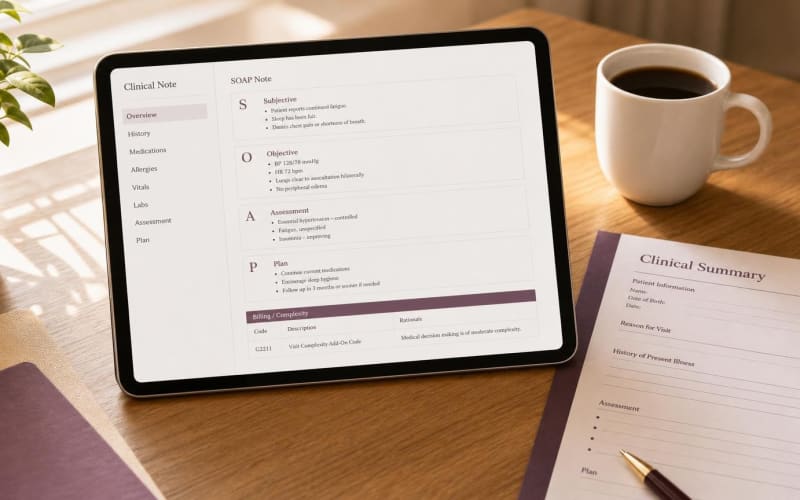
G2211 documentation succeeds only when complexity appears in the chart
HCPCS add-on code G2211 may be reported with office and outpatient E/M codes 99202-99205 and 99211-99215, and from January 1, 2026, with home or residence codes 99341, 99342, 99344, 99345, and 99347-99350. It cannot be billed without one of those base E/M codes.
Because Merry purges audio and transcript from RAM at session close, the Practice Fusion chart becomes the only record an auditor reviews. If longitudinal complexity lives in the conversation but not in Assessment and Plan, the G2211 claim has no support. Merry's templates write the continuing care relationship, multiple chronic conditions, medication management, and care coordination directly into those fields.
The $15,600+ figure is an illustrative annual estimate for one family physician, assuming roughly 16 dollars per eligible G2211 claim across about 975 qualifying visits. Actual capture depends on payer mix, locality, and documented eligibility.
Modifier 25 and modifier 59 require visibly separate narratives
NCCI defines modifier 25 as a significant, separately identifiable E/M service on the same day as a procedure. Merry writes E/M management and the procedure as distinct Assessment and Plan subsections, for example a diabetes and hypertension review kept apart from a same-day joint injection. With limited exceptions, G2211 is not paid when the base E/M carries modifier 25, though since January 1, 2025 it is payable when modifier 25 accompanies an annual wellness visit (G0438, G0439), vaccine administration, or a Medicare Part B preventive service other than glaucoma screening.
Modifier 59 and X-modifiers require documented distinctness by session, procedure, site, organ, incision, or lesion. Merry records each anatomic site or lesion as its own Objective and procedure entry so coders have defensible text, and it never proposes a modifier to bypass an edit.
Three integration paths produce very different Practice Fusion workflows
The comparison below shows how each approach handles a family medicine encounter.
| Criterion | Traditional API Marketplace Integration | Manual Copy-Paste | Merry AI Chrome DOM Injection |
|---|---|---|---|
| Practice Fusion write access | Depends on vendor API and partnership approval | Clinician pastes into each field | Writes into visible SOAP and diagnosis search inputs |
| Setup | IT project, contracts, interface fees | None | Chrome Extension install, no IT ticket |
| Marketplace or API fees | Recurring | None | None |
| Diagnosis search | Varies by API surface | Typed manually | Search phrase injected, clinician selects code |
| Audio and transcript retention | Often stored on vendor servers | Depends on source tool | Purged from RAM at session close, 0-day retention |
| Resilience to UI updates | Tied to API versioning | Not applicable | Field map re-validated on each page load |
| Error handling | Sidecar document fallback | Manual misfiling risk | Halts and shows draft when field match is uncertain |
| Clinician attestation | Required | Required | Required before save |
Server-centric ambient scribes depend on integrations Practice Fusion does not offer
Cloud ambient vendors such as Freed, Suki, Heidi, and DeepScribe generally rely on server-side processing and formal EHR integrations. Where Practice Fusion exposes no note-editing API, those tools often fall back to a sidecar note the clinician must copy into the chart. Many also retain audio or transcripts on vendor servers for QA and re-editing, which draws more scrutiny as state health data and AI rules tighten.
Clinician attestation remains the final control on every injected note
Every draft Merry writes is editable, unsaved text until the clinician reviews it and signs in Practice Fusion. Practices in California or Texas should review the final statutory text of California AB 3030 and SB 1120 and Texas HB 1709 against their patient notification and consent workflow.
To see the workflow on your own Practice Fusion charts, book a 15-minute audit at https://cal.com/merryai/demo.