Endocrine visits in Tebra lose defensible complexity when A1c trends stay buried in the lab tab
Clinical documentation inside Tebra rarely fails because endocrinologists lack dedication. It fails because the evidence of longitudinal management lives in three different places: lab results in one view, medication changes in another, and the follow-up plan in a free-text line typed at the end of a long clinic day. When an auditor reviews the note, the reasoning that connected those facts is often missing.
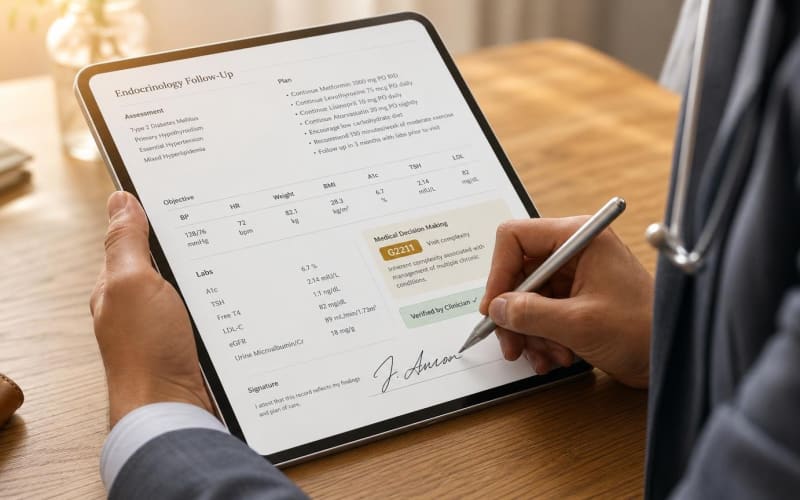
A typical diabetes follow-up visit involves reviewing a CGM download, comparing the current A1c against the prior two or three values, adjusting basal and bolus insulin, considering a GLP-1 receptor agonist, screening for hypoglycemia, and setting a return interval. That is real cognitive work. If the note only records the final insulin dose, the longitudinal relationship that justifies HCPCS add-on code G2211 is invisible on paper.
Merry AI addresses this gap by drafting the endocrine narrative from the encounter and writing it into the exact Tebra note sections where reviewers look for it. The clinician then reads, edits, and signs.
Merry AI writes into the Tebra Clinical Note editor through browser DOM selectors, not server APIs
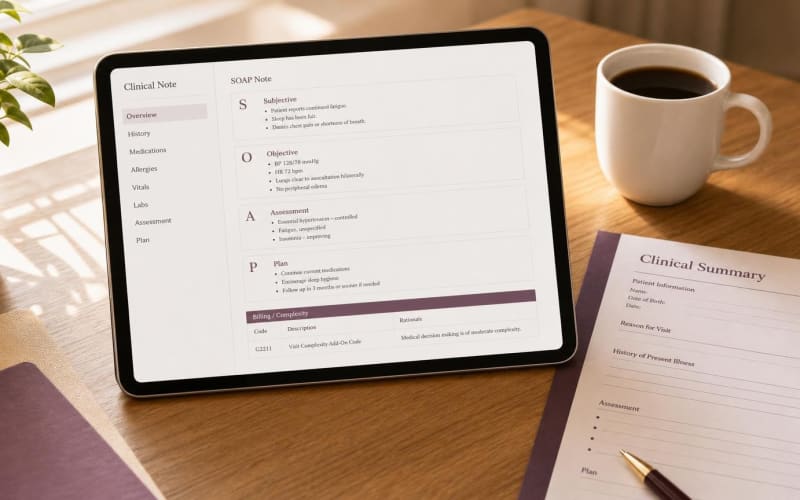
The Merry Chrome Extension runs a content script inside the clinician's existing Tebra browser session. When a Clinical Note is open, whether reached from the Dashboard appointment, the patient Facesheet, or the Notes tab, the extension detects the note editor and maps its visible input fields by DOM selector. Assessment, Plan, and related free-text sections each receive a stable anchor.
After the clinician approves the draft in the Merry side panel, the extension inserts text into those mapped fields the same way typed input would arrive. Tebra's servers receive the note only when the clinician saves it. No Tebra API key, interface engine, HL7 feed, or FHIR endpoint is involved, because the write happens in the browser's rendering of the chart rather than on Tebra's back end.
Selector maps are versioned and maintained against Tebra front-end updates. If a field cannot be located with confidence, the extension stops and asks the clinician to place the cursor manually rather than guessing. A wrong field is worse than no write at all.
Browser-native DOM mapping bypasses EHR marketplace paywalls entirely
Most ambient documentation vendors build for large health systems through API marketplaces. For smaller independent endocrinology practices on Tebra, that model adds per-provider integration fees, vendor approval cycles, and IT projects that the practice may not have staff to run. The comparison below shows how the three common approaches differ for an endocrine clinic.
| Criterion | Traditional API Marketplace Integration | Manual Copy-Paste | Merry AI Chrome DOM Injection |
|---|---|---|---|
| Setup requirement | Vendor approval, credentials, IT project | None | Chrome Extension install per user |
| Recurring integration fees | Often per provider or per transaction | None | None |
| Field-level placement in Tebra | Limited to what the API exposes | Clinician places text by hand | Maps Assessment, Plan, and related editor fields |
| Endocrine structure (A1c trend, titration, interval) | Depends on vendor template | Depends on clinician memory | Structured by specialty prompt logic |
| Error risk | Mapping errors at interface layer | Wrong patient or wrong section paste | Halts if field match confidence is low |
| Clinician attestation | Varies by vendor | Implicit | Required before every write |
| Time to first note | Weeks to months | Immediate | Same day |
The practical difference is that DOM injection works inside the workflow the clinician already uses, while manual copy-paste depends on attention at the end of the day, when errors are most likely.
A1c trend, titration schedule, and follow-up interval are the three facts that prove ongoing complex condition management
Endocrine longitudinal complexity becomes defensible when three elements appear together in the note. Merry prompt logic treats them as a required set rather than optional fields.
The A1c trend comes first. A single value shows status, while a trend shows management. Merry drafts a line such as: A1c 9.1% in January, 8.4% in May, 7.6% today, individualized target below 7.0% given low hypoglycemia risk. The values are drawn from what the clinician reviewed and stated during the visit, and the clinician confirms each number against Tebra lab results before signing. Merry does not invent or infer lab values.
The titration schedule comes second. A defensible plan is specific: increase basal insulin glargine by 2 units every 3 days until fasting glucose is consistently 80 to 130 mg/dL, hold titration and call the clinic for any reading below 70 mg/dL, continue current bolus ratio. Individualized parameters such as renal function, prior hypoglycemia, and cognitive status belong in the reasoning, and the draft prompts the clinician to confirm them rather than defaulting to a generic algorithm.
The follow-up interval comes third. A return visit in 6 weeks with interim CGM data review shows the clinician remains the continuing focal point for metabolic care. Coordination notes, such as communication with the primary care physician or nephrology about CKD, strengthen that record further.
G2211 attestation stays a clinician decision, never an automated default
CMS defines G2211 as an add-on for visit complexity tied to longitudinal care that serves as the continuing focal point for needed services or ongoing care of a single serious or complex condition. It is reported only with office or outpatient E/M codes 99202 through 99205 and 99211 through 99215, and, beginning January 1, 2026, with home or residence codes 99341, 99342, 99344, 99345, and 99347 through 99350.
Modifier 25 changes the answer. CMS generally denies G2211 when the base E/M carries modifier 25, except when the same practitioner furnishes an Annual Wellness Visit, vaccine administration, or certain Medicare Part B preventive services that day. An endocrine visit with a same-day procedure such as a thyroid nodule biopsy may not qualify.
Merry never inserts G2211 language into every follow-up visit. Instead, the side panel shows whether the three supporting facts are present, displays the base code family, and flags any modifier 25 conflict. The clinician decides whether the encounter reflects a longitudinal relationship. Automated, uniform billing language across every visit would create upcoding exposure, and Merry is built to avoid that pattern.
Every injected sentence carries provenance before the clinician signs
Tebra's native audit trail records the user who saved the note, not whether text was typed or inserted. Merry keeps its own encounter-level log showing which sections were drafted, which were edited by the clinician, and when attestation occurred. Practices can export this log for compliance review, which gives auditors a provenance record that the EHR alone cannot provide.
Merry also avoids overwriting content. If Tebra AI Note Assist or a practice template has already populated a section, the extension appends beneath existing text and highlights the insertion for review, so the chart never silently contradicts itself.
Sensitive endocrine content stays in separate templates from the general chart
Endocrinology visits often surface sensitive material: diabetes distress, disordered eating behaviors, gender-affirming hormone therapy counseling, or fertility concerns. Merry routes these discussions into a separately controlled draft, and the clinician decides what belongs in the general Tebra note. Psychotherapy notes as defined under HIPAA are not written into the general chart by default.
A 15-minute audit maps your Tebra note sections to Merry selectors
The fastest way to start is a short workflow review. We open a de-identified Tebra note template with your team, confirm which sections hold A1c trend, titration, and follow-up content, and configure the specialty prompts your clinicians already follow. Clinicians can also browse specialty templates at https://templates.scribing.io before the call.