Wound debridement claims for CPT 11042 are won or lost in the procedure documentation
Clinical documentation inside Tebra rarely fails because wound care clinicians lack dedication. It fails because the evidence a reviewer needs is scattered. Measurements sit in one sentence, tissue type sits in another, and the history of failed dressings lives in a prior visit that nobody re-reads. When that evidence is not present on the date of service, a debridement claim becomes difficult to defend.
CPT 11042 describes debridement of subcutaneous tissue, including epidermis and dermis if performed, for the first 20 sq cm or less. Each additional 20 sq cm is reported with 11045. Medicare contractor billing and coding guidance for wound care, such as the guidelines attached to LCD L34587, expects the record to show devitalized or necrotic tissue, the depth of tissue removed, the surface area debrided, and the wound's response to prior treatment. Merry AI structures every wound draft around those elements so nothing required for 11042 is left to memory.
Merry AI writes wound evidence into the Tebra encounter note panel through a Chrome DOM overlay
The Merry AI Chrome Extension runs as a content script inside the clinician's own authenticated Tebra browser tab. It does not call a Tebra server API, does not require an HL7 or FHIR interface, and does not depend on a marketplace listing. After the clinician approves a draft, the extension locates the encounter note panel using semantic attributes such as accessible labels and data attributes rather than session-specific IDs, which change between page loads.
Tebra renders encounter content dynamically, so the extension uses a MutationObserver to wait until the note component has fully mounted before writing. It then inserts the text and dispatches native input and change events. Those events cause Tebra's own form logic to register the content, which means the note is saved through Tebra's normal save path and attributed to the logged-in clinician.
Encounter binding prevents wrong-chart writes. Before injection, the extension reads the patient name and visit date displayed in the active encounter header and compares them to the draft. If they do not match, the write is blocked. An idempotency key tied to the encounter prevents the same wound block from being inserted twice when a clinician clicks back into the panel.
Practices should verify persistence once during onboarding. The test is simple: inject a draft, save, close the encounter, reopen it, and export the note to PDF. If the wound block appears in all three states, the write path is confirmed for that template.
Browser-native DOM mapping removes the API marketplace dependency for Tebra practices
Three integration paths produce three very different operational and audit outcomes. The comparison below reflects how each approach handles a wound debridement encounter.
| Criterion | Traditional API Marketplace Integration | Manual Copy-Paste | Merry AI Chrome DOM Injection |
|---|---|---|---|
| Setup time | Weeks to months of vendor and IT coordination | None | Minutes, installed per clinician browser |
| Cost model | Partnership, interface, or per-transaction fees vary by vendor | No integration fee, high labor cost | No API or interface fees |
| IT involvement | Credentials, scopes, and security review | None | None, runs in the existing Tebra session |
| Field targeting | Limited to endpoints the API exposes | Depends on where the clinician pastes | Targets the encounter note panel directly |
| 11042 element completeness | Depends on source note quality | Depends on clinician recall | Fixed wound block: L x W x D, tissue type, failed dressings |
| E/M and procedure separation | Rarely enforced | Rarely enforced | Procedure block and E/M narrative drafted separately |
| Wrong-chart risk | Low | Moderate, clipboard errors | Low, patient and visit header match required |
| Audit attribution | Integration service account or user | Clinician | Clinician, through Tebra's native save events |
The 11042 wound block records L x W x D, tissue type, and failed dressings in a fixed order
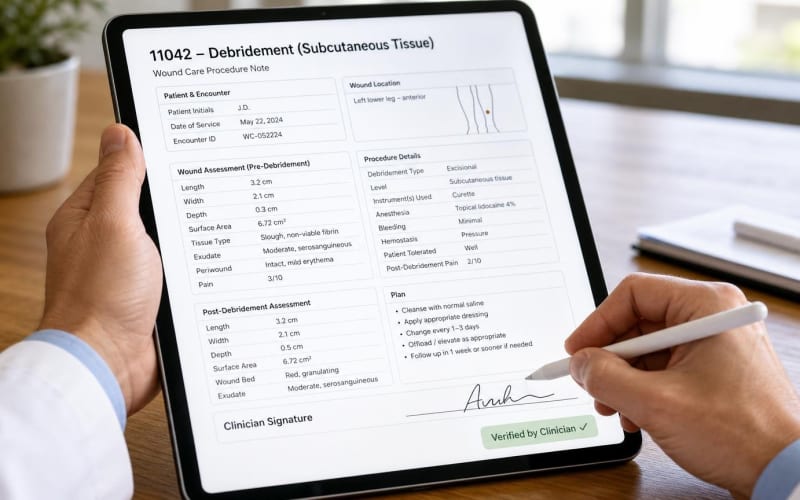
Each wound receives its own labeled section: wound number, anatomical location and laterality, etiology such as diabetic foot ulcer, venous ulcer, arterial ulcer, or pressure injury, and stage or grade where applicable, such as Wagner grade or pressure injury stage. Length, width, and depth are recorded in centimeters, followed by the surface area debrided, which is the value that drives 11042 versus 11045 units.
Tissue type is documented as percentages of granulation, slough, and eschar, along with exudate amount and character, signs of infection, and periwound condition such as maceration, callus, or edema. The depth of tissue removed is stated explicitly, because subcutaneous tissue supports 11042 while muscle or fascia supports 11043 and bone supports 11044.
Failed dressing history is written as a timeline rather than a list. Each prior dressing, such as hydrocolloid, alginate, or foam, is paired with its duration and the measured response. A typical rendered line reads: Wound 1, right lateral malleolus, 3.2 cm x 2.1 cm x 0.5 cm, 60% granulation and 40% slough, moderate serous exudate, no exposed bone; alginate for 3 weeks and foam for 2 weeks without measurable area reduction. That sentence gives a reviewer the medical necessity rationale for escalation.
Multiple wounds follow CPT summing rules. For codes 11042 through 11047, the surface areas of wounds debrided at the same depth are added together, while wounds debrided at different depths are reported separately by depth. Labeling each wound with its own measurements lets coders apply those rules, and apply Modifier 59 or XS only where an NCCI edit applies and the documentation supports a distinct site.
Separating procedure evidence from E/M decision-making is the foundation of Modifier 25 defense
Modifier 25 requires a significant, separately identifiable E/M service beyond the usual pre-procedure and post-procedure work. CMS NCCI guidance is clear that appending Modifier 25 without distinct supporting documentation is not sufficient. When wound measurements and debridement details are blended into the E/M narrative, the same text appears to justify both services, which weakens the claim.
Merry AI drafts two distinct blocks. The procedure block holds wound measurements, tissue type, depth of debridement, instrument, hemostasis, and immediate post-procedure care. The E/M narrative holds glycemic control, vascular status, nutrition, offloading strategy, care coordination, and the longitudinal treatment plan. The clinician decides whether a separate E/M was performed and edits accordingly.
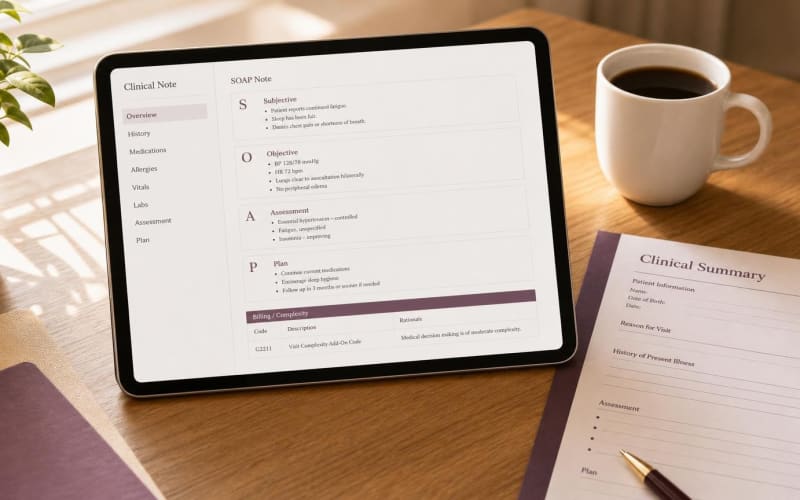
G2211 has a narrower lane. Per CMS MLN Matters MM13473 and MLN006764, G2211 is not payable when the base E/M carries Modifier 25, except when the same-day service is an annual wellness visit, vaccine administration, or a Medicare Part B preventive service. On a day when an E/M is billed with Modifier 25 alongside 11042, G2211 is generally not payable. G2211 fits the follow-up management visits in an ongoing wound plan where no procedure is billed. Merry AI surfaces the longitudinal documentation and never appends codes.
Clinician attestation remains the final control on every injected wound note
No draft reaches the chart without clinician review. The extension inserts text only after the clinician approves it, and the note is signed through Tebra's existing signature workflow. This preserves the authorship validation and amendment integrity that the CMS fact sheet on documentation integrity in electronic health records identifies as core to a valid record.
Audio and transcripts are not retained after the draft is generated, and Merry AI operates under an executed Business Associate Agreement. Practices should also review their Tebra agreement with counsel to confirm browser-based automation aligns with platform terms and internal HIPAA policies.
Payer scrutiny of advanced wound therapy is increasing. California SB 1120 requires that medical necessity determinations in utilization review be made by licensed clinicians reviewing the individual record, which places more weight on what that record actually says. A complete failed dressing timeline with measured response is the documentation those reviewers look for.
Wound care teams can start with pre-built structures at templates.scribing.io or map their current Tebra encounter layout during a 15-minute workflow audit.