Statutory Scope of Florida Statute 934.03 in Psychiatry
Florida treats ambient clinical audio as the interception of an oral communication. Section 934.03(1)(a) prohibits intentionally intercepting any oral communication through an electronic, mechanical, or other device. Section 934.02(2) defines oral communication as speech uttered with an expectation that it is not subject to interception, and a psychiatric consultation room is the paradigm of that expectation.
The controlling clinical exception is section 934.03(2)(d), which permits interception only when all parties to the communication have given prior consent. The statute draws no distinction between a stored recording and real-time streaming to a transcription model; both constitute interception. Law enforcement and child-protection exceptions elsewhere in section 934.03(2) do not reach routine psychiatric care.
Exposure under Chapter 934 is both criminal and civil. Section 934.03(4) classifies unlawful interception as a felony of the third degree, and section 934.10 authorizes civil actions for actual or statutory damages, punitive damages, and attorney fees. Section 934.06 can bar unlawfully intercepted content from evidence, complicating defense of a contested record.
Defining All Parties in Family and Group Sessions
Psychiatry expands the party set beyond the identified patient. Spouses, parents, adolescents, interpreters, case managers, and co-treating clinicians each speak during the encounter, and each is a party whose prior consent is required. A single patient-consented checkbox does not satisfy the statute when a parent or partner contributes collateral history.
Directive P1 governs this workflow: log verbal consent from every participant present, including family, before any recording begins. If any participant declines, that person leaves the room or the session proceeds without ambient capture. In telepsychiatry, the clinician should confirm who is present at the remote site, including off-camera household members, and document the answer.
Consent-Gated Capture Architecture
Merry binds recording capability to the open encounter note rather than to a free-standing microphone toggle. The Chrome extension detects a charting context through resilient DOM selectors, confirms that a progress note is in edit state, and refuses to arm capture on inbox views, chat widgets, or cross-origin editor iframes it cannot inspect.
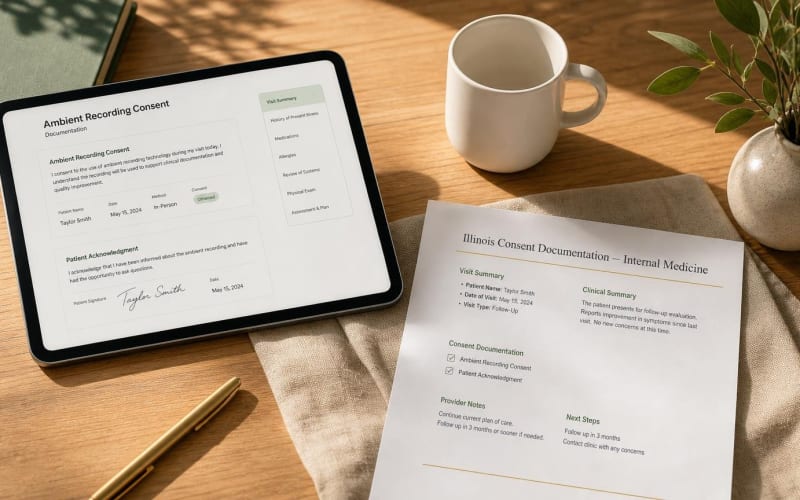
Directive P7 requires one setting: turn on the all-party consent gate in Merry Chrome extension settings. With the gate enabled, the extension writes a standardized consent line to the top of the note, enumerating each participant by name and role with date and time, before the audio pipeline initializes.
Encounter-Bound Consent State Machine
Each encounter moves through three explicit states. In UNCONSENTED, no capture is possible. In CONSENT_PENDING_IN_NOTE, consent text is drafted but unsaved, and capture remains blocked. Only CONSENT_LOGGED, in which the finalized participant list persists in the note, permits audio processing. Deleting the consent block reverts the encounter to UNCONSENTED, and opening another patient chart terminates capture immediately.
Zero-Day Audio Retention
Audio exists only in volatile memory for the duration of transcription. Buffers are never written to local storage, disk, browser cache, or server archives, and they are deallocated once the transcript is generated. No replayable file remains for disclosure or use under sections 934.03(1)(c) and (d); the only artifact is the textual record already governed by HIPAA and section 456.057.
Statutory Comparison of Documentation Models
The following table contrasts three documentation approaches against the operative provisions of Chapter 934.
| Compliance Dimension | Manual Charting | Standard Generic AI Scribes | Merry AI Compliance Architecture |
|---|---|---|---|
| Interception, § 934.03(1)(a) | No device captures audio | Microphone toggle may activate before consent | Capture blocked until CONSENT_LOGGED |
| All-party consent, § 934.03(2)(d) | Not implicated | Often a single patient checkbox | Every participant enumerated in note |
| Audio retention | None | Hours to days for QA or model training | Volatile memory only; zero-day retention |
| Disclosure exposure, § 934.03(1)(c) | Minimal | Stored files create breach and subpoena surface | No replayable artifact exists |
| Telehealth bystanders | Clinician discretion | Rarely addressed | Remote-site participant confirmation |
| Clinician burden | High after-hours charting | Low, with legal uncertainty | Low, with auditable consent trail |
Manual charting avoids interception risk entirely but consumes time that erodes mental status and risk-assessment detail. Generic ambient tools reduce that burden while frequently leaving consent enforcement to clinician memory.
Documentation Integrity, Reimbursement, and Audit Readiness
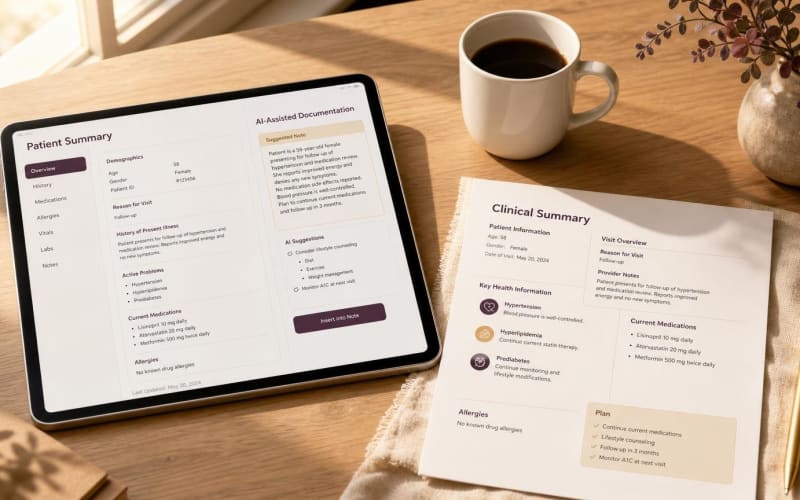
Psychiatric records carry heightened evidentiary weight. Suicidal and homicidal ideation statements, safety plans, capacity determinations, and Baker Act criteria under Chapter 394 must reflect the clinician's exact language. Merry maps spoken findings into structured MSE fields without inferring unstated findings, and it never assigns a DSM-5-TR diagnosis without explicit clinician confirmation.
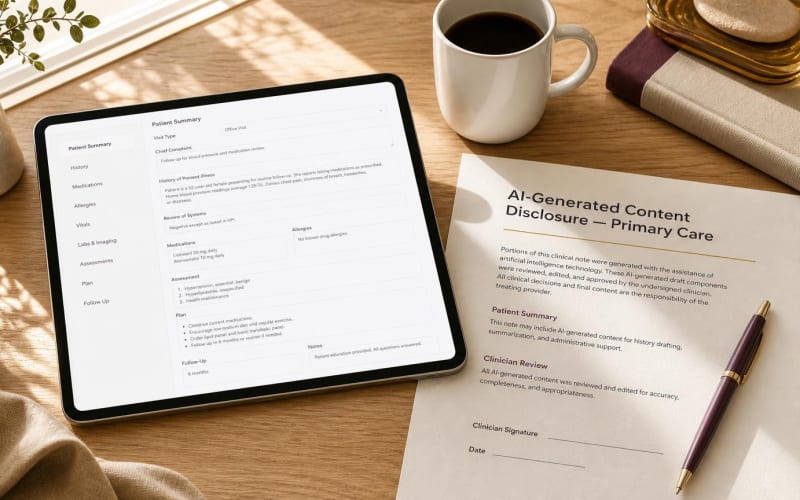
Clinician attestation remains the final safeguard. The psychiatrist reviews, edits, and signs every note, and the consent line remains part of the signed record. Practices should audit a quarterly sample to confirm that every voice in the transcript appears in the consent block.
Reimbursement structuring follows CMS guidance. HCPCS G2211 is reportable with office/outpatient codes 99202–99215 and, from January 1, 2026, with eligible home or residence codes, but it is generally not payable when the base E/M carries modifier 25 outside CMS-allowed preventive or vaccine scenarios. Merry separates E/M decision-making from psychotherapy add-on narrative, such as 99214 with 90833, and from procedures such as TMS, so billing teams apply modifier 25 only where a separately identifiable E/M service exists.
Peer-reviewed risk management literature consistently identifies contemporaneous, specific documentation as the strongest defense in psychiatric liability claims; relevant reviews are indexed at https://www.ncbi.nlm.nih.gov/pmc/.
Practices preparing for Florida audits can Schedule a 15-Minute Workflow Audit to verify consent gate configuration, participant logging, and iframe handling across their EHR.