Statutory Compliance Architecture for Texas HB 149
Documenting family medicine encounters under Texas HB 149, the Texas Responsible Artificial Intelligence Governance Act, begins with a narrow but enforceable duty. Effective January 1, 2026, Tex. Bus. & Com. Code §552.051 requires a person providing health care services or treatment to disclose AI interaction to the patient or personal representative no later than the date the service is first provided. In an emergency, disclosure follows as soon as reasonably possible.
The disclosure must be clear, conspicuous, and written in plain language, and it may not rely on a dark pattern. A hyperlink to a practice notice is permitted, but a static notice alone does not prove that a specific patient was informed at a specific visit. Encounter-level provenance closes that evidentiary gap.
Enforcement rests with the Texas Attorney General, who maintains an online complaint mechanism and must issue written notice before filing suit. Under §552.104, a practice receives a 60-day cure period. Uncured violations carry civil penalties under §552.105, and continuing violations accrue per day.
Directive P1: Timestamped Disclosure Before Capture
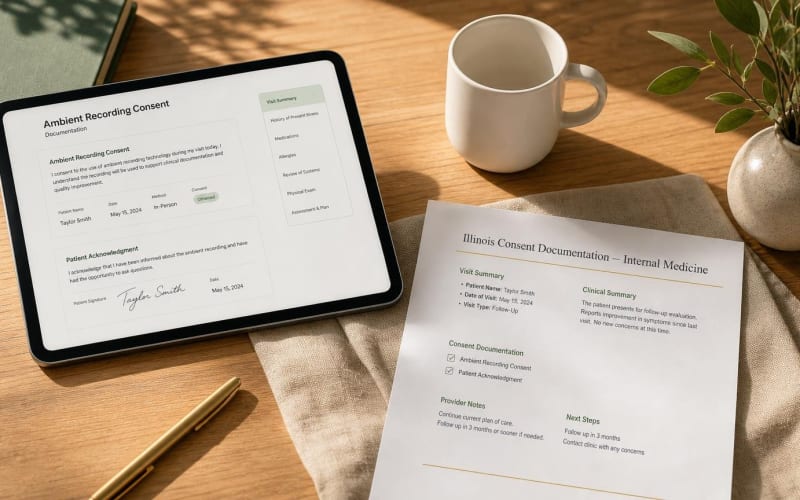
Merry inserts a timestamped disclosure and patient acknowledgment line at the top of the active note editor before any documentation is captured. A typical header reads: AI-Assisted Documentation (Merry) – Patient informed and acknowledged at 2026-04-11 09:14 CST. The line is plain text, so it carries into PDF exports, CCD documents, and billing copies.
Insertion is idempotent and session-bound. The extension checks for an existing header before writing, re-resolves selectors after single-page route changes, and writes under the clinician's authenticated session so the EHR's native audit trail remains intact. It never writes into problem lists, orders, or messaging fields.
Directive P7: Enabling the Texas Disclosure Toggle
Before the first Texas visit, open Merry Chrome settings, select Compliance, and enable the Texas HB 149 disclosure toggle. Once active, the recorder will not start until the header is present and the acknowledgment checkbox is confirmed. Practices with multiple Texas sites should verify the toggle per clinician profile and record the configuration date in the organizational AI governance inventory.
Zero-Retention Audio and Prohibited-Use Exposure
HB 149 prohibits specified uses, including AI deployed with intent to discriminate against a protected class under §552.056 and behavioral manipulation under §552.052. Stored ambient recordings create long-lived repositories that could later be repurposed toward profiling or secondary model training. Merry processes audio in RAM and shreds it at encounter close, with zero-day retention.
A recording never stored cannot be subpoenaed, breached, or repurposed. During an Attorney General inquiry, this architecture narrows the factual question to what appears in the signed note. Operational logs retain only encounter identifiers, timestamps, and model metadata, which is sufficient for incident response without retaining clinical content.
Clinician Attestation and Human Review
The clinician remains the author. Merry drafts; the physician edits, verifies, and signs. Structured findings such as PHQ-9 scores, BMI, blood pressure trends, and medication changes must remain clinician-confirmed and must not be flattened into vague narrative. Diagnosis specificity should be confirmed against current code sets at https://www.cms.gov/medicare/coding-billing/icd-10-codes before signature.
2026 CMS Billing Integrity in Family Medicine
HCPCS add-on code G2211 requires documented longitudinal complexity, meaning the practitioner serves as the continuing focal point for needed care or manages a single serious or complex condition over time. Eligible base codes are office and outpatient visits 99202-99205 and 99211-99215. Beginning January 1, 2026, home or residence codes 99341, 99342, 99344, 99345, and 99347-99350 also qualify.
Modifier 25 interaction remains narrow. G2211 is generally not payable when the base E/M carries modifier 25. CMS exceptions permit payment when that E/M is reported with an Annual Wellness Visit, vaccine administration, or a Medicare Part B preventive service, and the exception extends to home or residence visits in 2026.
Modifier 59 never attaches to an E/M service under NCCI policy; modifier 25 is the correct designation for a significant, separately identifiable E/M. Merry surfaces documentation cues, such as a separate evaluation of an unrelated complaint, but never applies modifiers. Silent billing automation would be opaque and difficult to defend.
| Compliance Dimension | Manual Charting | Standard Generic AI Scribes | Merry AI Compliance Architecture |
|---|---|---|---|
| §552.051 patient disclosure | Verbal, rarely documented | Website or portal notice only | Timestamped header in every note |
| Patient acknowledgment | Undocumented | Optional consent form | Required checkbox before capture |
| Audio retention | None | Frequently persisted in cloud storage | RAM-only, zero-day shredding |
| G2211 longitudinal evidence | Clinician-dependent | Generic boilerplate | Chronic-condition interplay surfaced for review |
| Modifier 25 and 59 logic | Coder-applied | Occasional automated suggestion | Cues only; humans apply modifiers |
| Attorney General inquiry defensibility | Limited provenance | Partial metadata | Note-level proof plus governance log |
Implementation and Audit Readiness
Begin with a governance inventory. Catalog Merry as an AI system in your compliance program, document the patient-facing notice, and confirm that the Texas toggle is enabled for every clinician. Then sample ten signed notes per clinician and verify that the disclosure timestamp precedes the first documented clinical element.
Audit trails should reconcile directly. Compliance views should show which notes received AI assistance, with timestamps matching the note header. Billing staff should confirm that G2211 claims cite chronic-condition management and care coordination, and that modifier 25 claims separate E/M work from procedure rationale.
Practices preparing for 2026 enforcement can Schedule a 15-Minute Workflow Audit to review header placement, toggle configuration, and G2211 documentation patterns against their EHR environment.