
CLINICAL MEMORY
Longitudinal Diagnostic Memory
Carry LVEF trajectories, stent dates, and DAPT timelines from visit to visit. Find post-PCI prompt packs at Access Specialty Prompts at templates.scribing.io to generate notes in 5 seconds.
Specialty Clinical Playbook
LVEF, stent dates, and DAPT plans captured at every post-PCI follow-up. Book your audit at https://cal.com/merryai/demo.
 Dr. Sarah Chen, MD
Specialty Architecture
Engineered to mirror the pacing, diagnostic frameworks, and documentation requirements of Interventional Cardiology.
CLINICAL MEMORY
Carry LVEF trajectories, stent dates, and DAPT timelines from visit to visit. Find post-PCI prompt packs at Access Specialty Prompts at templates.scribing.io to generate notes in 5 seconds.

CONTEXT RETRIEVAL
Retrieve prior echo findings, NYHA class changes, and staged PCI history without moving between tabs.
COMPLEXITY CAPTURE
Capture longitudinal complexity add-on revenue with dated, data-anchored Assessment language and modifier 25 warnings. Schedule a 15-Minute Specialty Workflow Audit today.

SPEAKER ROUTING
Separate physician, patient, and caregiver voices, then map angina history, medication adherence, and exam findings into the correct note sections.
Point-of-Care Flow
Zero IT friction, zero complex API setup, and human-verified attestation on every note.
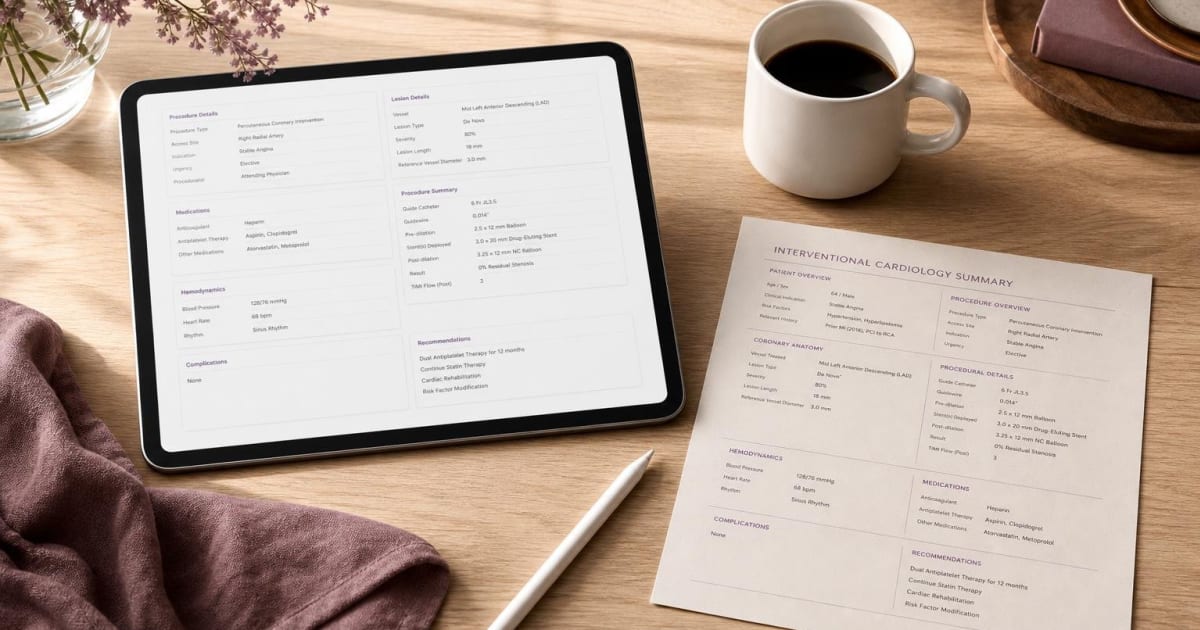
The six-week post-PCI visit looks routine on the schedule, but it carries more decisions than most clinic encounters. The interventionalist is confirming access-site healing, reassessing angina against the Canadian Cardiovascular Society scale, checking adherence to a P2Y12 inhibitor, reviewing a repeat echocardiogram, and deciding whether a staged procedure for residual disease is still warranted. Each thread belongs in the chart, and each is easy to lose when the note is assembled from memory at the end of clinic.
When documentation is reconstructed after hours, the details that matter most tend to blur. Stent dates become 'last spring.' Ejection fraction becomes 'improved.' The DAPT plan becomes 'continue current meds.' None of that is clinically wrong, but it leaves the covering physician, the primary care team, and any reviewing auditor without the specifics that explain why this patient remains under active interventional follow-up.
Merry listens to the encounter as it unfolds, separates the voices of physician, patient, and family member, and drafts a structured note that keeps those specifics intact. The clinician reviews every line before anything reaches the chart.
Our first clinical directive is simple: every post-PCI follow-up records LVEF percent, stent dates, and the DAPT plan. These three elements carry the narrative of coronary disease management across months and years, and they are the elements most often missing when a chart is pulled for review.
Ejection fraction is only useful when it is anchored. Merry captures the numeric value, the modality, whether transthoracic echo, cardiac MRI, or nuclear perfusion, the study date, and the interpretive category. It pairs that value with the current NYHA functional class as stated by the clinician, so a trajectory from 32 percent with class III symptoms to 41 percent with class II symptoms reads as the result of deliberate guideline-directed titration.
Procedural history should read like a timeline rather than a summary. Merry records the index PCI date, each staged or repeat intervention, stent type, and lesion location, such as proximal LAD, left main, or a bifurcation. It also notes residual disease, chronic total occlusions left for medical therapy, and any interval concern for restenosis or stent thrombosis.
Antiplatelet decisions deserve their reasoning on the page. Merry documents the agents, start date, planned duration, and the ischemic versus bleeding risk balance behind that plan. When therapy is shortened after a gastrointestinal bleed, extended after a complex left main intervention, or interrupted for noncardiac surgery, the note states why, and when the next reassessment falls.
Each diagnostic indicator below maps to the data points Merry prompts for and the billing evidence a reviewer will look for. Prompt packs built on this structure are available at https://templates.scribing.io.
| Specialty Diagnostic Metric | Required Clinical Data Points | Billing Evidence |
|---|---|---|
| LVEF percent | Value, modality, study date, NYHA class | Ongoing management of ischemic cardiomyopathy supports G2211 framing |
| Stent history | Index and staged PCI dates, stent type, lesion location | Establishes a serious condition under continuing care |
| DAPT plan | Agents, start date, planned duration, bleeding risk rationale | Documents active decision making across visits |
| Angina burden | CCS class, nitroglycerin use, exercise tolerance | Supports MDM level for 99213 to 99215 |
| Same-day procedure status | Procedure performed, modifier 25 intent | Flags G2211 suppression to prevent denials |
The matrix matters because G2211 is an add-on code. It is reported only with office or outpatient E/M base codes 99202 through 99205 and 99211 through 99215, and the visit must reflect continuing care for a serious or complex condition. CPT definitions for those base codes are maintained by the AMA at https://www.ama-assn.org/practice-management/cpt.
Our second directive addresses placement. Before the encounter begins, the Merry Chrome Extension identifies the cardiology Assessment and Plan field in the active EHR window. It reads visible section labels and accessibility attributes rather than session-specific element IDs, which many web EHRs regenerate at every login. Problem lists, medication orders, and the cath lab procedure log are left untouched.
Placement in the Assessment field keeps longitudinal language where clinical reasoning lives. A complexity statement in the HPI reads like boilerplate; the same statement in the Assessment, tied to a dated LVEF and a stated DAPT end date, reads as a physician explaining why this patient still needs this clinic.
Same-day procedures need a guardrail. CMS edits deny G2211 when the associated E/M is billed with modifier 25 on the same date, with narrow exceptions since January 2025 for certain preventive services. When a catheterization or PCI shares the date of service, Merry flags the conflict and offers to suppress the longitudinal paragraph.
Every inserted paragraph remains editable. The clinician accepts, revises, or deletes the text before signing, and Merry does not clone prior visit language forward. Practices in California and Texas can enable disclosure language for patient-facing derivative content to support AB 3030 and state AI governance reviews.
Audio and transcripts are not retained after the session closes. Processing runs under a signed Business Associate Agreement, and session buffers are cleared from memory once the note is delivered.
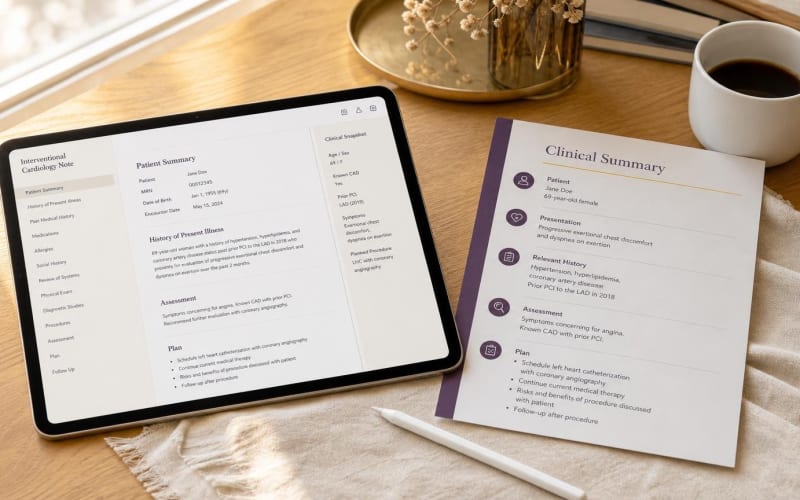
Discrete LVEF, stent date, and DAPT capture, with G2211 gated on modifier 25. Book your audit at https://cal.com/merryai/demo.

Separate Mohs stage maps from distinct E/M problems so modifier 25 holds under review. Book your audit at https://cal.com/merryai/demo.

Discrete LVEF, stent date, and DAPT capture, with G2211 gated on modifier 25. Book your audit at https://cal.com/merryai/demo.