CLINICAL MEMORY
Longitudinal Diagnostic Memory
Track Oswestry trajectories, myotomal deficits, and conservative care across visits. Access Specialty Prompts at templates.scribing.io for lumbar and cervical consult structures.
Specialty Clinical Playbook
Oswestry, motor grades, and dated conservative care, charted the way payers read. Book your audit at https://cal.com/merryai/demo.
 Dr. Sarah Chen, MD
Specialty Architecture
Engineered to mirror the pacing, diagnostic frameworks, and prior authorization requirements of Spine Surgery.
CLINICAL MEMORY
Track Oswestry trajectories, myotomal deficits, and conservative care across visits. Access Specialty Prompts at templates.scribing.io for lumbar and cervical consult structures.

CONTEXT RETRIEVAL
Retrieve prior ODI scores, motor grade trends, MRI levels, and epidural injection history without tab bouncing.
COMPLEXITY CAPTURE
Document the ongoing care relationship behind chronic spine pathology so coding decisions rest on evidence. Schedule a 15-Minute Specialty Workflow Audit today.
SPEAKER ROUTING
Separate surgeon, patient, and family voices and route exam findings and conservative care history into the correct note sections.
Point-of-Care Flow
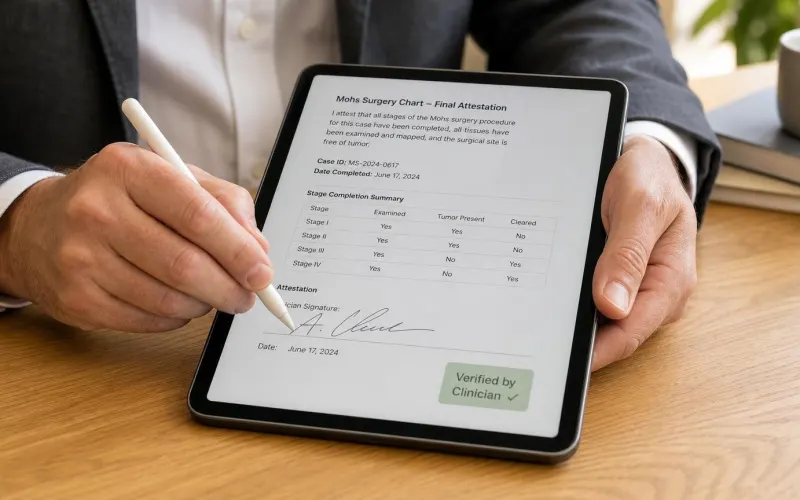
Zero IT friction, zero complex API setup, and human-verified attestation on every note.
Most lumbar fusion denials begin with the note, not with the surgeon's judgment. A reviewer reading a request for L4-L5 decompression and fusion looks for a short list of facts: disability measured with a validated instrument, an objective neurologic deficit, imaging that correlates with the exam, and a dated record of conservative care that failed. When any one of those facts lives only in the surgeon's memory, the request returns pended, and the patient waits.
Merry AI was built around that reviewer's checklist. During the visit, the ambient session listens for the Oswestry Disability Index result, the bilateral motor examination, provocative tests, and the history of physical therapy, NSAIDs, and epidural steroid injections. Each finding is placed where a reviewer expects to find it.
First-pass denials cluster into three patterns. The first is disability without a number: 'significant functional limitation' instead of 'ODI 46%, severe disability.' The second is a loosely described deficit, such as 'left leg weakness,' when criteria require 'left EHL 4/5, dorsiflexion 4-/5, consistent with L5 radiculopathy.' The third, and most common, is conservative care without dates, doses, or outcomes. Each is a documentation problem rather than a clinical one.
Medical necessity for elective spine surgery rests on validated disability, objective neurologic findings, and a failed conservative course. Specialty prompt packs at https://templates.scribing.io define how each pillar is phrased, and every draft is reviewed and attested by the surgeon before signing.
The Oswestry Disability Index is recorded as a percentage with its severity band, the date administered, and its relation to any intervention. When a prior score exists, the draft states the trajectory, for example 'ODI 38% at intake, 46% today despite eight weeks of therapy,' showing disability that is progressing rather than resolving.
Motor strength is documented on the MRC 0 to 5 scale, bilaterally, by myotome: hip flexion for L2-L3, knee extension for L3-L4, dorsiflexion and great toe extension for L5, plantarflexion for S1. Reflex asymmetry, dermatomal sensory change, and straight leg raise findings sit alongside the grades, correlated with MRI level and laterality.
Six weeks of conservative care means little to a reviewer without dates. Merry AI structures the history as a timeline: physical therapy with start date, visit count, and response; NSAIDs with agent, dose, duration, and reason stopped; epidural injections with level, approach, date, and duration of relief. 'Transforaminal ESI left L5 on 03/04, 40% relief for nine days' answers the payer's question before it is asked.
The timeline is never boilerplate. If a patient has not completed a defined course, the draft says so plainly. Suggested diagnosis codes reflect documented level and laterality and should be confirmed against the current https://www.cms.gov/medicare/coding-billing/icd-10-codes code set.
The matrix below shows how each spine metric becomes evidence a reviewer can verify.
| Spine Diagnostic Metric | Required Clinical Data Points | Billing Evidence |
|---|---|---|
| Oswestry Disability Index | Percentage, severity band, date, prior ODI trend | Validated functional limitation supporting surgical necessity |
| MRC Motor Grades (0-5) | Bilateral grades by myotome, reflexes, sensory findings | Objective deficit correlating with imaging level |
| Provocative Testing | Straight leg raise angle, slump, Spurling's, side tested | Radicular pattern supporting M54.16 or M51.16 |
| Physical Therapy | Start and end dates, visit count, functional response | Failure of six or more weeks of structured care |
| NSAIDs and Adjuvants | Agent, dose, duration, reason discontinued | Pharmacologic trial completed per payer policy |
| Epidural Steroid Injection | Level, approach, date, percent and duration of relief | Interventional failure supporting surgical candidacy |
| Longitudinal Management | Chronicity, ongoing care relationship, coordination | Supports G2211 when not billed with modifier 25 |
Longitudinal complexity deserves careful handling. G2211 applies when the surgeon serves as the continuing focal point for a serious or complex condition, and CMS generally denies it when the base E/M carries modifier 25 for a same-day procedure. Merry AI documents the care relationship truthfully and leaves coding decisions with the surgeon and billing team.
The Chrome Extension works inside the athenaOne browser window, with no API contract or interface fee. The ODI, motor grades, reflexes, and provocative tests land in exam findings; the conservative care timeline, imaging correlation, and surgical recommendation land in the plan text field. Injection is keyed to the visible encounter, never a background chart.
Each write fires the same input and change events a typed entry would, so autosave and audit logging behave normally. Nothing reaches the chart until the surgeon has attested the draft.
Audio is processed in memory and shredded from RAM once the note is delivered, with zero-day retention under a signed Business Associate Agreement. The only lasting artifact is the attested note, owned by the clinician. Practices in California and Texas should update patient notices to describe ambient documentation and how to reach a human clinician.
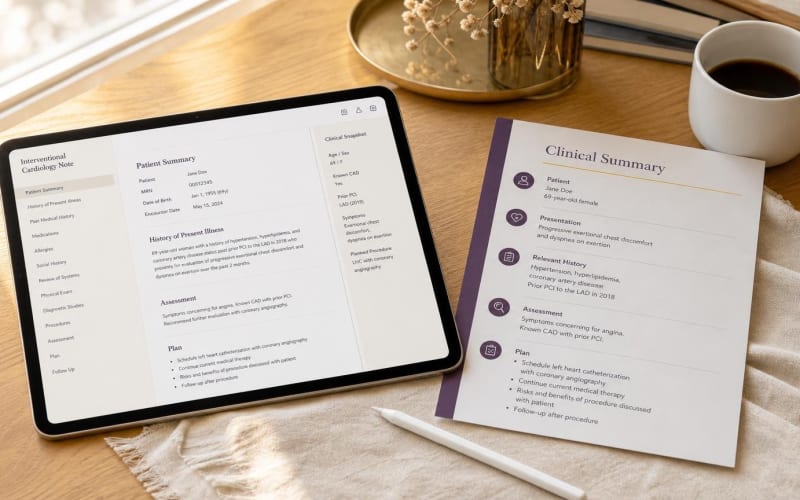
Discrete LVEF, stent date, and DAPT capture, with G2211 gated on modifier 25. Book your audit at https://cal.com/merryai/demo.
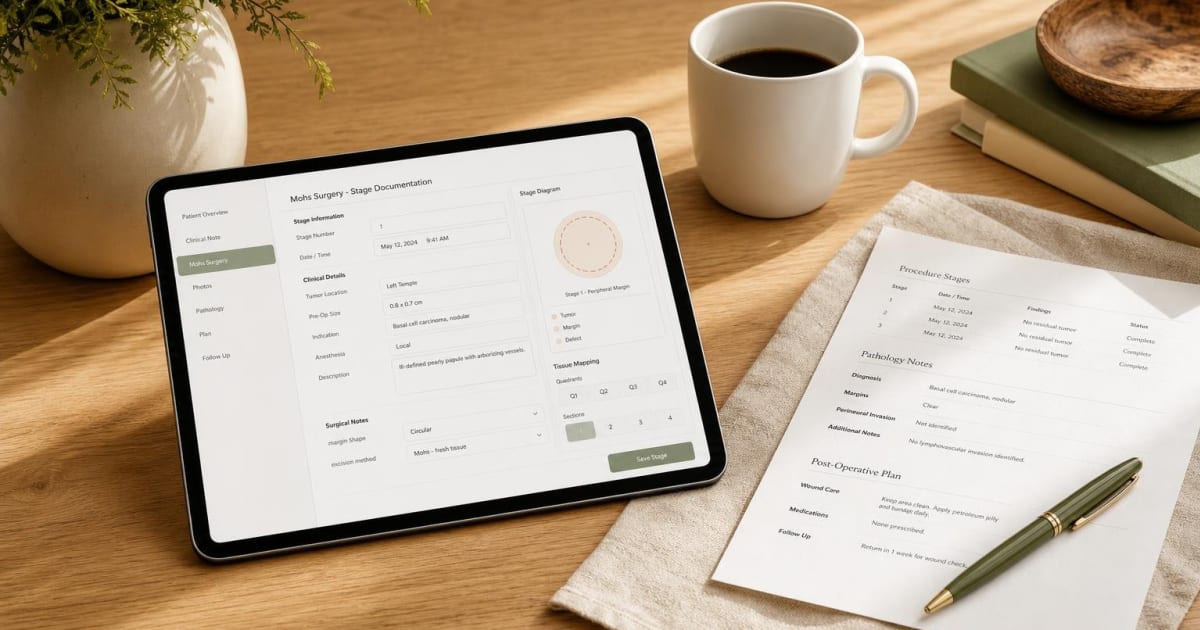
Separate Mohs stage maps from distinct E/M problems so modifier 25 holds under review. Book your audit at https://cal.com/merryai/demo.

Discrete LVEF, stent date, and DAPT capture, with G2211 gated on modifier 25. Book your audit at https://cal.com/merryai/demo.