
CLINICAL MEMORY
Longitudinal Tumor Memory
Carry prior tumor sites, histologic subtypes, and transplant history forward across visits. Access Specialty Prompts at templates.scribing.io to draft Mohs notes in seconds.
Specialty Clinical Playbook
Keep full-body exam and risk work apart from Mohs stage notes so Modifier 25 holds. Book your audit at https://cal.com/merryai/demo.
 Dr. Sarah Chen, MD
Specialty Architecture
Engineered to mirror the pacing, diagnostic frameworks, and documentation requirements of Mohs Dermatology.
CLINICAL MEMORY
Carry prior tumor sites, histologic subtypes, and transplant history forward across visits. Access Specialty Prompts at templates.scribing.io to draft Mohs notes in seconds.
CONTEXT RETRIEVAL
Surface prior Mohs sites, margin histories, and surveillance intervals without leaving the active chart.
COMPLEXITY CAPTURE
Keep separately identifiable E/M work distinct from stage notes and preserve longitudinal complexity. Schedule a 15-Minute Specialty Workflow Audit today.
SPEAKER ROUTING
Separate surgeon, patient, caregiver, and histotechnician voices, then route findings to exam, risk, plan, or procedure sections.
Point-of-Care Flow
Zero IT friction, zero complex API setup, and human-verified attestation on every note.
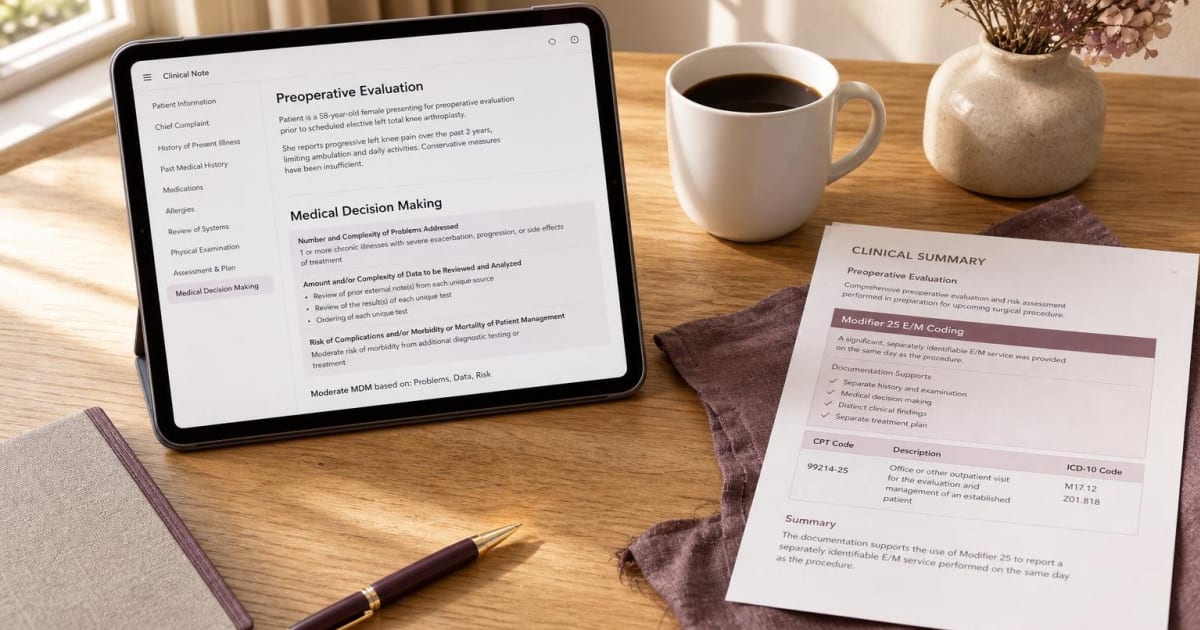
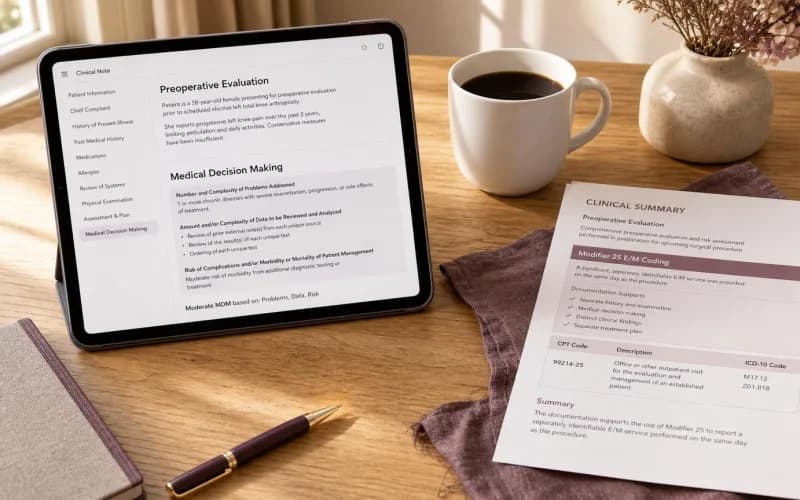
Most Mohs Modifier 25 denials do not begin with a coding error. They begin in the chart, where a full-body skin examination, a transplant-related risk discussion, and three stages of margin mapping are written as one continuous procedural narrative. When an auditor reads that note, the evaluation work looks like the routine preoperative assessment already bundled into the 0-day global of CPT 17311.
The standard is plain enough. Modifier 25 requires an E/M service that is significant and separately identifiable from the procedure performed on the same date. The decision to proceed with Mohs on a biopsy-proven lesion is not, by itself, that service. A total body skin exam that finds a new pigmented lesion on the back, a discussion with the transplant team about immunosuppression reduction, or a reset of surveillance intervals for a patient with a fourth squamous cell carcinoma this year can be.
Our view is simple. If the documentation does not separate these streams, the coder cannot defend them. Merry AI was built around that separation.
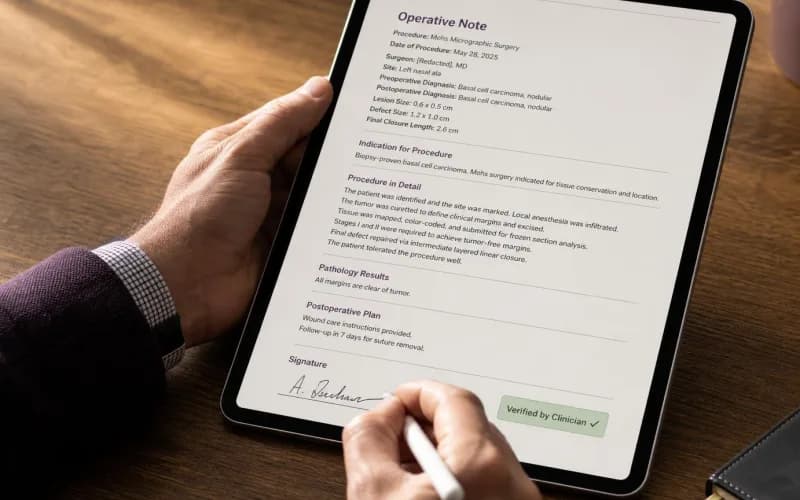
The ambient engine listens once but writes in several places. As the surgeon examines, counsels, and operates, each transcript segment is tagged with a destination: full-body exam, immunosuppression risk, surveillance plan, or Mohs stage narrative. Nothing is merged for convenience. Each segment waits for clinician review before it reaches the chart.
Total body skin examination findings are written to the exam section of the visit note, not the procedure template. That includes regions examined, lesions of concern with location and morphology, dermoscopic impressions, and any biopsies ordered on separate lesions. When a patient mentions a lung transplant and current mycophenolate, the engine records it as a discrete immunosuppression entry rather than a phrase buried in the history. Gorlin syndrome, prior radiation at the site, and a history of multiple nonmelanoma skin cancers are handled the same way.
Stage-level documentation stays inside the procedure note. The engine enriches the narrative summary field with the indication for Mohs, H-zone location, preoperative size, histologic subtype, number of stages, blocks per stage, and margin status at each stage. It does not overwrite the structured stage grid the surgeon maintains. Perineural invasion, infiltrative or micronodular patterns, and the reconstruction method are captured in the surgeon's own words, ready for attestation.
Our Chrome Extension maintains a versioned field map for each supported browser-based EHR. The E/M sections and the procedure note are mapped as separate targets, even when the Mohs template lives in a nested iframe or a separate tab. A tab-context check confirms the active patient, the active encounter, and whether the field has been edited since the last write. No API contract or interface engine is required.
Each diagnostic metric below corresponds to a data point the engine extracts and a billing argument it supports. Coders can read the matrix against current descriptor language at https://www.ama-assn.org/practice-management/cpt.
| Specialty Diagnostic Metric | Required Clinical Data Points | Billing Evidence |
|---|---|---|
| Total body skin exam | Regions examined, new or changing lesions, dermoscopy, separate biopsies | Separately identifiable E/M supporting Modifier 25 |
| Immunosuppression profile | Transplant type, agent and dose, hematologic malignancy, biologics | Elevated MDM risk and G2211 longitudinal complexity |
| Lesion indication | H-zone location, size in mm, primary vs recurrent, prior treatment | Appropriate-use support for CPT 17311 or 17313 |
| Histologic risk | Subtype, differentiation, perineural or lymphovascular invasion | Medical necessity for Mohs over standard excision |
| Stage and block count | Stages completed, blocks per stage, margin status per stage | Accurate 17312, 17314, and 17315 add-on reporting |
| Separate lesion mapping | Distinct anatomic site, separate procedure, separate closure | Modifier 59 or XS on non-E/M services |
| Surveillance plan | TBSE interval, nodal palpation, imaging, oncology coordination | Continuity narrative supporting G2211 |
The matrix matters most when a single patient generates several claims on one date. Distinct sites and distinct lesions must remain distinct in the note, or NCCI edits will collapse them. Specialty prompt packs that mirror these rows are available at https://templates.scribing.io.
Longitudinal skin cancer care is where many Mohs surgeons do their most consequential cognitive work. When the surgeon says, "We'll see you every four months for full-body checks, sooner for anything new," the engine writes the interval to the plan, drafts the future visit reminder, and preserves the patient instructions. Over successive encounters, the record shows the surgeon as the continuing focal point for a serious, ongoing condition, which is the substance G2211 asks for. CMS permits G2211 alongside an E/M billed with Modifier 25, so the separation described above protects both.
Boilerplate weakens these claims. Phrases such as "complex patient with multiple comorbidities" invite denial. Merry AI keeps the specific history: the number of prior tumors, the transplant date, the dermatopathology trend, and the coordination with oncology.
Audio is held only in memory during the session. Once the transcript is generated and the clinician has approved the note, buffers are overwritten and discarded. No recording is saved to disk or browser storage, and none is used for model training. A Business Associate Agreement is executed before first use, and patient-facing summaries can carry an AI-assistance disclosure where state law, such as California AB 3030, requires it.
The clinician signs every note. The engine organizes the record, but judgment and attestation remain with the surgeon.
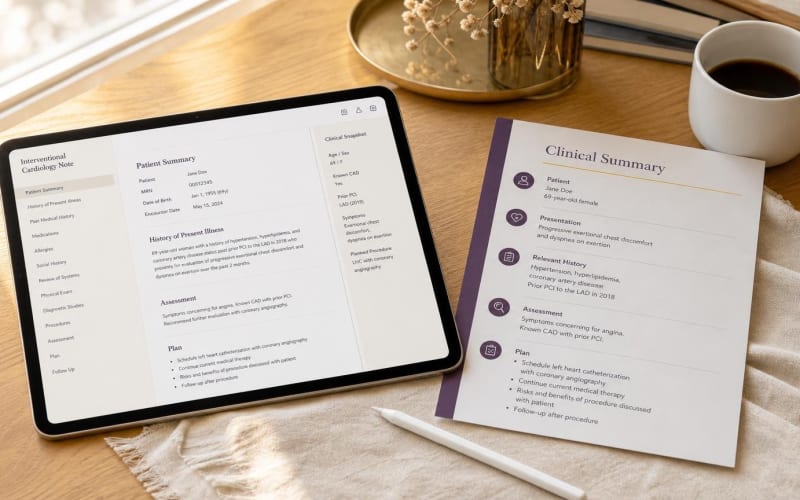
Discrete LVEF, stent date, and DAPT capture, with G2211 gated on modifier 25. Book your audit at https://cal.com/merryai/demo.
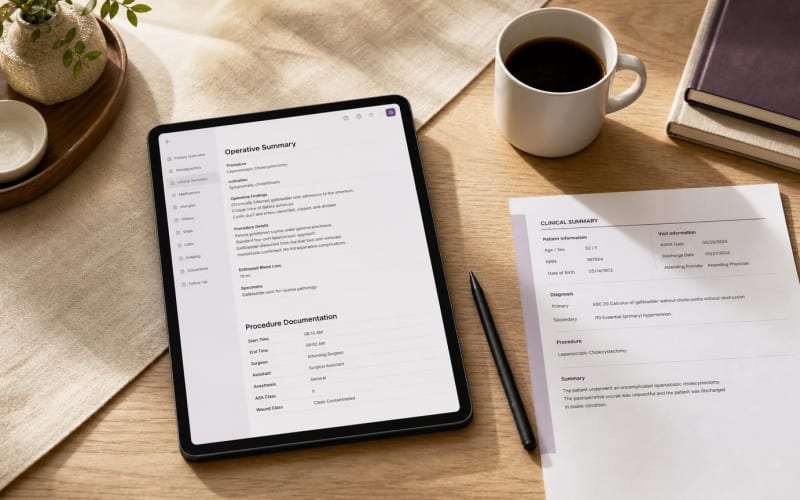
Separate Mohs stage maps from distinct E/M problems so modifier 25 holds under review. Book your audit at https://cal.com/merryai/demo.

Discrete LVEF, stent date, and DAPT capture, with G2211 gated on modifier 25. Book your audit at https://cal.com/merryai/demo.