CLINICAL MEMORY
Longitudinal Lesion Memory
Track every lesion by site, size, pathology, and prior topical therapy dates across visits. Access Specialty Prompts at templates.scribing.io to draft Mohs notes in seconds.
Specialty Clinical Playbook
Stage logs, block counts, and dated 5-FU failures, charted lesion by lesion. Book your audit at https://cal.com/merryai/demo.
 Dr. Sarah Chen, MD
Specialty Architecture
Engineered to mirror the pacing, diagnostic frameworks, and documentation requirements of Mohs Dermatology.
CLINICAL MEMORY
Track every lesion by site, size, pathology, and prior topical therapy dates across visits. Access Specialty Prompts at templates.scribing.io to draft Mohs notes in seconds.
CONTEXT RETRIEVAL
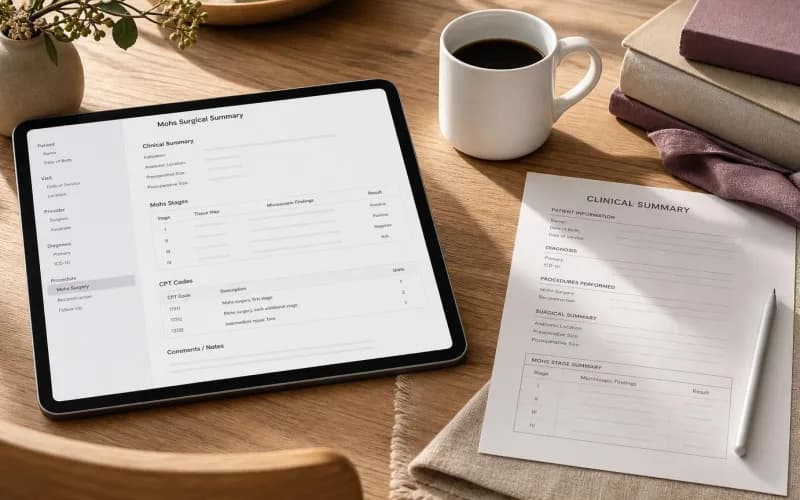
Recall biopsy accessions, histologic subtypes, and prior stage logs between stages without tab bouncing.
COMPLEXITY CAPTURE
Document longitudinal skin cancer surveillance and flag G2211 only where modifier 25 edits permit it. Schedule a 15-Minute Specialty Workflow Audit today.
SPEAKER ROUTING
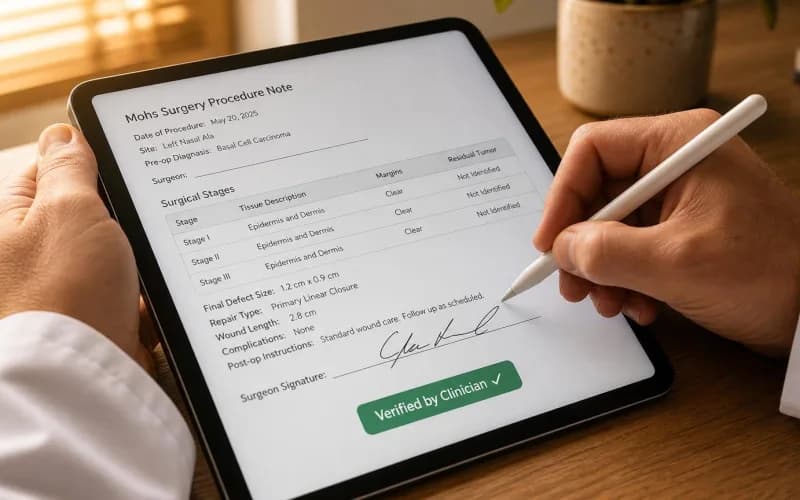
Separate surgeon, patient, histotechnician, and family voices, routing margin findings to the stage log and history to the E/M block.
Point-of-Care Flow
Zero IT friction, zero complex API setup, and human-verified attestation on every note.
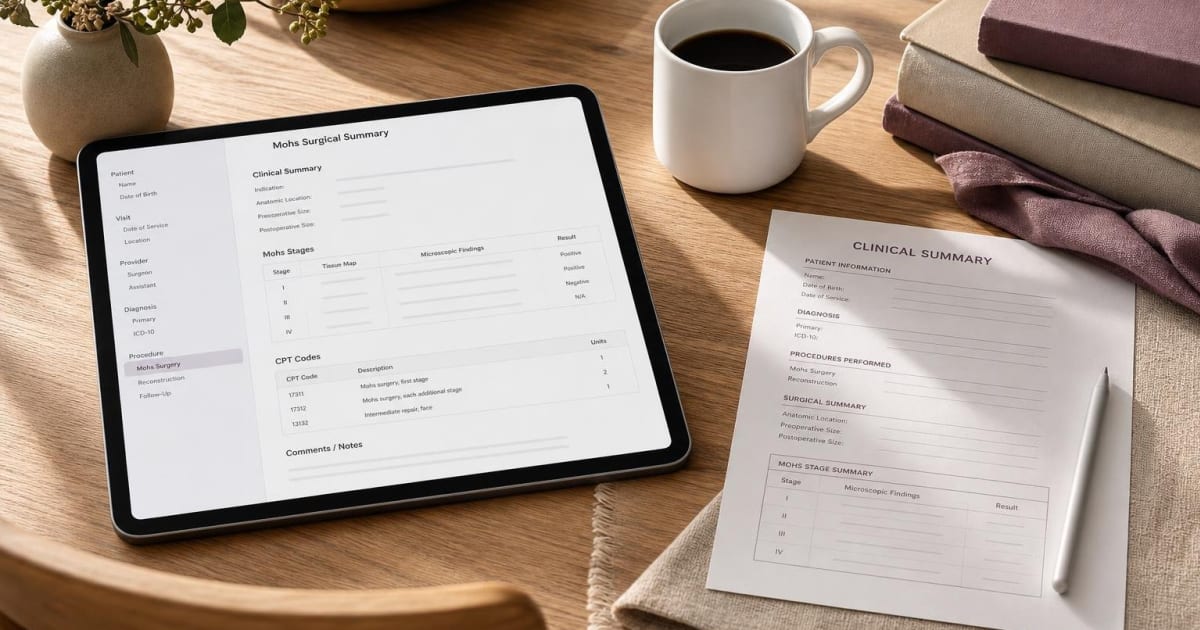
Mohs micrographic surgery is documented at three levels at once: the lesion, the stage, and the tissue block. CMS coverage guidance and the Noridian LCD L35702 expect each lesion's anatomic location, size, number of stages, and blocks per stage, along with confirmation that the same physician served as both surgeon and pathologist. When any one of those dimensions is ambiguous, CPT 17311 through 17315 become difficult to defend, and the Recovery Audit topic on incorrect Mohs units shows reviewers are looking closely.
Generalist ambient scribes tend to produce a single narrative block. That serves a routine office visit, but a Mohs day rarely looks like one. A morning list may include a recurrent infiltrative basal cell carcinoma of the nasal ala, a well-differentiated squamous cell carcinoma on the dorsal hand, and a field of actinic keratoses on the scalp that has already failed a course of 5-fluorouracil. Each belongs in a different section of the chart, under a different code family.
Merry listens for the details a Mohs surgeon already says aloud: the site, the clinical size in millimeters, the biopsy accession and its pathology, and whether the tumor is primary or recurrent. Each lesion is held as a discrete record in transient memory, then rendered into the lesion grid rather than buried in prose.
Prior topical therapy failures carry real weight in medical necessity. When a patient reports finishing a four-week course of 5-FU in March with persistent hyperkeratotic papules at follow-up, Merry records the agent, start and stop dates, duration, and the reason for failure, whether non-response or intolerance. Those dates move into the assessment so the decision for destruction or Mohs reads as a reasoned escalation rather than an isolated choice.
Appropriate use criteria hinge on location zone, size, histologic subtype, and patient factors. Merry captures H-zone placement such as the central face, periorbital skin, or ear; aggressive features such as morpheaform, infiltrative, or micronodular growth and perineural invasion; and systemic modifiers like organ transplant immunosuppression or anticoagulation. Each axis is tied back to the specific lesion it concerns.
The stage log is where audit exposure concentrates. For each lesion, Merry populates stage number, blocks examined, margin status, and the histologic description when tumor is seen, including depth, growth pattern, and presence of scar. Additional stages map to 17312 or 17314, and blocks beyond five in any stage map to 17315. AK destruction is counted separately: 17000 for the first lesion, 17003 for lesions two through fourteen, or 17004 alone when fifteen or more are treated. Code descriptors should always be confirmed against the AMA CPT reference.
The matrix below summarizes how each diagnostic signal travels from the procedure room into the record.
| Specialty Diagnostic Metric | Required Clinical Data Points | Billing Evidence |
|---|---|---|
| Lesion site and risk zone | Anatomic location, H/M/L zone, laterality | 17311 vs 17313 selection |
| Lesion size and subtype | Clinical size in mm, biopsy pathology, primary vs recurrent | Appropriate use and medical necessity |
| Stage progression | Stage number, margin status per stage | Units for 17312 or 17314 |
| Tissue block count | Blocks per stage, histology when tumor present | 17315 for blocks beyond five |
| AK destruction burden | Lesion count, sites, cryotherapy method | 17000, 17003, or 17004 |
| Topical therapy failure | Agent, start and stop dates, reason for failure | Escalation rationale in assessment |
| Separate E/M problems | Unrelated dermatoses, medication review, counseling | Modifier 25 support |
A same-day E/M service must be significant and separately identifiable from the pre-operative evaluation already bundled into Mohs. Merry keeps operative detail in the procedure composer and places only distinct problems, such as rosacea management or assessment of a new pigmented lesion, into the E/M block. Distinct sites receive clear narration to support modifier 59 or the XS subset when coding staff choose them.
The Chrome Extension works inside the browser window you already chart in. It identifies the visit note, the Mohs procedure grid, and pathology fields by their labels and attributes, including content rendered in iframes, and writes each section to its proper place. There is no API contract to negotiate and no interface fee.
G2211 deserves conservative handling here. CMS edits generally deny the longitudinal complexity add-on when the base E/M carries modifier 25, with exceptions limited to same-day preventive services, annual wellness visits, and vaccine administration. Merry still records longitudinal complexity, such as multiple prior skin cancers or chronic immunosuppression, but it will not suggest G2211 beside a Mohs claim. It flags the code for standalone surveillance visits where the relationship is ongoing.
Protected health information stays transient. Encounter data lives in memory only while the note is composed and injected, then is cleared. Nothing is written to local storage, and telemetry is limited to non-identifying counts. Every AI-drafted section is attributed and awaits your attestation before signing.
Specialty prompt packs for Mohs stage logs, AK destruction notes, and post-operative wound-care instructions are available at https://templates.scribing.io. They are a quiet place to start before your next surgical day.
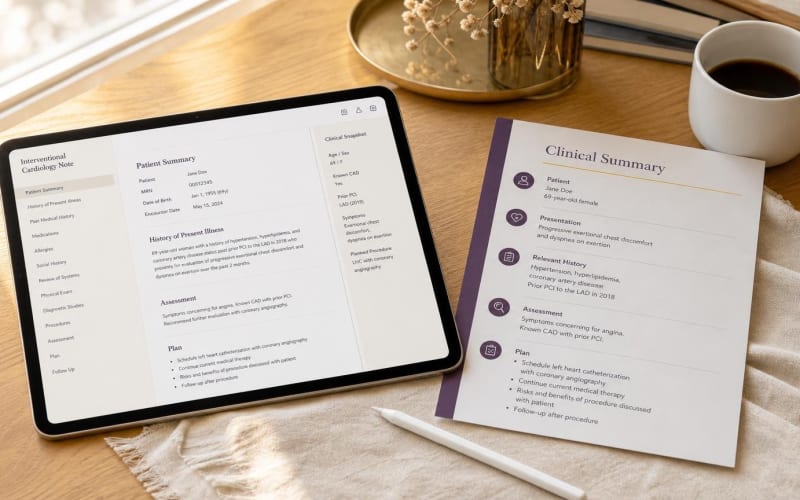
Discrete LVEF, stent date, and DAPT capture, with G2211 gated on modifier 25. Book your audit at https://cal.com/merryai/demo.
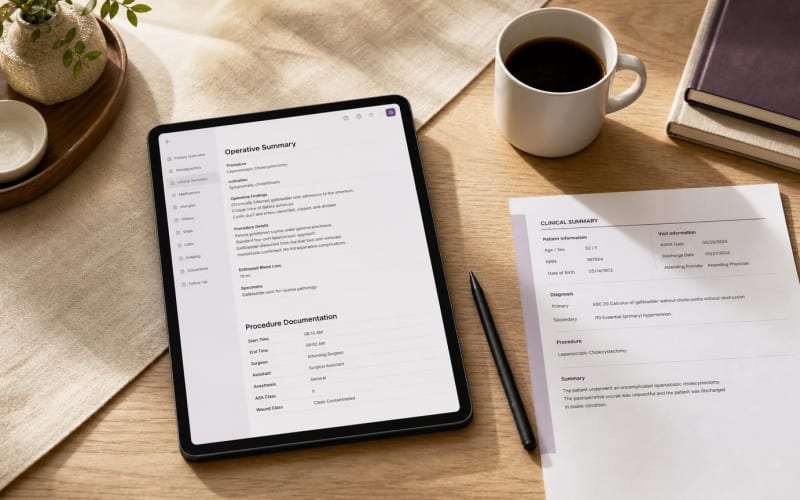
Separate Mohs stage maps from distinct E/M problems so modifier 25 holds under review. Book your audit at https://cal.com/merryai/demo.

Discrete LVEF, stent date, and DAPT capture, with G2211 gated on modifier 25. Book your audit at https://cal.com/merryai/demo.