
CLINICAL MEMORY
Longitudinal Diagnostic Memory
Track ROM trends, dermatomal changes, and conservative care timelines across visits. Find spine prompt packs at Access Specialty Prompts at templates.scribing.io to generate notes in 5 seconds.
Specialty Clinical Playbook
ROM degrees, dermatomal deficits, and dated PT failures documented before every 64483. Book your audit at https://cal.com/merryai/demo.
 Dr. Sarah Chen, MD
Specialty Architecture
Built to follow the pacing, diagnostic frameworks, and documentation requirements of Orthopedic Spine.
CLINICAL MEMORY
Track ROM trends, dermatomal changes, and conservative care timelines across visits. Find spine prompt packs at Access Specialty Prompts at templates.scribing.io to generate notes in 5 seconds.

CONTEXT RETRIEVAL
Retrieve prior ROM measurements, motor grades, MRI level concordance, and PT dates without switching between tabs.
COMPLEXITY CAPTURE
Support G2211 on non-procedure spine follow-ups while respecting modifier 25 limits on injection days. Schedule a 15-Minute Specialty Workflow Audit today.
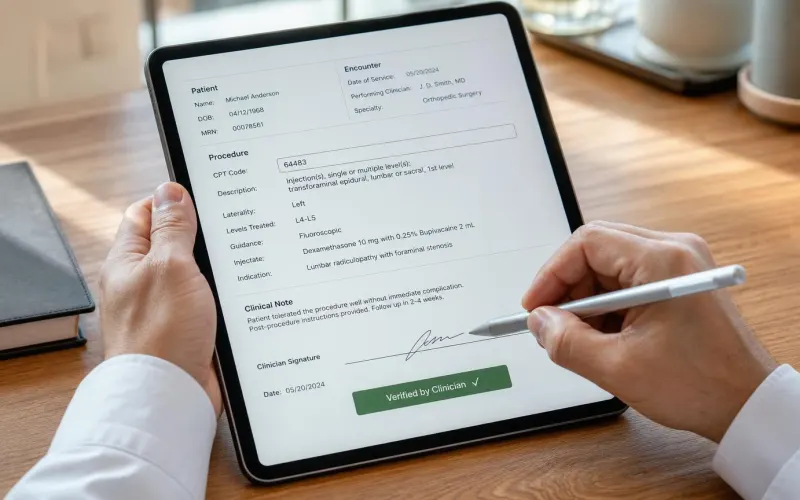
SPEAKER ROUTING
Diarize dialogue among surgeon, patient, family, and residents, then map neurologic findings directly into the spine-approved E/M exam section.
Point-of-Care Flow
Zero IT friction, zero complex API setup, and human-verified attestation on every note.
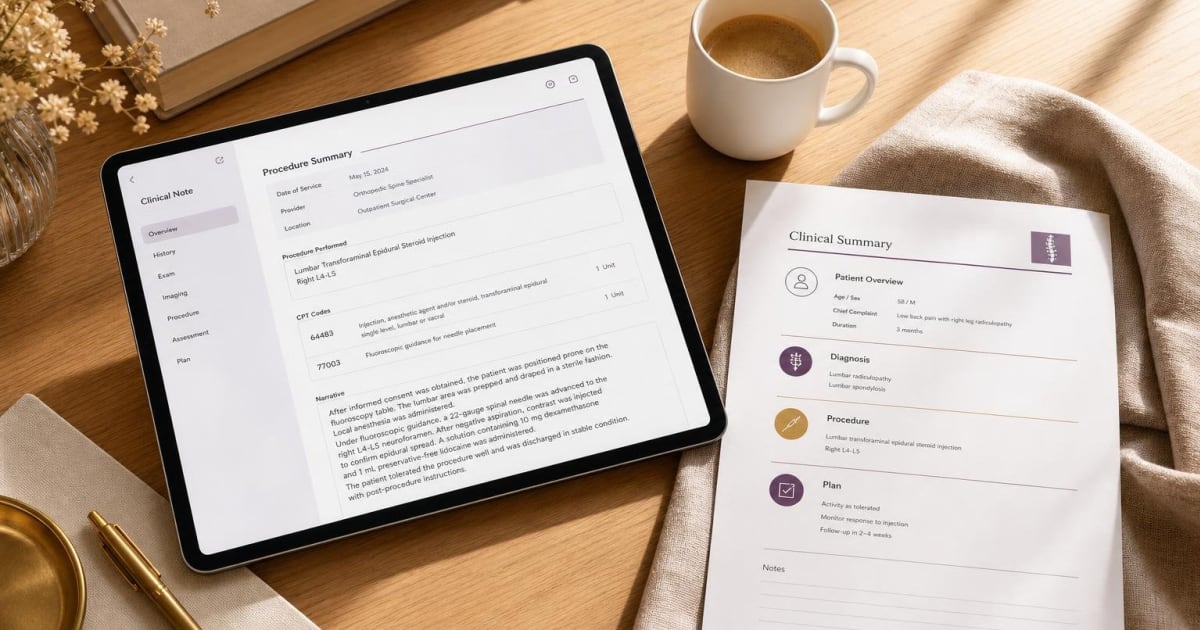
A transforaminal injection decision is rarely made in isolation. By the time a patient with L5 radiculopathy reaches the procedure suite, the surgeon has weighed months of history, a focused neurologic exam, imaging concordance, and a conservative care record that may span three clinics. Payers and Recovery Audit Contractors reviewing CPT 64483 expect every one of those threads to appear in the chart in measurable terms before the needle is placed.
Most ambient documentation tools produce a single, readable narrative. That is a reasonable goal in primary care, but in spine it creates a specific vulnerability. Radicular findings, range-of-motion limits, and injection technique can collapse into one block of prose. When that happens, the evaluation and management service no longer reads as significant and separately identifiable. Modifier 25 becomes difficult to defend, and the medical necessity case for the injection weakens with it.
Merry AI was built around a quieter premise: the chart should reflect how a spine surgeon actually reasons. That order is objective numbers first, neurologic pattern second, and dated conservative care failures third. The procedure is documented on its own terms.
Before any 64483 is scheduled, three categories of evidence should be present in the encounter note. Merry listens for each during the ambient conversation and structures them as discrete data points rather than descriptive impressions.
Phrases like limited lumbar motion carry little weight under review. Merry captures each plane the surgeon measures and states it numerically. For example: flexion 30 degrees against an expected 60, extension 5 degrees against an expected 25, and right lateral bending 10 degrees compared with 25 on the left, with pain reproduced at L4-L5. These values turn a subjective complaint into objective functional limitation. They also establish a baseline for post-injection comparison at the next visit.
A transforaminal approach targets one specific nerve root, so the exam must point to that root. Merry organizes sensory, motor, and reflex findings by level. A typical entry reads: decreased pinprick over the dorsum of the right foot, tibialis anterior and extensor hallucis longus at 4/5, and patellar reflex 1+ on the right versus 2+ on the left. The assessment then states the concordant pattern, such as right L5 radiculopathy correlating with foraminal stenosis at L4-L5 on MRI.
Payers commonly look for six to eight weeks of documented conservative management, and state-level utilization review continues to raise the bar for a reviewable rationale. Merry assembles a timeline with start and end dates. A typical timeline includes physical therapy twice weekly from 09/08/2025 to 11/14/2025 with persistent pain, NSAIDs at stated doses since 08/20/2025, and a home exercise program since 08/27/2025. Each entry records the patient's response, so failure is documented rather than implied.
The matrix below reflects how Merry maps each spine diagnostic metric to the data points it must capture and the billing evidence those data points support. Always confirm code definitions against the current AMA reference at https://www.ama-assn.org/practice-management/cpt.
| Specialty Diagnostic Metric | Required Clinical Data Points | Billing Evidence |
|---|---|---|
| Lumbar ROM | Degrees per plane, expected norms, side-to-side comparison, pain-limited planes | Objective functional limitation supporting 64483 medical necessity |
| Dermatomal Deficit | Sensory distribution, motor grade 0-5, reflex grading, laterality | Concordant radiculopathy justifying the targeted level and side |
| Imaging Concordance | MRI or CT level, foraminal stenosis or herniation, correlation to exam | Level-specific necessity; supports 64484 add-on levels when applicable |
| Conservative Therapy | PT dates and frequency, medication doses and duration, home exercise adherence, response | Documented failure interval expected under MAC epidural LCDs |
| Separate E/M Evaluation | Distinct HPI, exam, MDM, discussion of treatment options | Modifier 25 viability on same-day 64483 |
| Longitudinal Management | Ongoing plan for a single serious or complex spine condition | G2211 support on non-procedure office visits |
Coders retain final authority over modifier and code selection. Merry surfaces signals such as a separately documented E/M or longitudinal management of radiculopathy. It does not auto-assign modifier 25, modifier 59, or G2211.
The Chrome Extension binds spine E/M and procedure note fields as distinct DOM targets. It identifies the active office visit editor through tab titles, ARIA labels, and data attributes, and it recognizes when the procedure module sits in a separate iframe. ROM degrees, dermatomal maps, and therapy timelines are written only into the E/M section. When the surgeon opens the procedure tab, automatic insertion pauses. The procedure note stays limited to level, laterality, guidance, medications, and complications.
This structural separation matters for G2211 as well. On a same-day visit billed with 64483 and modifier 25, G2211 is generally not payable, and Merry does not suggest it. On follow-up visits without a procedure, the same longitudinal record of radiculopathy management can support the add-on. This applies when the surgeon serves as the continuing focal point for that condition.
Protected health information stays in browser memory only during capture, processing, and insertion. Buffers are cleared immediately after the E/M section is written and cleared again on navigation. Nothing is written to local storage, IndexedDB, or files, and a Business Associate Agreement is executed before go-live.
Specialty prompt packs for lumbar radiculopathy, cervical myelopathy, and pre-operative fusion evaluations are available at https://templates.scribing.io. Each pack follows the documentation order described here, so the note reads the way a spine surgeon thinks.
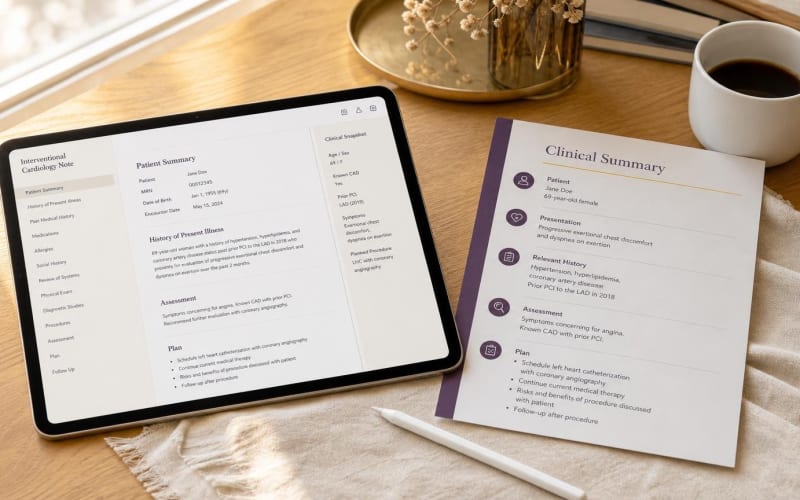
Discrete LVEF, stent date, and DAPT capture, with G2211 gated on modifier 25. Book your audit at https://cal.com/merryai/demo.
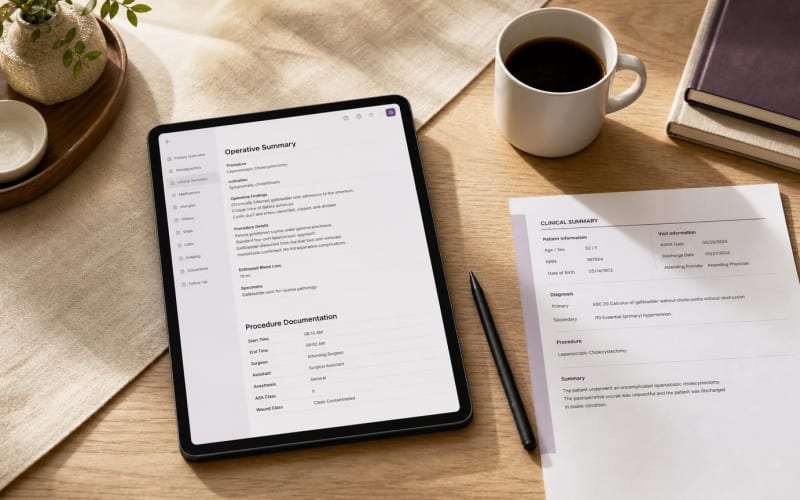
Separate Mohs stage maps from distinct E/M problems so modifier 25 holds under review. Book your audit at https://cal.com/merryai/demo.

Discrete LVEF, stent date, and DAPT capture, with G2211 gated on modifier 25. Book your audit at https://cal.com/merryai/demo.