
CLINICAL MEMORY
Longitudinal Opioid Trajectory Memory
Find 40+ prompt packs at templates.scribing.io to generate notes in 5 seconds and surface prior MME totals, treatment agreements, and unresolved aberrancy flags.
Specialty Clinical Playbook
Ambient documentation engineered for opioid stewardship, PDMP defense, and interventional E/M coding. Book your audit at https://cal.com/merryai/demo.
 Dr. Sarah Chen, MD
Specialty Architecture
Engineered to mirror the pacing, diagnostic frameworks, and controlled-substance documentation requirements of Pain Management.
CLINICAL MEMORY
Find 40+ prompt packs at templates.scribing.io to generate notes in 5 seconds and surface prior MME totals, treatment agreements, and unresolved aberrancy flags.
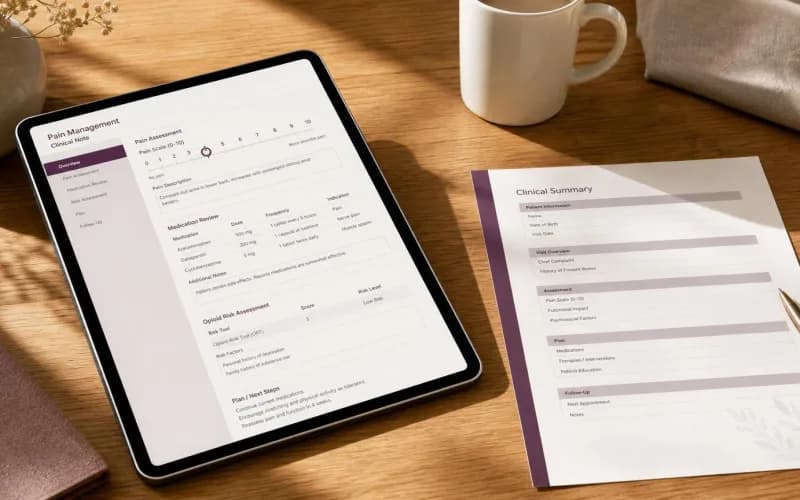
CONTEXT RETRIEVAL
Retrieve prior pain scores, functional benefit trends, toxicology history, and procedure logs in one structured draft without tab bouncing.
WORKFLOW INTELLIGENCE
Capture same-day E/M complexity alongside injection procedures and auto-draft defensible medical necessity. Claim your 15-Minute Workflow Audit today.
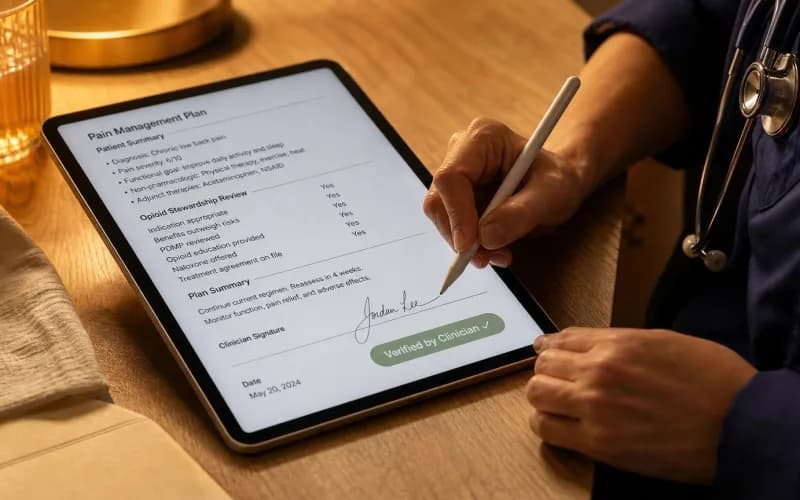
SPECIALTY-AWARE REASONING
Diarize patient and caregiver dialogue and map risk assessment, PDMP findings, and consent directly into opioid-safe note sections.
Point-of-Care Flow
Zero IT friction, zero complex API setup, and human-verified attestation on every controlled-substance note.

Clinical documentation in Pain Management occupies a uniquely high-stakes intersection of therapeutic ambiguity, controlled-substance regulation, and procedural billing complexity. Unlike a routine primary care encounter, every chronic opioid visit generates a medicolegal artifact that may be reviewed by state medical boards, the DEA, payers, and plaintiff attorneys. The note must simultaneously establish medical necessity, document a defensible risk-benefit calculus, and preserve the longitudinal narrative that justifies continued therapy. Merry AI was engineered to treat the pain encounter not as a transcription problem but as a structured evidence-capture problem.
The interventional pain physician navigates a documentation burden that spans the diagnostic evaluation, the procedural intervention, and the pharmacologic stewardship layer within a single visit. A patient may present for a lumbar transforaminal epidural injection while also requiring an opioid refill assessment and a functional reassessment. Each of these threads demands distinct documentation elements, distinct billing evidence, and distinct compliance controls. Our architecture separates these streams at the point of capture so that the E/M service, the procedure note, and the stewardship record each stand on their own evidentiary footing.
Ambient capture in this specialty must also respect the reality that pain encounters frequently involve caregivers, adult children, or spouses who report on adherence, function, and behavioral changes. Merry AI diarizes these voices so that a caregiver's observation about medication-seeking behavior is never silently absorbed into the patient's own subjective account. This speaker attribution is not cosmetic; it directly affects how aberrancy is documented and defended if the prescribing decision is later scrutinized.
Merry AI's stewardship documentation is designed to live inside the opioid-ordering moment rather than as a detached template completed after the fact. The clinical rationale is well established: the CDC guideline recommends discussing the known risks and realistic benefits of opioid therapy before initiating opioids for subacute or chronic pain, and recommends PDMP review at initiation and at least every three months during continuing therapy. Our note structure prompts the clinician to affirm that opioid therapy is clinically indicated, that expected benefits for pain and function outweigh foreseeable risks, and that non-opioid alternatives were considered and documented.
A defensible risk-benefit attestation must be structured but editable. A bare checkbox demonstrates workflow completion without demonstrating medical necessity, which is precisely the failure mode that collapses under audit. Merry AI drafts an attestation narrative from the ambient conversation, capturing the discussed risks, the expected functional benefit, the naloxone consideration, and the follow-up interval, and then presents it for clinician verification. The clinician edits and attests; the system time-stamps and attributes.
The PDMP query remains a clinical decision-support input rather than a substitute for judgment, and Merry AI documents its status rather than replacing the query itself. Our note captures the date and time of the query, the querying clinician, the jurisdiction, whether data were successfully retrieved, the clinically relevant findings, and the resulting action. This structured record aligns with the MIPS Promoting Interoperability measure requiring PDMP query for Schedule II opioids and Schedule III or IV drugs prescribed via certified EHR technology, and it preserves the reference required for medicolegal defensibility.
Speaker separation carries clinical weight in pain management that exceeds most specialties. When a spouse reports that the patient has been running out of medication early, that statement must be attributed to the caregiver and documented as a third-party observation, not as a patient admission. Merry AI's diarization engine tags each utterance to its source, preserving the distinction between the patient's stated pain trajectory and collateral reports of aberrant behavior. This attribution feeds directly into the risk assessment section of the note.
Morphine milligram equivalent totals must be computed accurately and tracked over time, because dose thresholds trigger jurisdiction-specific documentation and monitoring requirements. Merry AI surfaces the current MME, compares it against the prior visit, and flags dose escalations that may require additional risk mitigation or naloxone co-prescribing under applicable state law. The longitudinal view lets the clinician document the trajectory of a taper or the justification for maintained therapy across a series of encounters.
Interventional pain billing hinges on the clean separation of the evaluation service from the procedure performed on the same day. The compliance literature on E/M services in interventional pain, available through peer-reviewed sources at https://www.ncbi.nlm.nih.gov/pmc/, documents three decades of persistent confusion over proper documentation. Merry AI addresses this by structuring the significant, separately identifiable evaluation as a distinct note component that supports Modifier 25, while the procedure note captures the anatomical target, imaging guidance, laterality, and post-procedure assessment independently.
Medical Decision Making elements drive the E/M level, and our drafting engine maps the ambient conversation onto the number and complexity of problems addressed, the data reviewed, and the risk of the management options selected. For a patient with multiple pain generators, comorbid substance-use risk, and ongoing opioid management, the complexity narrative supporting a higher-level visit and CPT G2211 longitudinal complexity capture is drafted automatically for clinician verification.
The Modifier 25 logic bridge requires evidence that the E/M service was significant and separately identifiable from the procedure. Merry AI drafts language demonstrating that the evaluation addressed distinct clinical questions beyond the pre-procedure assessment inherent to the injection, preserving the separately billable service against payer downcoding.
Functional benefit documentation is the evidentiary backbone of continued opioid or interventional therapy. Consistent with implementation-ready interprofessional pain assessment reference models described in the informatics literature, Merry AI anchors each note to measurable functional goals rather than pain scores alone, capturing changes in activity, work status, and sleep to justify the treatment plan.
The audit record for every opioid order must preserve the original and modified prescription values, the author and signer, reliable timestamps, the PDMP query status, the attestation responses, alerts shown and overridden with reasons, patient education delivered, and the follow-up plan. Merry AI structures its output so that clinical notes are amendable through addenda rather than silent overwriting, and so that the applied documentation reflects the rule in effect at the time of prescribing. This governance posture is what separates a defensible record from a mere transcript.
Because pain management operates under a configurable patchwork of federal and state controls including DEA electronic prescribing requirements, HIPAA, 42 CFR Part 2 substance-use privacy restrictions, and jurisdiction-specific prescribing limits, Merry AI treats compliance as configurable rather than fixed. The clinician retains final authority; the system ensures the record is complete, attributable, and time-stamped before the prescribing decision is committed. To see how this maps to your specific state and EHR, Schedule a 15-Minute Specialty Workflow Audit or Access Specialty Prompts at templates.scribing.io.
| Diagnostic Framework | Required Clinical Data Points | Billing Evidence |
|---|---|---|
| Opioid Risk-Benefit Attestation | Indication, expected pain/function benefit, alternatives considered, naloxone consideration | Medical necessity for continued therapy; MDM risk element |
| PDMP Stewardship Record | Query date/time, jurisdiction, findings, clinical response | MIPS PI_EP_2 query measure; DEA/board defensibility |
| MME Dose Tracking | Current MME, prior MME, escalation flags, taper trajectory | Dose-threshold documentation triggers; monitoring justification |
| Interventional Procedure Note | Anatomical target, imaging guidance, laterality, post-procedure status | CPT procedure code linkage; medical necessity |
| Same-Day E/M Evaluation | Distinct problems addressed, data reviewed, management risk | Modifier 25; E/M level; CPT G2211 complexity |
| Functional Outcome Assessment | Activity, work, sleep, measurable goals vs prior visit | Continued-therapy justification; MDM problem complexity |

Convert dietetic assessments into clinician-reviewed ADIME drafts with transparent G0270 unit logic. Book your audit at https://cal.com/merryai/demo.

Convert member priorities and verified data into traceable, clinician-reviewed longitudinal summaries and care-goal records. Book your audit at https://cal.com/merryai/demo.

Structured GLP-1 documentation, BMI-indexed milestone tracking, and payer-ready prior-auth evidence built for metabolic medicine. Book your audit at https://cal.com/merryai/demo.