The Documentation Weight of a Pediatric Endocrine Visit
A pediatric endocrine visit rarely involves a single speaker or a single data stream. A twelve-year-old with type 1 diabetes may describe a lunchtime low at school while a parent recalls overnight alarms, and the clinician is reading a CGM download, a growth chart, and a pump report at once. The note has to keep each source distinct.
Merry listens with multi-speaker attribution, so caregiver history, the patient's own account, and the clinician's reasoning remain separate threads. Puberty staging, school nurse coordination, and family concerns about weight or sleep land where a reviewer expects to find them, rather than blurring into one paragraph of HPI.
Four Data Points Recorded at Every Visit
Every visit should record four anchors: CGM time-in-range, the A1c trend, the current growth percentile, and the rationale for any insulin dose change. Together they tell the next clinician, the payer, and the family what happened between visits and why the plan moved.
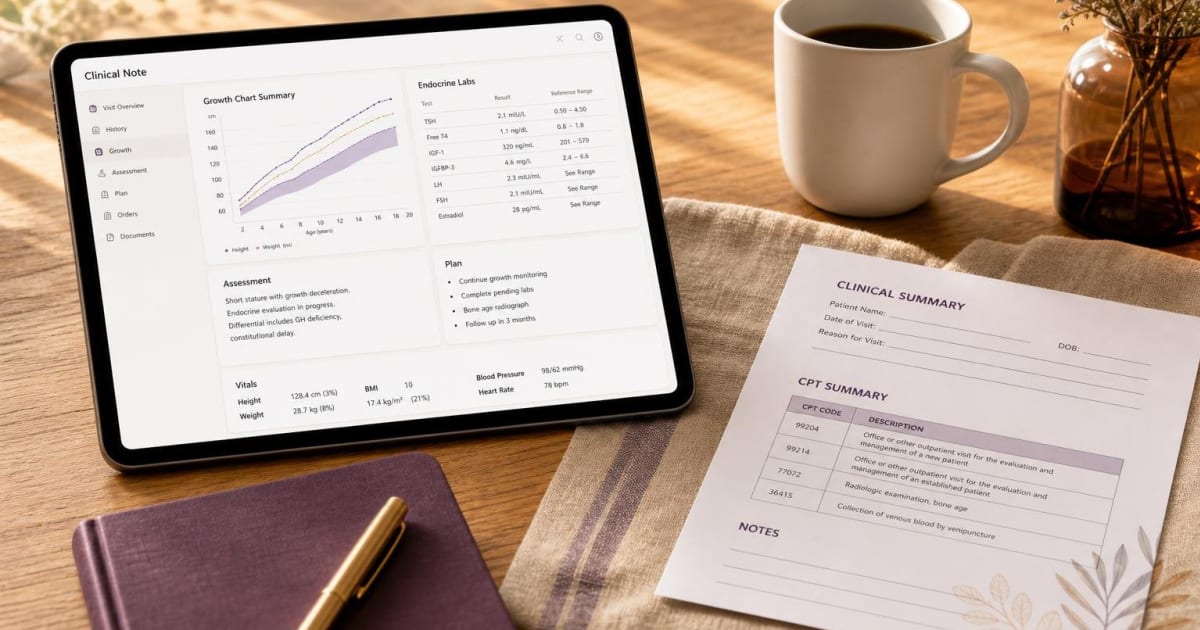
Merry prompts for each anchor when it is absent from the conversation. If the clinician lowers an overnight basal rate after recurrent nocturnal lows, the draft states the pattern, the change, and the safety reasoning, including daycare or school considerations. Height velocity and BMI percentile sit beside the glycemic data, so a rising insulin requirement during a growth spurt is read in context rather than mistaken for under-bolusing.
CGM Interpretation and CPT 95251 Integrity
CPT 95251 describes the professional analysis, interpretation, and report of continuous glucose monitoring data, not the device or technical component. It requires review of at least 72 hours of CGM data and a report of findings and recommendations. Current descriptor language is maintained by the AMA at https://www.ama-assn.org/practice-management/cpt.
A defensible interpretive report contains three elements: confirmation that at least 72 hours of interpretable data were reviewed; a summary of time-in-range, time below 70 mg/dL, time above 180 mg/dL, mean glucose, and variability; and the recommendations communicated to the patient and family. Merry drafts each element explicitly and compares the CGM picture with laboratory A1c to note agreement or discordance.
Separating the Interpretive Report from E/M Work
When 95251 and an office visit are reported on the same date, the interpretive work should be visibly distinct from the evaluation and management narrative. Merry places the CGM report in its own labeled section, apart from history, examination, and the broader plan, which keeps distinct work legible under NCCI review. Modifier selection remains a clinician and billing decision.
Clinical Logic Matrix
The matrix below maps each pediatric endocrine metric to the data points the note must carry and the billing evidence they support.
| Specialty Diagnostic Metric | Required Clinical Data Points | Billing Evidence |
|---|
| CGM Time-in-Range | Percent time 70 to 180 mg/dL, time below and above range, at least 72 hours reviewed | CPT 95251 interpretive report |
| A1c Trend | Current and prior A1c, concordance with CGM glucose indicators | MDM data review, E/M level support |
| Growth Percentile | Height, weight, and BMI percentiles, height velocity, Tanner stage | Medical necessity for regimen changes |
| Insulin Dose Change Rationale | Basal, bolus, or carb ratio change tied to an observed pattern, hypoglycemia safety plan | MDM prescription drug management |
| Hypoglycemia and DKA History | Severe hypoglycemia events, DKA episodes, risk tier | G2211 longitudinal complexity |
| School and Psychosocial Context | School or daycare plan, family capacity, behavioral health coordination | MDM social factors, G2211 continuity |
Clinicians who want ready-made structures for these sections can find specialty prompt packs at https://templates.scribing.io, including CGM interpretation and growth review templates.
Chrome DOM Mapping, Privacy, and Longitudinal Complexity
Merry works through a Chrome extension inside the clinician's active EHR browser window. There is no API build and no change to the EHR's audit trail or signing workflow. Injected text arrives as editable content, so the clinician reviews and owns every line before attestation.
Growth Chart and CGM Field Mapping
Pediatric endocrine notes often live in rich-text editors or iframe-embedded panels beside tabs for labs, growth charts, and device flowsheets. Merry maps its output through the browser DOM: the CGM interpretation lands in the diabetes management or CGM report section, and percentiles and velocity land in the growth assessment field. Repeat insertions update the existing block rather than duplicating it.
Visit audio is held only in volatile memory and discarded at session close, with zero-day retention. What persists is the signed documentation inside the EHR. A Business Associate Agreement is executed before any clinical use.
Longitudinal complexity deserves the same care. For a child whose diabetes, pump therapy, and pubertal insulin resistance are managed by one endocrinologist over years, Merry drafts a brief continuity paragraph covering relationship duration, titration across growth phases, and coordination with school and primary care. This supports G2211 with the office E/M visit. CMS generally does not pay G2211 when the E/M carries modifier 25, apart from listed preventive exceptions, so the clinician decides when it applies.
Medical necessity remains a human judgment. Under California SB 1120, determinations must be made by licensed professionals who consider the requesting provider's recommendation and the patient's history. Merry writes the narrative; the pediatric endocrinologist makes and signs the decision.