CLINICAL MEMORY
Longitudinal Milestone Memory
Find 40+ pediatric prompt packs at templates.scribing.io to generate Bright Futures notes in 5 seconds and surface unresolved developmental concerns across visits.
Specialty Clinical Playbook
Bright Futures-aware ambient documentation with 3-speaker diarization that separates caregiver, clinician, and child voices. Book your audit at https://cal.com/merryai/demo.
 Dr. Sarah Chen, MD
Specialty Architecture
Engineered to mirror the pacing, diagnostic frameworks, and documentation requirements of Bright Futures well-child and adolescent supervision visits.
CLINICAL MEMORY
Find 40+ pediatric prompt packs at templates.scribing.io to generate Bright Futures notes in 5 seconds and surface unresolved developmental concerns across visits.

CONTEXT RETRIEVAL
Retrieve prior CDC/WHO percentile trajectories, ASQ-3 domain scores, and immunization gaps in one structured draft without tab bouncing.
WORKFLOW INTELLIGENCE
Capture longitudinal complexity add-on revenue and auto-draft anticipatory guidance. Claim your 15-Minute Workflow Audit today.
SPECIALTY-AWARE REASONING
Diarize caregiver, child, and clinician dialogue with PR/CD/CO tags and map findings into age-band Bright Futures flowsheet rows.
Point-of-Care Flow
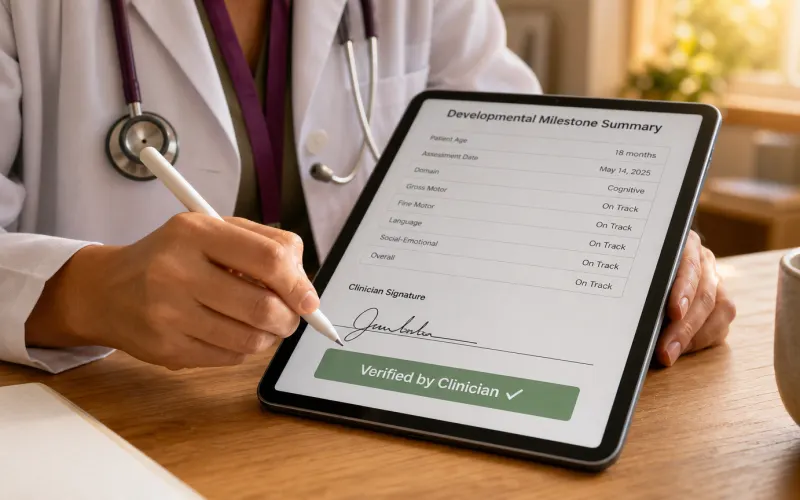
Zero IT friction, zero complex API setup, and human-verified attestation on every note.

Clinical documentation in Pediatrics demands a fundamentally different architecture than adult ambulatory medicine, because the historian is rarely the patient. A well-child encounter is a three-body problem: the caregiver narrates developmental history, the child or adolescent contributes direct observation and, increasingly with age, confidential disclosure, and the clinician layers professional surveillance judgment on top. Merry AI was engineered around this reality, deploying three-speaker acoustic voiceprinting tuned to the acoustic chaos of a pediatric exam room, where crying, overlapping speech, and high-frequency child vocalizations routinely defeat consumer-grade diarization.
The anchor truth of the platform is that it functions as a Bright Futures-aware documentation layer sitting on top of Office Practicum and other pediatric EHRs. It separates clinician versus parent versus child speech, then auto-maps AAP Bright Futures developmental milestones directly into pediatric flowsheet fields consistent with the AAP Bright Futures Tool and Resource Kit EHR builder guidance. This is not generic transcription; it is age-band-aware routing that knows a 4-year visit requires different milestone tables than a 15-year adolescent supervision visit.
Documentation completeness drives both care quality and revenue integrity. As detailed in peer-reviewed pediatric informatics literature available at https://www.ncbi.nlm.nih.gov/pmc/, the chart note has evolved from a clinician memory aid into the primary proof of care and the substrate for billing adjudication. Merry AI identifies missing Bright Futures components for the relevant age band and nudges the clinician before signing, ensuring EPSDT and preventive-service documentation is defensible.
Pediatric diarization requires acoustic models trained on three distinct voice classes: adult caregiver voices, clinician voices, and child or adolescent voices in noisy, overlapping conditions. Merry AI assigns PR (parent report), CD (child direct), and CO (clinician observation) tags to every extracted statement. When a parent says 'she uses four-word sentences and can brush her teeth herself,' the platform maps the statement to the verbal language and self-help milestone rows respectively, marking each as achieved with a transcript-linked source snippet.
Clinician-channel extraction captures professional judgment distinct from reported history. A statement like 'development appears appropriate for age' or 'concern for expressive language delay' populates the surveillance status field and, where warranted, drops an entry onto the Bright Futures problem list. This separation of reported behavior from clinical assessment is exactly the traceability an auditor expects to see.
Adolescent visits introduce a confidentiality constraint absent from younger encounters. Bright Futures emphasizes confidential, adolescent-direct questioning around HEADSS domains: home, education, activities, drugs, sexuality, and suicidality. Merry AI demarcates parent-present versus adolescent-alone segments in the transcript and treats CD-channel statements during parent-absent segments with elevated confidentiality, routing them to restricted documentation sections that respect state minor-consent statutes.
The mapping engine maintains a canonical Bright Futures knowledge graph encompassing the periodicity schedule, developmental milestone tables spanning ages 0 through 17, and adolescent risk-assessment and counseling topics. At runtime, the platform first detects visit type and age band from EHR context, loads the correct milestone set, then parses conversation to identify milestone-relevant phrases and determine status semantics: achieved, not yet, or concern.
Screening instrument integration is native to the workflow. When conversation indicates autism concern or language delay, Merry AI surfaces the appropriate validated instrument, whether M-CHAT-R at 18 and 24 months or ASQ-3 domain scoring, and ensures pass/fail and follow-up fields are populated. Standardized adolescent instruments including PHQ-A for depression and CRAFFT for substance use are captured from the CD channel and mapped into the adolescent documentation tools.
Pediatric growth surveillance depends on hybrid WHO and CDC percentile tracking, with WHO curves for children under 24 months and CDC curves thereafter. Merry AI retrieves prior percentile trajectories alongside the current encounter, flagging crossing of major percentile lines that may signal failure to thrive or accelerating adiposity, and drafts the interpretation into the assessment without the clinician bouncing between growth-chart tabs.
The table below maps the specialty diagnostic frameworks to the required clinical data points and the corresponding billing evidence each generates. This is the operational core of how ambient conversation becomes both a defensible chart and a defensible claim.
| Specialty Diagnostic Framework | Required Clinical Data Points | Billing Evidence |
|---|---|---|
| Bright Futures Developmental Surveillance | Milestone status per domain (gross motor, fine motor, verbal/social language, self-help); parent-child interaction observation | Preventive medicine E/M (99381-99395); EPSDT component documentation |
| M-CHAT-R/F Autism Screening | 20-item score, follow-up interview result at 18/24 months, pass/fail flag | 96110 developmental screening with standardized instrument |
| ASQ-3 / Developmental Screening | Domain-level cutoff scores, communication/motor/problem-solving/personal-social | 96110 units, referral order documentation |
| CDC/WHO Growth Percentiles | Weight, length/height, head circumference, BMI percentile, curve crossing | MDM data-review element supporting E/M level |
| Adolescent HEADSS / CRAFFT / PHQ-A | Confidential risk domains, CRAFFT positive items, PHQ-A severity | Risk-behavior counseling documentation; adolescent preventive coding |
| Longitudinal Medical Home Continuity | Continuing focal-point relationship, single/complex chronic condition management | HCPCS G2211 complexity add-on (not billable with Modifier 25 per CMS MM13272) |
Pediatric EHRs frequently operate as closed gardens with limited or absent write APIs, and Office Practicum's 200-plus pediatric-specific visit templates present a proprietary data model. Rather than wait in an integration queue, Merry AI's Chrome Extension performs DOM-level injection directly into the clinician's active EHR browser window. There is zero IT setup, no credential provisioning delay, and no complex API configuration. Clinicians can Access Specialty Prompts at templates.scribing.io to load age-band-specific note structures instantly.
Event-driven capture triggers when a Bright Futures-aligned well-visit template opens or an adolescent health supervision visit begins, and terminates at visit end or on explicit provider command. The mapping layer is deliberately Bright Futures-first and EHR-second, so a single canonical schema serves Office Practicum today and additional pediatric platforms tomorrow through lightweight per-EHR adapters.
No structured data commits to the chart without clinician review. An inline attestation panel displays which statements were attributed to which speaker and which flowsheet fields the AI proposes to populate, allowing the clinician to reject or correct mis-attributed content before signing. This human-verified checkpoint preserves clinical integrity and satisfies the traceability standard that both quality reviewers and payers increasingly demand. To see this live in your own workflow, Schedule a 15-Minute Specialty Workflow Audit.
The economics of pediatric practice hinge on complete preventive documentation and appropriate complexity capture. Merry AI structures each encounter to support EPSDT and well-child preventive coding while capturing the Medical Decision Making evidence for HCPCS G2211, the visit complexity add-on for services serving as the continuing focal point of a patient's care. The platform enforces the CMS edit preventing G2211 payment when the associated office E/M carries Modifier 25, and when a sick complaint accompanies a well visit it structures the two services for independent defensibility.
Privacy governance is non-negotiable in pediatrics. All audio, transcripts, and derived structured data are treated as PHI under HIPAA, encrypted in transit and at rest. Raw audio is processed ephemerally in RAM and shredded immediately after note generation, with a Business Associate Agreement executed for every practice. Combined with adolescent confidentiality routing and granular role-based access, this posture lets pediatric practices adopt ambient documentation without compromising the trust that defines the pediatric medical home.
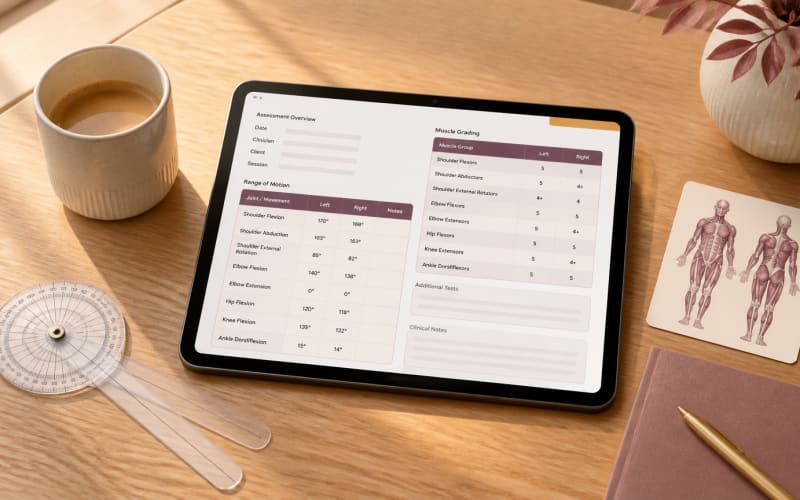
Convert spoken MSK exams into discrete ROM degrees and 0–5 strength grades that satisfy payer medical-necessity checklists. Book your audit at https://cal.com/merryai/demo.
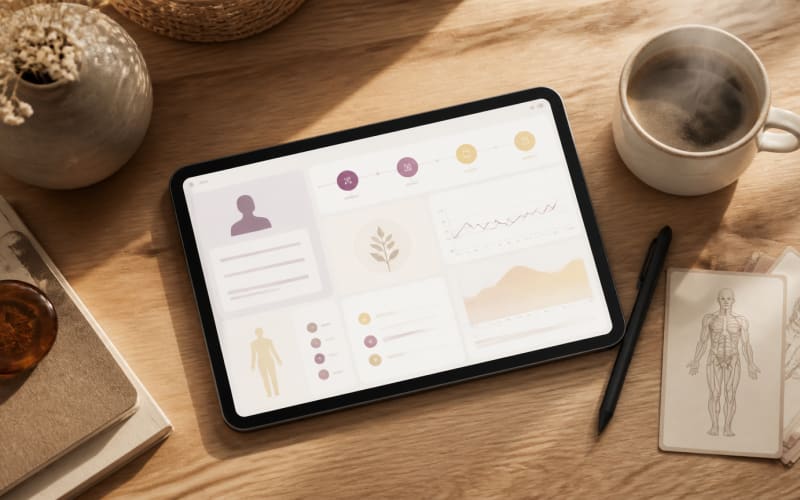
Ambient reasoning that captures GDMT titration, LVEF trends, and CPT G2211 complexity without a single voice command. Book your audit at https://cal.com/merryai/demo.

Ambient documentation that respects EMA sectional boundaries, auto-maps ABCDE morphology, and defends modifier-25 logic. Book your audit at https://cal.com/merryai/demo.