CLINICAL MEMORY
Longitudinal Diagnostic Memory
Carries prior Oswestry scores, ROM degrees, and dermatomal findings forward for comparison at each visit. Access Specialty Prompts at templates.scribing.io for lumbar and cervical packs.
Specialty Clinical Playbook
Record dermatomal deficits, ROM degrees, Oswestry scores, and failed PT weeks. Book your audit at https://cal.com/merryai/demo.
 Dr. Sarah Chen, MD
Specialty Architecture
Engineered to mirror the pacing, diagnostic frameworks, and documentation requirements of Spine Surgery.
CLINICAL MEMORY
Carries prior Oswestry scores, ROM degrees, and dermatomal findings forward for comparison at each visit. Access Specialty Prompts at templates.scribing.io for lumbar and cervical packs.

CONTEXT RETRIEVAL
Surface prior injection dates, PT episode durations, and imaging levels during the visit without tab bouncing.
COMPLEXITY CAPTURE
Partitions E/M reasoning from the procedure note and flags where G2211 cannot pair with Modifier 25. Schedule a 15-Minute Specialty Workflow Audit today.
SPEAKER ROUTING
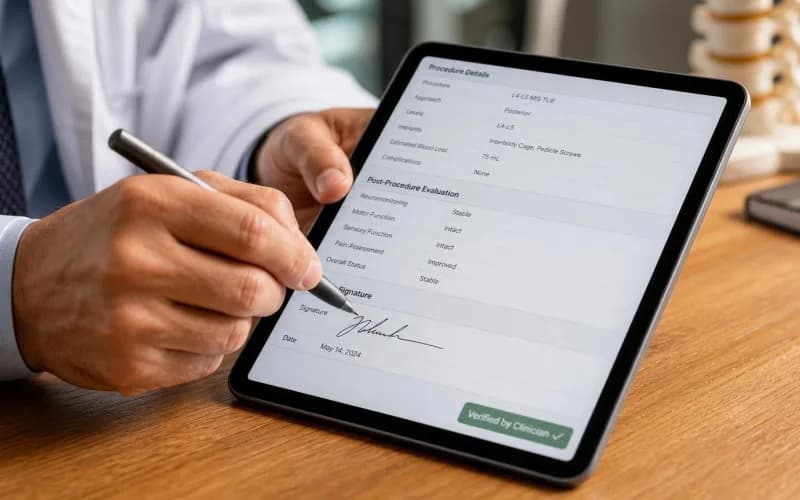
Separates surgeon, patient, caregiver, and medical assistant voices, routing dictated exam findings to the exam section and caregiver observations to history.
Point-of-Care Flow
Zero IT friction, zero complex API setup, and human-verified attestation on every note.
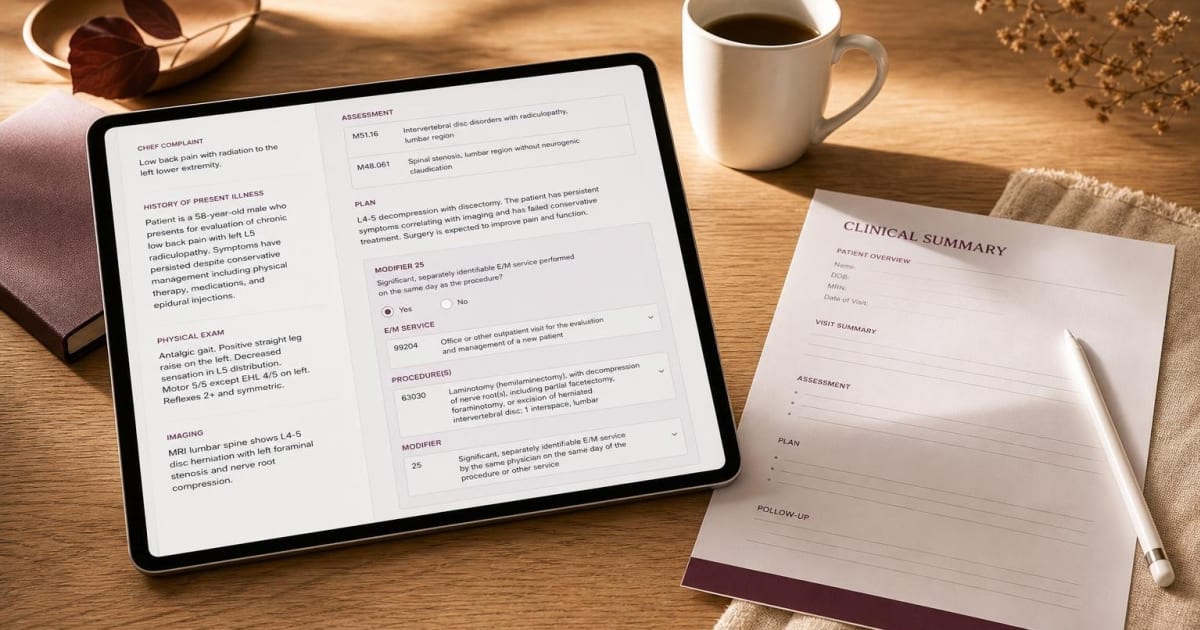
Most spine Modifier 25 denials do not stem from poor medicine. They stem from notes where the evaluation and the injection read as a single event. When a surgeon sees an established patient with worsening L5 radiculopathy, reviews a new MRI, discusses decompression versus another transforaminal injection, and then performs that injection the same afternoon, the payer sees an E/M line and a procedure line. If the note does not show work beyond the bundled pre-procedure assessment, the E/M is the line that gets denied.
Modifier 25 requires a significant, separately identifiable E/M service on the same day as a procedure. The decision to inject, by itself, is generally considered part of the procedure's own preoperative work. What justifies the E/M is everything else: a new or changed neurologic finding, a surgical candidacy discussion, medication management, or evaluation of a second, unrelated complaint. CPT descriptors for these modifiers are maintained by the AMA and are worth reviewing at https://www.ama-assn.org/practice-management/cpt.
Decision-for-surgery visits follow different rules. When the same-day or prior-day visit results in the decision for a major procedure carrying a 90-day global period, Modifier 57 applies rather than Modifier 25. Merry AI keeps these pathways distinct in the drafted note so the coder is not left guessing which encounter type occurred.
Auditors reviewing spine claims look for the same handful of objective elements. Narrative summaries such as 'patient continues to have back pain' do not survive review. Quantified, dated, level-specific findings do.
Neurologic findings must be segmental. The draft records sensory change by dermatome (diminished pinprick over the dorsal foot for L5, the lateral foot for S1), motor grades by myotome (EHL 4/5, plantarflexion 5/5), reflex asymmetry (absent right Achilles), and provocative tests with laterality, such as a positive straight leg raise at 40 degrees reproducing concordant leg pain. Each finding is linked to the imaging level rather than copied from the radiology report.
Lumbar range of motion belongs in degrees, not adjectives. Flexion to 45 degrees with radicular reproduction tells an auditor something 'limited flexion' never will. Merry AI captures the values spoken during the exam and compares them with prior visits when they exist.
Oswestry Disability Index scores carry weight in both injection and surgical necessity reviews. The note records the percentage, the categorical disability band, and the items driving it, such as sitting tolerance or walking distance.
Failed conservative care needs dates. Many MAC local coverage determinations for epidural steroid injections expect roughly four weeks of failed conservative management before injection. The draft lists each physical therapy episode with start date, total weeks, frequency, and response, alongside NSAID, neuropathic agent, and home exercise trials.
| Spine Diagnostic Metric | Required Clinical Data Points | Billing Evidence |
|---|---|---|
| Dermatomal deficit | Level, laterality, sensory modality, comparison to prior exam | Supports a new or worsening problem for the Modifier 25 E/M |
| Motor strength by myotome | MRC grade per muscle group, side, progression | Establishes neurologic change beyond pre-injection review |
| Lumbar ROM | Flexion, extension, lateral bend in degrees, pain reproduction | Objective exam data supporting medical necessity |
| Oswestry Disability Index | Percentage score, disability band, driving items, trend | Functional documentation expected by many LCDs |
| Failed PT and conservative care | Dates, total weeks, modalities, documented response | Satisfies conservative-care duration before injection or surgery |
| Longitudinal management | Prior interventions, comorbidities, ongoing plan | Supports G2211 only on E/M lines billed without Modifier 25 |
NextGen Office runs in the browser, which allows the Merry AI Chrome Extension to place text directly into the active encounter without an API project, interface fees, or IT tickets. The extension identifies the open encounter and writes into the clinician's existing template fields.
The extension binds to HPI and Assessment/Plan fields specifically. Symptom chronology, conservative care history, and Oswestry results land in HPI. The E/M reasoning, surgical options discussed, and the decision to proceed with injection land in the Plan, followed by a separately labeled procedure note with consent, level, approach, medication, and immediate post-procedure assessment. That physical separation in the chart is what makes the Modifier 25 rationale visible to a reviewer. Demographics, orders, and medication lists are never touched.
Specialty prompt packs for lumbar radiculopathy, cervical myelopathy, and post-fusion follow-up are available at https://templates.scribing.io, and each can be adapted to a surgeon's preferred exam sequence.
Every note remains a draft until the surgeon reviews and signs it. Merry AI does not select codes or append modifiers; it organizes what was said and examined so the coding decision rests on clear evidence.
Audio is processed in memory and discarded once the text is generated. No recording or transcript persists outside the EHR, and a Business Associate Agreement is executed before any clinical use.
G2211 deserves careful handling in spine practices. Medicare generally does not pay the add-on when the base E/M carries Modifier 25, except when the same-day service is an annual wellness visit, vaccine administration, or a listed Part B preventive service. A same-day injection is not one of those exceptions. The note can still document longitudinal complexity accurately; the billing team decides which line it supports.
Quiet documentation habits compound. A clinic that consistently records levels, degrees, scores, and dates spends less time on appeals and more time with patients.
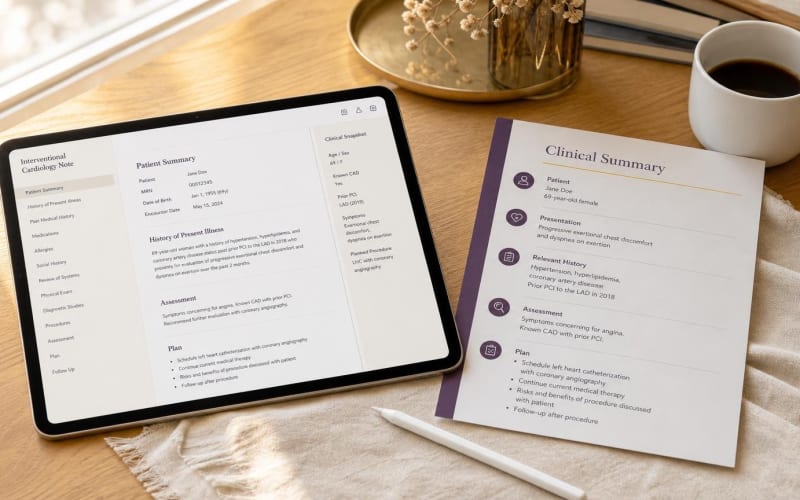
Discrete LVEF, stent date, and DAPT capture, with G2211 gated on modifier 25. Book your audit at https://cal.com/merryai/demo.
Separate Mohs stage maps from distinct E/M problems so modifier 25 holds under review. Book your audit at https://cal.com/merryai/demo.

Discrete LVEF, stent date, and DAPT capture, with G2211 gated on modifier 25. Book your audit at https://cal.com/merryai/demo.