
CLINICAL MEMORY
Longitudinal Limb & Lesion Memory
Find 40+ prompt packs at templates.scribing.io to generate operative and clearance notes in 5 seconds and surface unresolved vascular questions.
Specialty Clinical Playbook
Point-of-care translation of ABI/TBI, duplex, and CTA findings into audit-defensible pre-op clearance and prior auth packets. Book your audit at https://cal.com/merryai/demo.
 Dr. Sarah Chen, MD
Specialty Architecture
Engineered to mirror the diagnostic frameworks, perioperative pacing, and prior-authorization requirements of Vascular Surgery.
CLINICAL MEMORY
Find 40+ prompt packs at templates.scribing.io to generate operative and clearance notes in 5 seconds and surface unresolved vascular questions.
CONTEXT RETRIEVAL
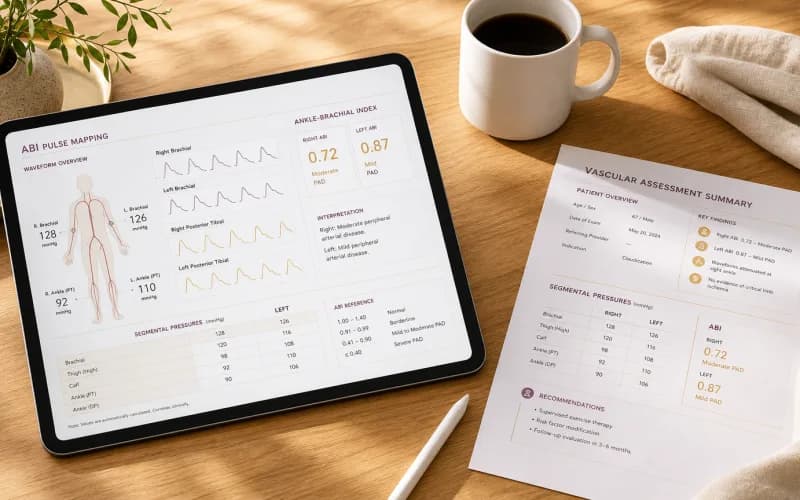
Retrieve prior duplex velocities, ABI/TBI trends, and CTA/MRA findings in one structured draft without bouncing between imaging tabs.
WORKFLOW INTELLIGENCE
Capture longitudinal complexity add-on revenue for serial claudication and CLTI management. Claim your 15-Minute Workflow Audit today.
SPECIALTY-AWARE REASONING
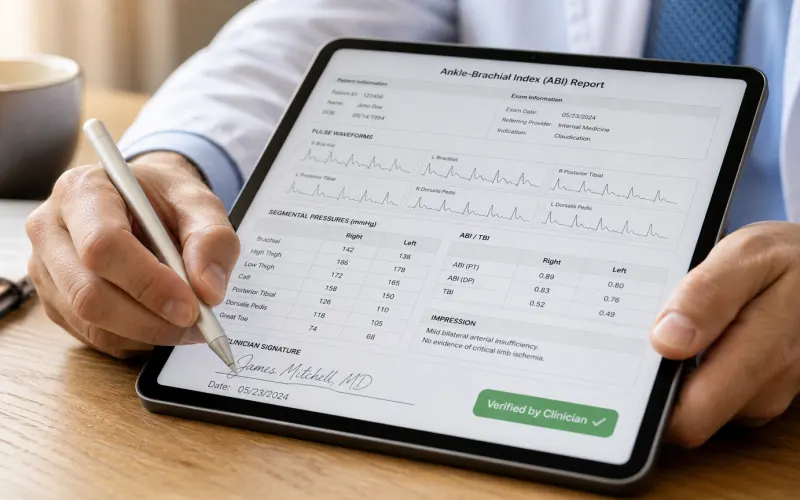
Diarize surgeon dictation and patient history, then map objective vascular findings directly into medical necessity and clearance sections.
Point-of-Care Flow
Zero IT friction, zero complex API setup, and human-verified attestation on every clearance note.

Clinical documentation in Vascular Surgery carries a dual burden that few other specialties share: the note must simultaneously satisfy the operative and perioperative record while assembling an audit-defensible medical necessity trail for prior authorization. A single pre-op clearance encounter may weave together subjective claudication history, objective pulse and wound findings, duplex velocities, ABI/TBI ratios, and a documented clearance decision — all of which must remain internally consistent with the billed CPT and the payer packet.
Merry AI approaches this problem not as generic documentation assistance but as point-of-care translation. The system maps structured vascular findings into the exact documentation fields required for CPT/E/M support, pre-op clearance defensibility, prior authorization, and audit readiness. Crucially, it preserves provenance back to clinician-entered or imported source data and refuses to fabricate unsupported medical necessity statements — a discipline CMS auditors reward.
Because Epic's perioperative tooling documents pre-, intra-, and post-procedure workflows within a single record, and athenaOne's Authorization Management service extracts clinical necessity evidence from the chart, Merry AI sits precisely at the seam where those workflows meet. The note, the coded encounter, and the authorization packet all draw from one verified source of truth.
Objective vascular findings drive both clinical decision-making and payer approval. Merry AI captures pedal and femoral pulse grading, ischemic rest pain, limb-threat classification, wound status, claudication distance, duplex/CTA/MRA results, ankle-brachial index (ABI), and toe-brachial index (TBI) values with lesion location and severity. These are the data points payer-facing checklists explicitly expect before an intervention is authorized.
When a surgeon dictates "non-palpable posterior tibial pulse, monophasic waveform, ABI 0.42 on the left," Merry AI recognizes these as structured medical necessity anchors rather than free text. Documentation of failed conservative therapy — supervised exercise, cilostazol trial, risk-factor modification — is attached automatically where the disease severity warrants it, closing the most common gap in denied vascular prior authorizations.
Pre-operative clearance in Vascular Surgery demands an explicit decision statement: cleared, not cleared, or cleared with conditions, each accompanied by documented rationale. CMS expects the history and physical to be completed and documented before any anesthesia-requiring procedure, so the timing and attestation of this note are themselves audit-sensitive elements. Merry AI enforces this decision logic as a mandatory field, preventing the ambiguous clearance notes that draw retrospective denials.
If a patient is not cleared or cleared conditionally, the reason and next steps are documented with the same rigor as the affirmative decision — cardiac optimization, anticoagulation bridging, or repeat imaging. The system pairs the clearance with the appropriate Z01.81x preprocedural examination diagnosis and ensures the E/M level is supported by the captured Medical Decision Making complexity.
Medical necessity is not an afterthought bolted onto the note; it is the spine of every vascular authorization. The chart must state explicitly why the intervention is needed and support it with pre-procedure diagnostics. Merry AI constructs the necessity narrative from the charted imaging, waveform evidence, symptom burden, and conservative-therapy failure — never from generic boilerplate that an auditor can strip away.
This discipline matters because recent peer-reviewed evaluation of AI-assisted CPT coding in vascular surgery, conducted at Tufts Medical Center across 120 operative cases, demonstrated that coding accuracy is tightly coupled to the completeness of the underlying operative documentation. Detailed operative notes outperformed brief summaries. Merry AI's structured capture is engineered to produce the former, aligning with current AMA CPT standards published at https://www.ama-assn.org/practice-management/cpt.
The following matrix connects the vascular diagnostic frameworks your team already uses to the clinical data points Merry AI captures and the billing evidence each element defends. This is the translation layer that converts an ambient conversation into a defensible claim.
| Specialty Diagnostic Framework | Required Clinical Data Points | Billing / Audit Evidence |
|---|---|---|
| ABI / TBI Assessment | Ankle and toe pressures, brachial pressure, index ratio, waveform morphology | Medical necessity for PAD intervention; supports 93922-93926 non-invasive studies |
| Duplex Ultrasound | Peak systolic velocity, velocity ratio, stenosis grade, lesion location | Objective severity documentation for endovascular CPT families |
| Rutherford / CLTI Classification | Rest pain, tissue loss, limb-threat category, wound status | Disease severity supporting urgency and G2211 continuity of care |
| Pre-Op Clearance (Z01.81x) | Cleared / not cleared / conditional decision, H&P completion, rationale | E/M level support; CMS pre-anesthesia H&P requirement |
| Operative Record | Indication, findings, technique, device details, fluoroscopy time, attestation | Procedure-specific CPT/HCPCS defense and coding accuracy |
Every structured element Merry AI writes carries a provenance link back to its source — the clinician's spoken finding, an imported duplex report value, or an imaging conclusion. Records must be accurate, signed, dated, and retained per CMS and state rules, and this provenance trail is what survives an internal audit or a payer takeback review. The authorization packet, the operative note, and the coded encounter remain mutually consistent because they were generated from the same verified data.
Merry AI deploys through a Chrome Extension that runs inside the surgeon's existing Epic or athenaOne browser window, requiring zero API configuration. In Epic, this aligns with the case-driven referral and pre-authorization workqueue routing that triggers once a scheduler enters the schedule-by date and CPT codes. In athenaOne, the structured chart content feeds directly into the Authorization Management workflow that transmits clinical necessity evidence to payers.
Getting your vascular team live takes minutes, not procurement cycles. Explore the specialty prompt library and Access Specialty Prompts at templates.scribing.io to preview pre-op clearance, endovascular operative, and prior-auth assembly templates. When you are ready to see the workflow against your own case mix, Schedule a 15-Minute Specialty Workflow Audit and we will map your most-denied CPT families to a defensible documentation pattern in real time.

Standardize multi-party group note-splitting and MSE metrics across 5-50 providers with centralized QA dashboards. Book your audit at https://cal.com/merryai/demo.

Structured colonoscopy notes with discrete polyp morphology, Paris classification, and automated ADR tracking pushed into gGastro and Epic GI. Book your audit at https://cal.com/merryai/demo.
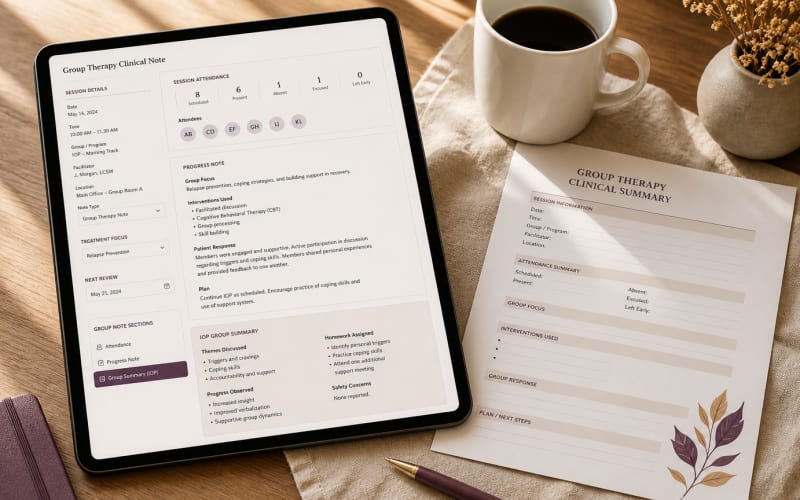
Turn one 3-hour group session into individualized, 42 CFR Part 2-compliant progress notes per client. Book your audit at https://cal.com/merryai/demo.