Statutory Compliance Architecture for California SB 1120
Documenting clinical encounters under California SB 1120 carries a downstream consequence that many wound clinics have not yet addressed. Effective January 1, 2025, the Physicians Make Decisions Act (Chapter 879, Statutes of 2024) amended Health and Safety Code Section 1367.01 and Insurance Code Section 10123.135 to govern how health plans and disability insurers use artificial intelligence, algorithms, or other software tools in utilization review and utilization management.
The statute imposes three obligations relevant to the wound encounter. A tool must base its determination on the enrollee's medical or other clinical history and individual clinical circumstances as presented by the requesting provider. It may not supplant provider decision-making. It may not deny, delay, or modify care based in whole or in part on medical necessity; that determination remains with a licensed physician or other qualified health care professional.
The practical implication is direct. If the reviewer must weigh individual clinical circumstances, the chart must state them explicitly. A note reading 'chronic ulcer, debrided' gives the reviewing physician nothing to weigh against an algorithmic score. A dense, dated, quantitative note does.
Building the Individualized Wound Record for CPT 11042
Debridement of subcutaneous tissue, reported as CPT 11042 for the first 20 sq cm or less, with 11045 for each additional 20 sq cm, is among the most frequently reviewed wound procedures. Noridian's Wound and Ulcer Care billing article (A58565), which applies to Medicare claims across California, expects documentation of wound location, size, depth, tissue removed, and a plan reflecting measurable progress. SB 1120 makes the same elements decisive in commercial and Medi-Cal managed care review.
Wound Size, Wagner Grade, and Dated Failed Therapies
Every 11042 note should record length, width, and depth in centimeters, computed area, tunneling and undermining, and the deepest tissue level removed. Serial measurements establish trajectory; a statement such as 'area reduced 12 percent over four weeks despite offloading' is evidence a reviewer cannot treat generically.
Wagner grade belongs in the assessment with its descriptor, for example 'Wagner grade 3, deep ulcer with abscess, osteomyelitis suspected on probe-to-bone.' Pair the grade with its supporting findings so the classification is not read as a bare label.
Failed therapies must be dated. List each prior intervention with start date, stop date, and failure mode: hydrocolloid from 03-08-2026 to 31-08-2026, discontinued for maceration; total contact cast from 01-09-2026, stopped for skin breakdown. Undated history is the most common reason a medical-necessity rationale weakens on review.
LVEF and A1c as Comorbid Context
Cardiometabolic markers define healing potential. The most recent hemoglobin A1c with collection date, and trend where available, documents glycemic control. LVEF percentage with echocardiogram date, and NYHA class where documented, informs perfusion, edema, anesthesia tolerance, and offloading feasibility. Neither value is a coverage criterion for 11042 by itself; both are individual clinical circumstances that SB 1120 requires the reviewer to consider.
EHR DOM Field Mapping for Wound Assessment
Wound documentation rarely lives in one place. The encounter note editor, wound flowsheet, photography tab, and cardiology and laboratory results sit on separate surfaces, often inside nested iframes. A transcript-only scribe sees the spoken narrative and misses the discrete values the clinician entered elsewhere.
Procedure Note and Flowsheet Selectors
Merry AI maps fields by semantic attribute rather than brittle absolute XPath. Note targets include div[contenteditable='true'] within the charting iframe, textarea[data-field='noteText'], and elements labeled aria-label='Assessment and Plan'. Flowsheet reads target input[data-field='wound_length'], wound_width, wound_depth, select[data-field='wound_grade'], and input[type='date'][data-field='dressing_change_date']. Field names vary by EHR build and are confirmed per site.
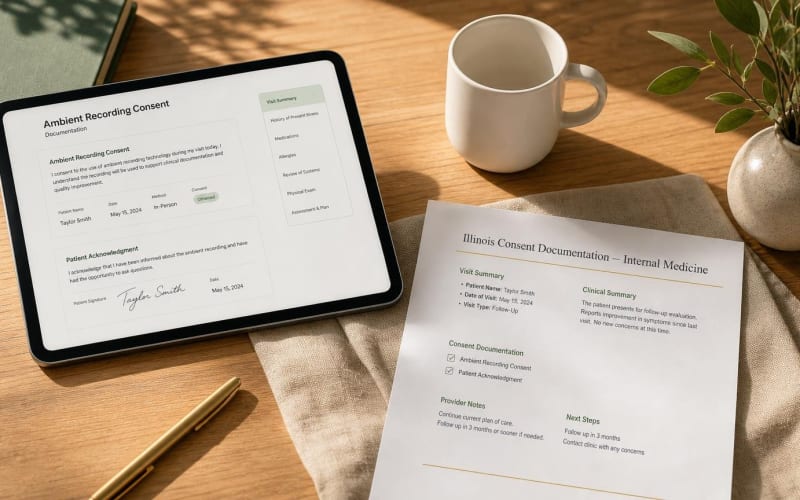
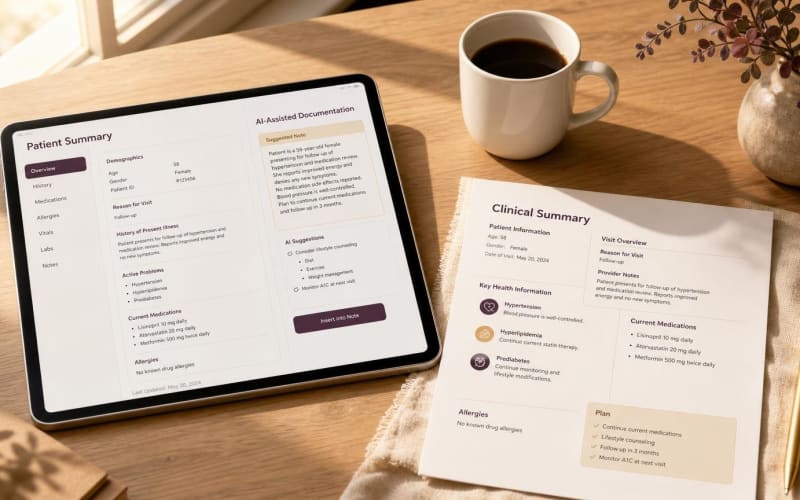
Each injected block is labeled 'Wound Summary: assembled from discrete fields, clinician reviewed,' and provenance is logged by field identifier and timestamp, keyed to encounter ID. A mutation observer refreshes the summary when flowsheet values change, and the block remains fully editable, so the physician's rationale, not the extension, governs the signed note.
Statutory Comparison and Audit Defensibility
The table below contrasts three documentation models against SB 1120 review criteria.
| Compliance Dimension | Manual Charting | Standard Generic AI Scribes | Merry AI Compliance Architecture |
|---|---|---|---|
| Wound metrics | Typed inconsistently; serial values often missing | Transcript-dependent; flowsheet values not read | Reads L x W x D and area from flowsheet fields |
| Wagner grade | Free text; descriptor often omitted | Captured only if spoken | Grade plus supporting findings from select field |
| Failed therapy chronology | Undated narrative | Summarized without dates | Dated entries with failure mode |
| LVEF and A1c context | Requires manual tab switching | Rarely retrieved | Pulled with result date from results tabs |
| Provenance and supervision | Implicit | Untagged generated text | Labeled block, field-level log, clinician attestation |
Longitudinal complexity billing follows the same record. HCPCS G2211, described in CMS MLN Matters MM13473, reflects an ongoing relationship for a serious or complex condition, and for CY 2026 CMS extends payment to home and residence E/M codes 99341 through 99350. When an E/M visit and 11042 occur on the same date, modifier 25 requires a significant, separately identifiable service, and G2211 is not payable on an E/M carrying modifier 25 except when billed with an Annual Wellness Visit, vaccine administration, or Part B preventive service. Modifier 59 or XS applies only to distinct anatomic sites or sessions. Verify descriptors against the AMA reference at https://www.ama-assn.org/practice-management/cpt.
Clinics preparing for payer audits can Schedule a 15-Minute Workflow Audit to review field mapping against their own EHR build.