Statutory Compliance Architecture for Florida Security of Communications Act
Documenting clinical encounters under Florida Chapter 934 begins with a single legal fact: ambient audio capture of a geriatric visit is an interception of an oral communication as defined in Fla. Stat. § 934.02(2). An examination room, a home visit, or an assisted living suite each carries a justified expectation that speech is not being captured. Liability attaches to the act of interception itself, not to whether audio is later written to disk.
Streaming audio through volatile memory does not remove the consent obligation. A buffer that exists only for seconds is still an interception at the moment the microphone opens. Data minimization reduces breach exposure and discoverability, but it is orthogonal to the threshold question Florida asks: did every party consent before capture began?
All-Party Prior Consent Under § 934.03(2)(d)
Florida permits interception only when all parties to the communication have given prior consent under Fla. Stat. § 934.03(2)(d). Unlawful interception is generally a felony of the third degree under § 934.03(4)(a). Section 934.10 authorizes civil actions for actual damages or liquidated damages of $100 per day or $1,000, whichever is greater, plus punitive damages and attorney fees. Section 934.06 bars unlawfully intercepted content from evidence.
Prior consent means sequence matters. Consent obtained after the microphone activates does not cure an interception that already occurred. The compliant record shows consent timestamped before the first audio frame, attributed to named individuals, and linked to the encounter.
Capacity, Surrogates, and Every Caregiver Present
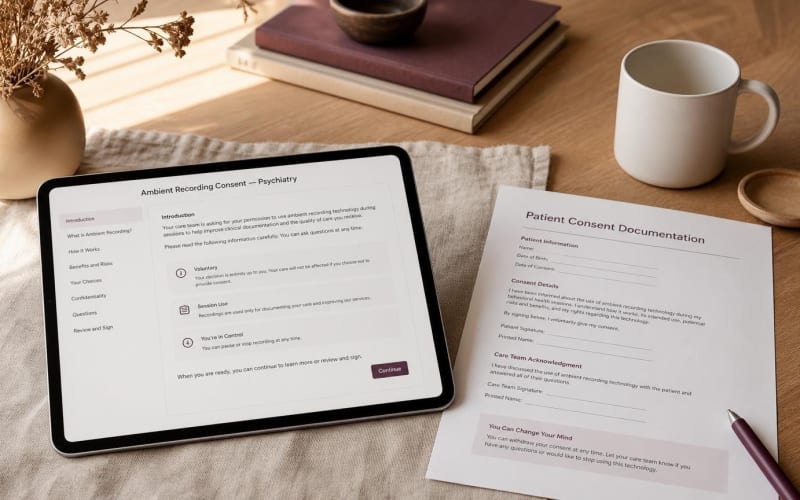
Geriatric encounters rarely involve two people. A visit may include the patient, an adult child, a spouse, a home health aide, or facility staff. Each speaker is a party to the oral communication. Merry AI requires the clinician to confirm consent from the patient and from each caregiver present, recording every participant's full name and relationship to the patient before capture is permitted.
Where cognitive impairment limits capacity, as with major neurocognitive disorder or delirium, consent to recording follows the same pathway as consent to examination. Florida's guardianship provisions in Chapter 744 and health care surrogate provisions in Chapter 765 identify who may act for the patient. Merry AI separates a patient-consent state from a surrogate-consent state and logs the documented basis of authority.
Arrivals mid-visit trigger re-consent. When a new family member or staff member enters, capture pauses until that person's name, relationship, and consent are added. A declining participant ends ambient capture for the encounter, and the clinician documents manually.
Consent-Gated Capture: DOM Injection Before Microphone Access
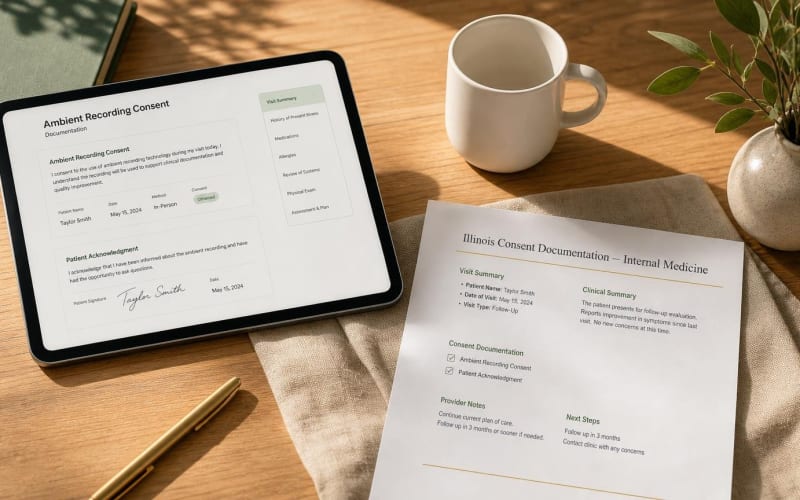
Merry AI injects a consent checkbox directly into the EHR DOM, adjacent to the visit header, before any audio pathway exists. The record button is disabled in code, not merely hidden through styling: no getUserMedia() call is issued until the checkbox is checked, every listed participant is attested, and a timestamped consent event is written to the note metadata.
The consent event writes into the chart through standard DOM change events, so the EHR's autosave and native audit trail register it. Participant names, relationships, capacity determination, and clinician attestation travel with the note, giving compliance officers a contemporaneous record if interception is ever alleged.
Volatile RAM and 0-Day Audio Retention
Audio streams exclusively into encrypted volatile memory and is shredded upon note finalization, with 0-day retention. No audio is persisted locally or in cloud storage, and none is repurposed for model training. This narrows what is subject to subpoena and prevents secondary use beyond the consented documentation purpose. Fla. Stat. § 456.057 continues to govern confidentiality of the finalized note.
Statutory Comparison: Documentation Liability by Architecture
The table below contrasts three documentation models against Chapter 934 and geriatric audit exposure.
| Compliance Dimension | Manual Charting | Standard Generic AI Scribes | Merry AI Compliance Architecture |
|---|---|---|---|
| § 934.03(2)(d) all-party consent | Not implicated; no interception | Verbal or single generic toggle | Named, per-participant consent before capture |
| Caregiver and surrogate attribution | Narrative only, if noted | Rarely distinguishes patient from surrogate | Name, relationship, and authority basis logged |
| Microphone gating | Not applicable | Record button available on load | getUserMedia() blocked until DOM checkbox attested |
| Audio retention | None | Cloud storage for QA or training | Volatile RAM, shredded at finalization, 0-day retention |
| § 934.10 civil exposure | Minimal | Elevated where consent is undocumented | Reduced by timestamped consent metadata |
| Geriatric documentation depth | Clinician-dependent, time-limited | General adult templates | ADL, IADL, TUG, MoCA, Beers Criteria capture |
Geriatric Documentation Integrity and Audit Defense
Consent compliance protects the encounter; documentation integrity protects the claim. Merry AI extracts quantitative geriatric measures, including MoCA or SLUMS scores, ADL and IADL dependencies, Timed Up and Go results, fall history, and Beers Criteria medication rationale. These elements support HCPCS G2211 when the note demonstrates longitudinal management of serious or complex conditions in office or home and residence E/M visits.
Modifier 25 claims require separation. When an annual wellness visit and a problem-oriented evaluation occur on the same day, the note must present distinct history, examination, and medical decision-making to support a significant, separately identifiable service under the NCCI Policy Manual. Every generated passage is reviewed and signed by the treating physician before finalization.
Peer-reviewed literature on geriatric documentation and recording consent is available through https://www.ncbi.nlm.nih.gov/pmc/. Practices preparing for internal review can Schedule a 15-Minute Workflow Audit to map consent capture, surrogate logging, and DOM gating against their EHR configuration.