Statutory Compliance Architecture for Illinois 720 ILCS 5/14-2
Illinois treats eavesdropping as a felony offense. Under 720 ILCS 5/14-2(a)(1), a person commits eavesdropping when they knowingly and surreptitiously use an eavesdropping device to overhear, transmit, or record any part of a private conversation to which they are not a party, unless all parties consent. Section 14-4 classifies a first offense as a Class 4 felony, and Section 14-6 grants aggrieved parties civil remedies, including actual and punitive damages.
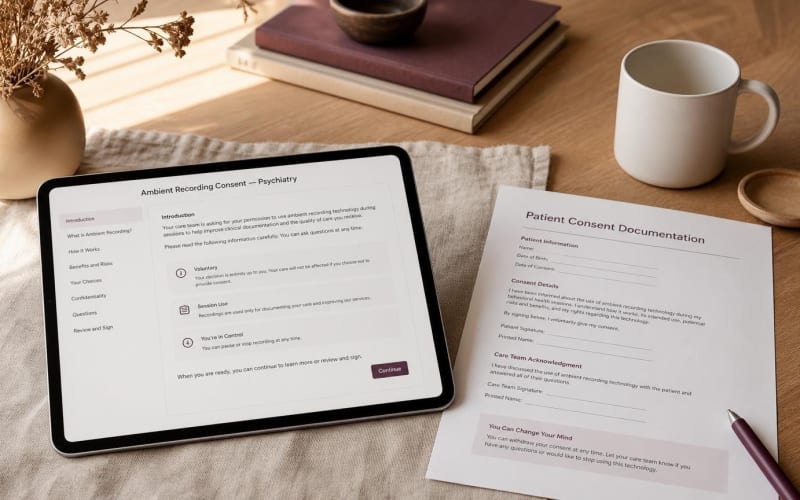
An ambient documentation system is a separate actor in the room. It is not a conversational party, so its capture of a psychotherapy session must rest on the consent of every person whose speech it records. The statute does not prescribe a consent format, logging location, or retention period; those implementation decisions determine whether a practice can later defend its conduct.
Behavioral health raises the stakes further. The Mental Health and Developmental Disabilities Confidentiality Act, 740 ILCS 110/5, generally requires written consent before records and communications leave the circle of authorized persons. Transmitting session audio to a cloud service must therefore be evaluated under both statutes.
Who Counts as a Party in a Therapy Room
Section 14-1(d) defines a private conversation by reference to circumstances reasonably justifying an expectation of privacy, which a therapy room plainly satisfies. In family therapy, couples work, adolescent sessions, and intake visits, the parties include guardians, parents, interpreters, and support persons. Consent from only the identified patient leaves the remaining voices unconsented.
Merry AI enumerates each participant before capture. The clinician confirms the roster, reads a short consent script aloud, and records an affirmative response from each person. If anyone declines or joins mid-session without consenting, capture pauses until the roster is reconciled. Because minors aged 12 to 17 hold independent record rights under 740 ILCS 110/4, their assent is recorded alongside guardian consent.
Encounter-Level Consent and Timestamp Injection
Consent must attach to the specific conversation being recorded. A one-time intake signature or general privacy notice does not establish that each party agreed to this session's capture. Merry AI treats consent as an encounter-scoped event: a new note, session date, or change in participants requires fresh confirmation.
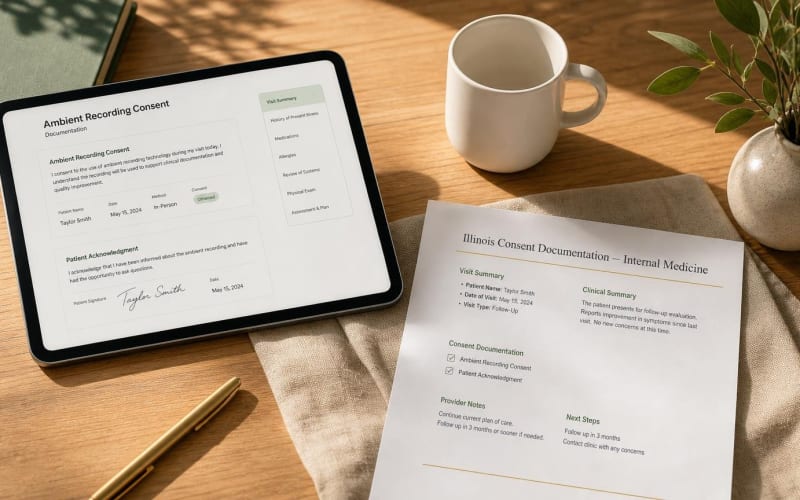
The overlay gates microphone activation on a verified chart write. When the clinician selects Start Capture, the browser extension locates the active note editor, whether a textarea, a contenteditable region, or an iframe-hosted body, and writes the consent statement. If the editor is read-only, absent, or fails to persist the line, the microphone remains closed. No code path records without charted consent.
Consent Timestamp in the Session Note Header
The consent timestamp is injected into the session note header DOM as visible text and a machine-readable attribute. A representative header reads: "2026-10-30T14:03:11-05:00 (CDT), Illinois. All parties present (patient, guardian, clinician) verbally consented to audio capture for clinical documentation under 720 ILCS 5/14-2(a)(1)." The same ISO 8601 value is written to a data-consent-ts attribute for audit queries.
Because the header saves through the EHR's native save and sign workflow, the consent line inherits the EHR's audit trail and clinician attribution. The extension never bypasses note locking or signature controls.
Audio Ephemerality and Mental Health Confidentiality
Neither Illinois statute sets a retention period for audio. Retention is nonetheless the largest discovery and breach surface in behavioral health, and raw psychotherapy audio is rarely part of the designated record set. Merry AI streams audio through volatile memory buffers only, overwrites segments as they are transcribed, and shreds residual buffers from RAM once the draft note is generated. Nothing is written to disk, object storage, or long-lived queues, and telemetry excludes waveform data.
Statutory Comparison Across Documentation Models
The table below contrasts three documentation models against the controls most relevant to Section 14-2 and 740 ILCS 110.
| Compliance Dimension | Manual Charting | Standard Generic AI Scribes | Merry AI Compliance Architecture |
|---|---|---|---|
| All-party consent (720 ILCS 5/14-2) | Not applicable; no device capture | Often one-time or patient-only | Per-encounter roster consent including guardians and family |
| Consent evidence location | Paper intake packet | Vendor portal, outside the chart | Timestamp injected into session note header DOM |
| Capture gating | Not applicable | Recording may start before consent is charted | Microphone blocked until consent line persists |
| Audio retention | None | Retained for QA or model training | RAM-only, shredded after note generation |
| 740 ILCS 110/5 exposure | Low | Elevated by stored cloud audio | Limited to derived text under BAA |
| Mid-session participant changes | Clinician memory | Rarely detected | Capture pauses until roster is reconciled |
Reimbursement Integrity and Audit Readiness
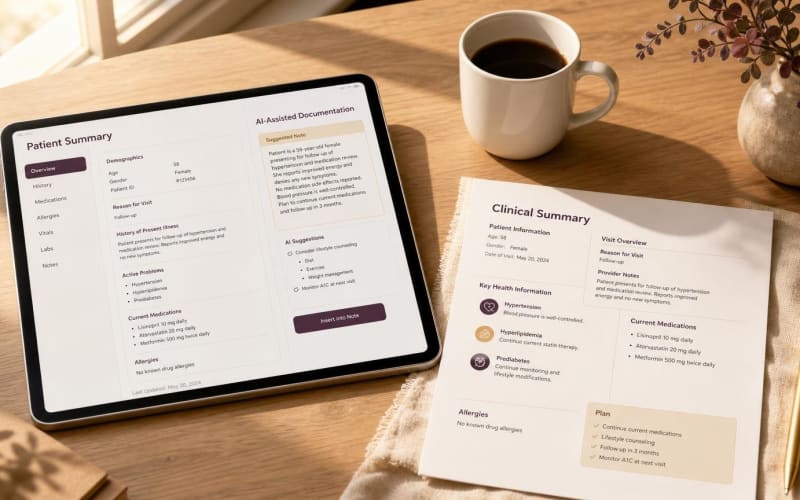
Lawful capture is only half of a defensible note. Behavioral health claims must document medical necessity in DSM-5-TR terms: symptom clusters, duration thresholds, functional impairment, a structured Mental Status Examination, and explicit risk assessment covering suicidality, violence, and substance use. Peer-reviewed literature on documentation integrity is available at https://www.ncbi.nlm.nih.gov/pmc/.
Psychotherapy add-on combinations require separation. When 90833 is reported with 99213 or 99214, the note must distinguish psychotherapy time, technique, and response from E/M medical decision making. Merry AI drafts these as discrete sections.
For HCPCS G2211, CMS requires documentation of a longitudinal relationship in which the clinician serves as the continuing focal point of care or manages a single serious or complex condition. CMS does not pay G2211 when the base E/M carries modifier 25, except where the separate service is a qualifying Part B preventive service. Merry AI flags conflicting G2211 suggestions and requires distinct documentation before modifier 59 is accepted.
Practices preparing for Illinois deployment should review their consent roster, EHR editor types, and audio pathways together. Schedule a 15-Minute Workflow Audit to map each control to your charting workflow.