Statutory Compliance Architecture for Illinois 720 ILCS 5 Article 14
Documenting clinical encounters under Illinois 720 ILCS 5 Article 14 begins with a precise reading of the offense. Section 14-2(a)(2) makes it unlawful to knowingly and intentionally use an eavesdropping device in a surreptitious manner to record a private conversation to which the user is a party, unless all other parties consent. Section 14-1 defines a private conversation as an oral communication made under circumstances that reasonably justify an expectation of privacy. That definition squarely describes the exam room.
Penalty exposure is criminal, not administrative. Under Section 14-4, a first offense is a Class 4 felony. Section 14-6 authorizes civil actions for injunctive relief, actual damages, and punitive damages. Section 14-5 renders unlawfully obtained recordings inadmissible. The regulated event is audio capture itself, so one misconfigured microphone exposes the entire multispecialty group.
Merry AI treats ambient capture as locked by default. Capture stays disabled until all-party consent is written into the Illinois encounter note through the DOM. Audio is processed in short in-RAM buffers and then overwritten at 0-day retention. No audio is written to disk, exported to logs, or used for model training.
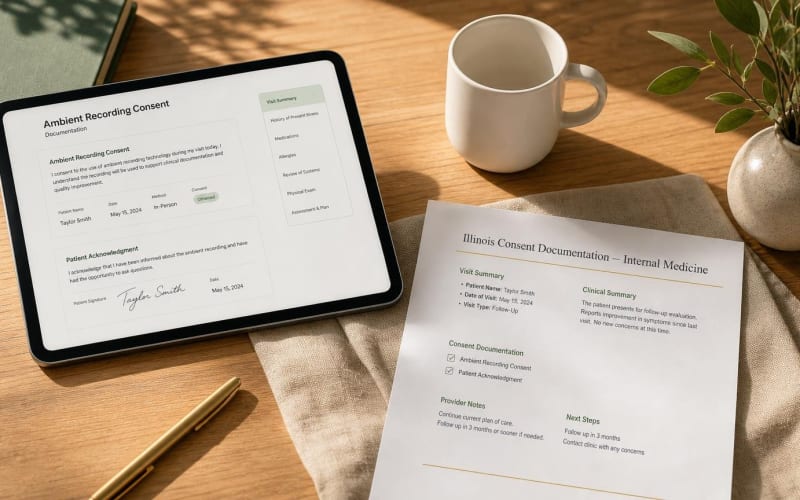
All-Party Consent Logging Before Capture
Directive P1 requires that every party be identified before the first audio frame is processed. The clinician, the patient, and any additional participant, such as an interpreter, family member, trainee, or chaperone, are logged by name with an ISO 8601 timestamp. If someone enters mid-encounter, capture pauses until that person is added and the log is re-stamped.
This sequencing addresses the surreptitious element directly. Section 14-1 defines surreptitious as obtained through stealth, deception, secrecy, or concealment. A named, timestamped consent record created before capture is the opposite of concealment. It gives compliance officers contemporaneous evidence instead of reconstructed recollection.
EHR Consent Attestation via Chrome DOM Injection
Directive P7 places the consent attestation inside the legal medical record rather than in a vendor dashboard. The Merry AI Chrome extension injects a structured line into the EHR note header that records consent under 720 ILCS 5/14-2, the names of all parties, and the timestamp. The line carries a machine-detectable data attribute that functions as the sole unlock for ambient text insertion.
Content scripts write through native editor interfaces, including textarea values, contentEditable regions, and embedded WYSIWYG APIs. This keeps EHR undo history and audit trails intact. When charting surfaces live inside iframes, scoped message passing mirrors the consent flag into the chart frame, and only on permitted origins.
Encounter-Scoped Consent Across Multi-Tab Charts
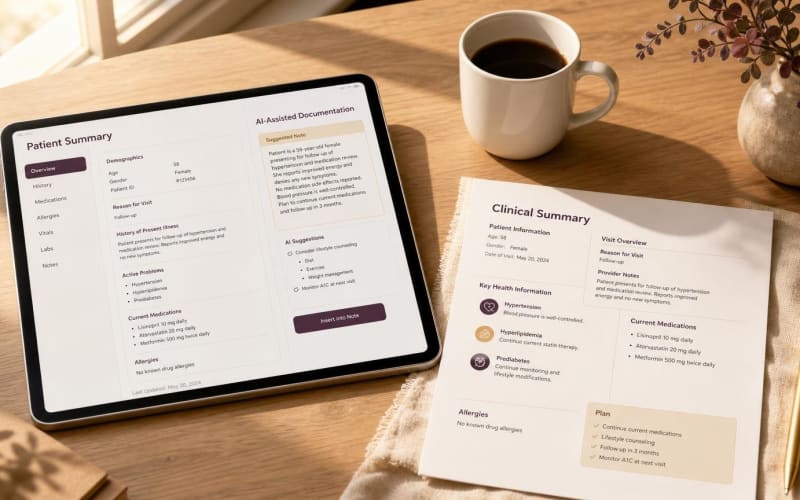
Multispecialty workflows span many tabs: History, Exam, Assessment and Plan, Orders, and specialty tabs for behavioral health, heart failure, orthopedics, and well-child care. The consent anchor is an encounter-scoped state flag. It enables assistance across every tab within one encounter. It never carries into another encounter, another patient, or another day.
Every ambient write is logged with the encounter ID, target DOM selector, timestamp, and consent anchor status at insertion. If the attestation line is deleted or altered, insertion halts and the event is recorded for compliance review.
Multispecialty Documentation Fidelity and 2026 CMS Billing
Consent architecture alone does not produce a defensible note. Each specialty maps its findings to discrete fields:
- Behavioral health: DSM-5-TR criteria, symptom duration, PHQ-9 and GAD-7 scores, and suicide risk stratification.
- Cardiology: NYHA class I through IV, plus LVEF with modality and study date.
- Orthopedics: numeric range-of-motion degrees by side.
- Pediatrics: anticipatory guidance aligned with Bright Futures periodicity.
The engine never infers unstated symptoms. Padded documentation would turn an eavesdropping safeguard into payer fraud exposure.
G2211 and NCCI Modifier 25/59 Separation
HCPCS add-on code G2211 recognizes longitudinal complexity with office/outpatient codes 99202 to 99205 and 99211 to 99215. Effective January 1, 2026, it also applies to home or residence codes 99341, 99342, 99344, 99345, and 99347 to 99350. CMS denies G2211 when the base E/M carries modifier 25. The exceptions are same-day annual wellness visits, vaccine administration, and Part B preventive services.
Merry AI enforces narrative separation between preventive and problem-oriented content, and between E/M work and same-day procedures. Modifier 25 requires a significant, separately identifiable E/M service. Modifier 59 requires documented distinct sites, sessions, or indications, and applies only when no more specific modifier fits.
Statutory Comparison and Audit Defensibility
The comparison below summarizes residual liability across three documentation models.
| Compliance Dimension | Manual Charting | Standard Generic AI Scribes | Merry AI Compliance Architecture |
|---|---|---|---|
| 720 ILCS 5/14-2 consent | No recording; not triggered | Clinician toggle; consent often verbal and unlogged | Named, timestamped all-party log before capture |
| Consent location | Not applicable | Vendor UI, outside legal record | Attestation line in EHR note header |
| Audio retention | None | Cloud storage for days to months | In-RAM buffers, 0-day retention |
| 14-6 civil exposure | Minimal | Elevated if consent contested | Reduced by contemporaneous evidence |
| Specialty discrete fields | Clinician-dependent | Narrative blending | DSM-5-TR, NYHA/LVEF, ROM, Bright Futures |
| G2211 and modifier 25/59 | Manual separation | Blended narratives | Enforced preventive, E/M, and procedure separation |
Compliance officers should validate this configuration with Illinois counsel, since courts may read recording broadly. Peer-reviewed literature on ambient documentation and consent is indexed at https://www.ncbi.nlm.nih.gov/pmc/. To test the consent gate, attestation injection, and retention behavior inside your EHR, Schedule a 15-Minute Workflow Audit.