Statutory Scope of 740 ILCS 14 in Primary Care
The Biometric Information Privacy Act (740 ILCS 14) lists a voiceprint as a biometric identifier under Section 10, alongside retina and iris scans, fingerprints, and scans of hand or face geometry. Biometric information is any information, however captured or stored, that is based on an identifier and used to identify an individual. For an Illinois primary care practice using ambient documentation, the operative question is not whether audio is heard. It is whether any party ends up in possession of a voiceprint or a derived template capable of identifying a speaker.
Section 15 imposes five duties on a private entity in possession of biometric data. These are a public written retention and destruction policy (15(a)), an informed written release before collection (15(b)), a prohibition on selling, leasing, trading, or otherwise profiting (15(c)), limits on disclosure (15(d)), and a reasonable standard of care for storage and transmission (15(e)). Section 20 provides liquidated damages of $1,000 per negligent violation and $5,000 per intentional or reckless violation, plus attorneys' fees. Public Act 103-0769 (2024) limits recovery to one violation per person for repeated collection by the same method and confirms that an electronic signature satisfies the written release requirement. Under Tims v. Black Horse Carriers, 2023 IL 127801, a five-year limitations period applies.
The Health Care Exclusion After Mosby
Section 10 excludes information captured from a patient in a health care setting, and information collected, used, or stored for health care treatment, payment, or operations under HIPAA. In Mosby v. Ingalls Memorial Hospital, 2023 IL 129081, the Illinois Supreme Court held that the HIPAA clause can also reach health care workers' biometric data used for those purposes. The exclusion is narrower than it appears for ambient vendors. A clinician voiceprint retained to improve diarization, personalize a model, or train a commercial product is difficult to characterize as treatment, payment, or operations. Merry therefore does not rely on the exclusion as its primary defense; it avoids possession entirely.
Consent-Gated Capture and the Pre-Session Written Release
Merry processes encounter audio in volatile RAM and zeroizes it at session end with 0-day retention. No audio file, transcript cache, speaker embedding, or voiceprint persists for patients, physicians, nurses, or medical assistants. Because no biometric identifier is retained, a Section 15(a) retention schedule has nothing to govern, and Section 15(c) profit exposure has nothing to monetize.
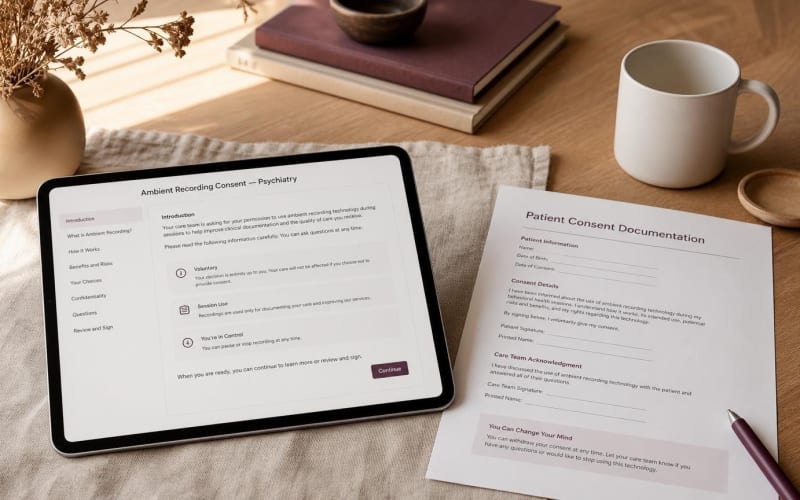
Written biometric consent is recorded before any session begins, consistent with Section 15(b) and with conservative practice even where the patient exclusion may apply. The release informs the patient in writing that audio is processed transiently, states the specific purpose (generation of a draft clinical note), states the term (the live encounter only), and captures an electronic signature as permitted by Public Act 103-0769.
Consent Timestamp and DOM Injection Lock
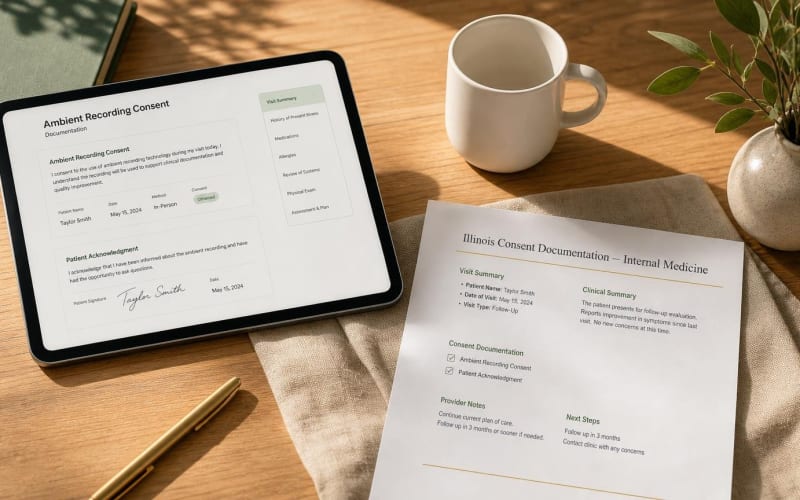
The browser extension enforces a hard consent gate. Audio capture and DOM injection into the EHR note field remain blocked until the clinician confirms the consent checkbox within an active, validated chart container. On confirmation, Merry writes an ISO 8601 consent timestamp, consent method, and encounter identifier into the chart, so the attestation lives in the legal medical record rather than a vendor log. If the patient header changes mid-session or another tab gains focus, capture pauses and injection is refused until consent is reconfirmed, preventing cross-patient contamination.
Statutory Comparison: Three Documentation Models
The table below contrasts exposure across the BIPA provisions most frequently litigated in Illinois courts.
| Compliance Dimension | Manual Charting | Standard Generic AI Scribes | Merry AI Compliance Architecture |
|---|---|---|---|
| Voiceprint creation (14/10) | None | Possible via diarization or speaker models | None; no embeddings persist |
| Retention schedule (14/15(a)) | Not triggered | Required where audio is stored for QA or training | Not triggered; 0-day retention |
| Written release (14/15(b)) | Not required | Varies by vendor and customer | Captured pre-session with e-signature |
| Profit prohibition (14/15(c)) | Not applicable | Risk if customer audio trains commercial models | No reuse; nothing retained |
| Consent evidence | Paper or EHR form | Often held in vendor systems | Timestamp written to encounter |
| EHR write control | Clinician only | Server-side API writes | DOM injection blocked until checkbox confirmed |
Generic ambient tools are not inherently noncompliant, but each retained audio file or speaker model creates a Section 15 obligation the practice must verify through vendor diligence and its business associate agreement.
Documentation Integrity, Coding, and Audit Defense
Privacy architecture does not replace coding governance. CMS permits HCPCS G2211 with office/outpatient E/M codes 99202-99205 and 99211-99215 when the clinician serves as the continuing focal point for all needed care or provides ongoing care for a single serious or complex condition. Merry structures the Assessment and Plan by problem, so longitudinal elements are visible to a coder without inflating narrative length.
Modifier 25 and NCCI Separation
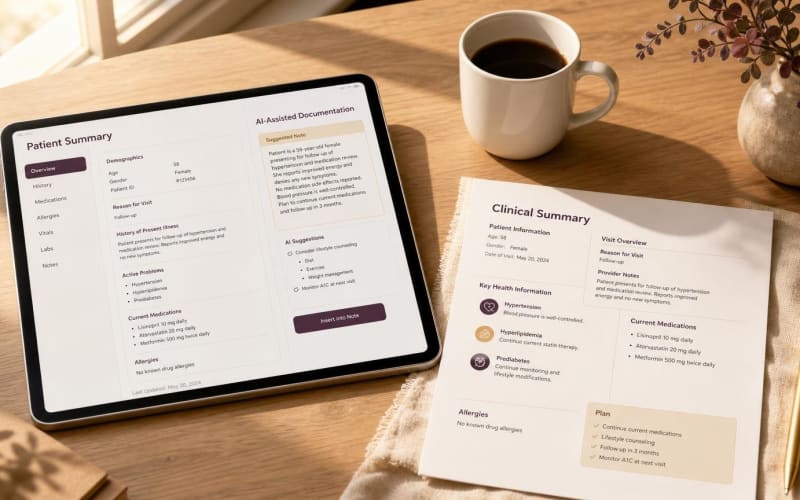
Merry never inserts modifier-supporting boilerplate. Modifier 25 requires a significant, separately identifiable E/M service, so the procedural note and E/M narrative remain distinct sections consistent with NCCI edits. Coding suggestions appear in a non-binding pane, require clinician attestation, and log overrides for compliance review. PHQ-9 and GAD-7 scores, NYHA class, LVEF, range of motion, and Bright Futures elements are documented only when stated, never templated as normal.
Clinicians reviewing the evidence base on ambient documentation accuracy can consult peer-reviewed literature at https://www.ncbi.nlm.nih.gov/pmc/. Practices that want to verify consent gate placement, timestamp capture, and EHR field mapping against their own workflow can Schedule a 15-Minute Workflow Audit.