Statutory Compliance Architecture for the Pennsylvania Wiretap Act
Pennsylvania treats ambient capture as interception. Under 18 Pa.C.S. § 5702, an 'intercept' is the aural or other acquisition of the contents of an oral communication through an electronic, mechanical, or other device. The statutory event occurs when the microphone opens, not when a file is saved. A multi-specialty group cannot rely on deletion policies alone. The lawful basis must exist before the first audio frame reaches a processor.
The all-party consent exception at 18 Pa.C.S. § 5704(4) permits interception only where all parties to the communication have given prior consent. In an exam room, that includes the patient, the clinician, and any identifiable speaker: a spouse at a cardiology follow-up, a guardian at a well-child visit, an interpreter, or a rotating resident. Exam rooms and telehealth sessions carry a reasonable expectation of privacy, so these exchanges qualify as oral communications under § 5702.
Exposure for noncompliant interception is substantial. Section 5703 classifies unlawful interception as a felony of the third degree. Section 5725 provides a civil action for actual damages of not less than $100 per day of violation or $1,000, whichever is higher, plus punitive damages and reasonable attorney fees. Section 5721.1 adds an evidentiary exclusion for unlawfully intercepted content.
Consent Injection Into the Subjective DOM Field
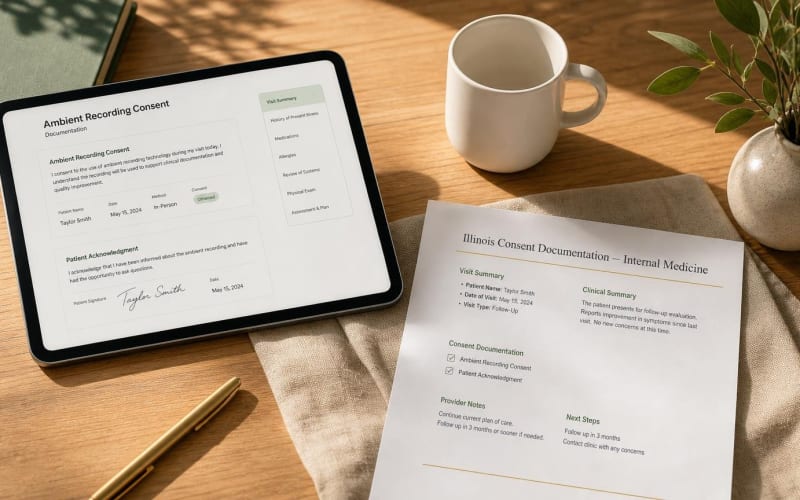
Priority directive P1 requires every note to begin with documented verbal all-party consent and a timestamp. Directive P7 specifies placement: the consent line is injected at the top of the Subjective DOM field before any narrative content. Merry AI dispatches native input events into the active contenteditable or textarea element. The EHR's own autosave and audit trail then record the insertion as authored text.
A representative Pennsylvania consent line reads: 'Verbal consent to ambient audio capture for documentation obtained from patient, clinician, and all present parties (names/roles) at 09:42:15 EST, per 18 Pa.C.S. § 5704(4).' The microphone stays hard-gated to OFF until the extension confirms this string is present and persisted in the note. If a new speaker enters, capture pauses until consent is documented again.
Volatile Memory Processing and Zero-Day Shred
Audio is processed in volatile RAM only. No .wav or .mp3 artifacts, disk buffers, or retraining datasets are created. Each segment buffer is zeroized when transcription for that segment completes. Only the derivative note remains, inside the covered entity's EHR. Because no recording or stored transcript exists, a subpoena can reach nothing beyond the chart already governed by the practice's records policy. Counsel should still confirm how transient processing maps to the § 5702 definitions. Documented prior consent addresses the interception itself in either reading.
Specialty-Specific Documentation Integrity
Behavioral health encounters require heightened consent language. Merry AI templates state that psychotherapy content may be summarized rather than transcribed verbatim. Clinicians can suspend capture during sensitive disclosures. DSM-5-TR symptom clusters, duration, and functional impairment are structured without retaining third-party statements beyond what clinical necessity requires.
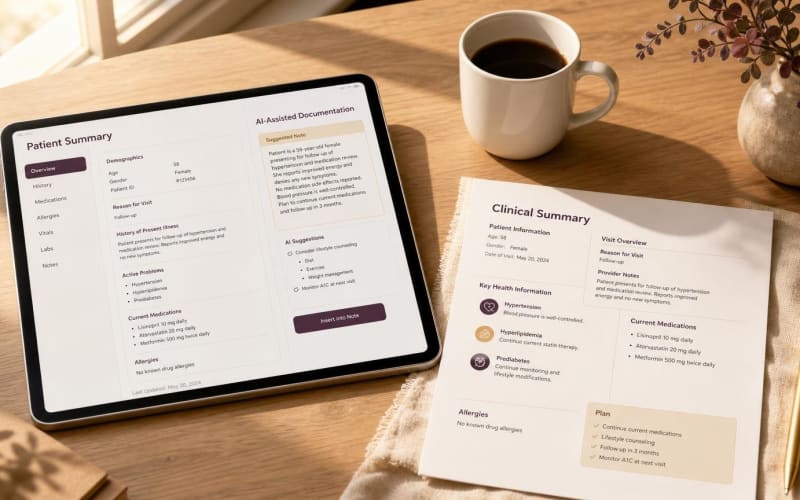
Cardiology visits frequently include family participants, so the consent line names each present speaker. Extraction maps exertional symptoms to NYHA class I through IV and records LVEF values for HFrEF or HFpEF classification. Orthopedic notes capture range of motion in degrees, 0 to 5 strength grades, and special tests such as Lachman or McMurray. Procedural informed consent is documented separately from recording consent.
Pediatric encounters introduce guardian consent plus age-appropriate assent. Bright Futures anticipatory guidance, developmental milestones, and growth percentiles are placed in the correct sections. The consent line also documents that parental statements and child responses may be captured solely for documentation.
Billing Alignment: G2211 and Modifiers 25/59
HCPCS G2211 remains an add-on to office/outpatient E/M codes 99202-99205 and 99211-99215. For CY 2026, it also applies to home or residence codes 99341, 99342, 99344, 99345, and 99347-99350. Documentation must show longitudinal focal-point care or ongoing management of a single serious or complex condition. G2211 is generally not payable when modifier 25 is appended. The exception is a same-day AWV, vaccine administration, or other Part B preventive service. Merry AI flags E/M plus 25 plus G2211 combinations and prompts for separately identifiable documentation. Modifier 59 and the X-modifiers (XE, XS, XP, XU) require evidence of a distinct site, session, or encounter to bypass NCCI procedure-to-procedure edits.
Comparative Liability Matrix
The following comparison isolates statutory exposure across three documentation models.
| Compliance Dimension | Manual Charting | Standard Generic AI Scribes | Merry AI Compliance Architecture |
|---|---|---|---|
| § 5704(4) prior consent proof | Not applicable; no interception | App-level toggle, rarely in chart | Timestamped all-party line atop Subjective field |
| Microphone gating | None required | Starts on user tap | Hard-gated until consent persists in DOM |
| Stored audio subject to subpoena | None | Recordings and transcripts often retained | None; volatile RAM, zero-day shred |
| § 5725 civil exposure | Minimal | Elevated where consent is undocumented | Reduced through encounter-level proof |
| Specialty structuring | Clinician-dependent | Generic SOAP output | DSM-5-TR, NYHA, ROM, Bright Futures |
| G2211 and modifier 25/59 support | Manual review | Limited | Inline documentation prompts |
Implementation and Verification
Practices should validate the workflow against counsel's reading of the § 5702 definitions, HIPAA business associate obligations, and each specialty's documentation standards. Audit a weekly sample of notes to confirm two things: the consent line precedes all Subjective content, and its timestamp precedes the first-capture log entry.
Peer-reviewed literature on ambient documentation accuracy and consent practices is indexed at https://www.ncbi.nlm.nih.gov/pmc/. Review it alongside CMS documentation integrity guidance on authorship validation and amendments.
To review your current consent and capture sequence across specialties, Schedule a 15-Minute Workflow Audit.